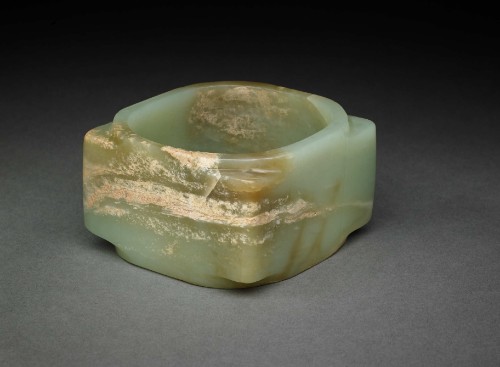
The yellowish-celadon stone well-polished and cut, of rectangular outline, the center with a circular aperture having a lip and base rising beyond the squared corners and forming a slight bevel, the stone with streaks of chalky inclusions and caramel colored patches
Cong
Courtesy of the Harn Museum of Art, Photography by Randy Batista

Cong

Artist Chinese Artist
DateZhou dynasty (1050-256 BCE)
Place of originChina, Asia
MediumJade
Dimensions1 13/16 x 2 15/16 x 2 13/16 in. (4.6 x 7.5 x 7.1 cm)
ClassificationsSculpture
Credit LineBequest of Dr. David A. Cofrin
Object number2009.48.130
Collections
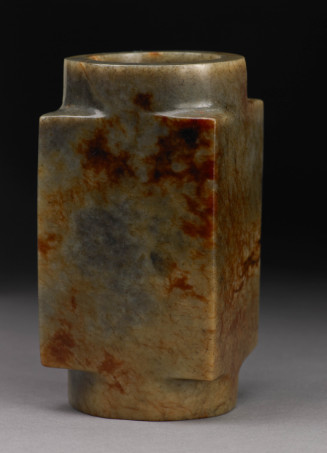
Visual DescriptionThe yellowish-celadon stone well-polished and cut, of rectangular outline, the center with a circular aperture having a lip and base rising beyond the squared corners and forming a slight bevel, the stone with streaks of chalky inclusions and caramel colored patches
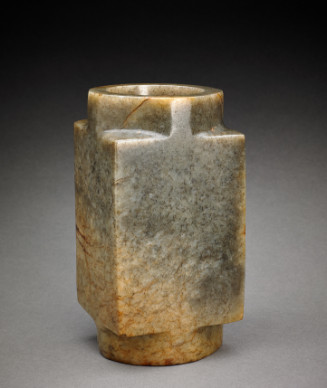
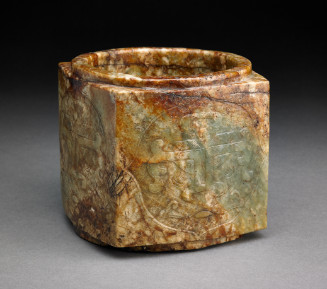
Carved from black-flecked, gray stone shading to buff with areas and veins of russet coloring in the form of a rectangular block surrounding a hollowed cylinder extending beyond the sharp triangular shoulders at either end to form a collar, the interior showing evidence of having been carved from both ends
Chinese Artist
Western Zhou dynasty (c. 1050-771 BCE)
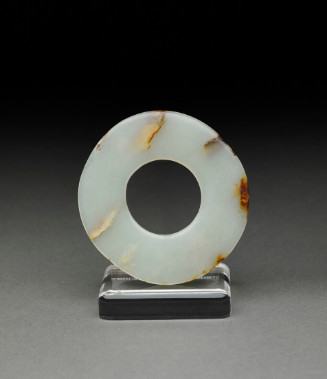
The smooth translucent stone, pierced with a circular aperture, with slightly rounded sides on both sides tapering to the inside and outside edges, the white stone with strong russet streaks
Chinese Artist
Neolithic Period or later
The semi-translucent stone of rich, dark olive-green color with brown mottling and veining, with areas of yellowish-buff color emanating from some of the veins and some opaque alteration from burial, carved as a rectangular block enclosing a cylindrical tube extending beyond the triangular shoulders at either end to form a collar, with a smooth satiny polish, some encrustation
Chinese Artist
Western Zhou dynasty (c. 1050-771 BCE)
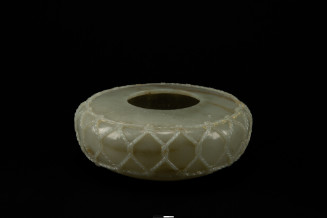
Of compressed globular form, finely carved with 'rope twist' strapwork around the body forming a pattern of lozenge-shaped panels on an otherwise plain ground, the stone of celadon tone with faint russet and white inclusions
Chinese Artist
18th-19th century or later
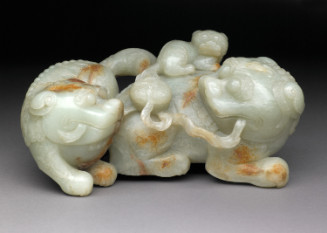
The massive stone well carved as a pair of recumbent fu lions turned to face each other, a beribboned brocade ball trailing from one of the lion's closed jaws, the 'snail' curled mane trailing over each lion's back to meet the bushy tails, one small cub poised on the back, the underside detailed with clawed feet, the stone of celadon tone with patches of russet highlights
Chinese Artist
17th-18th century
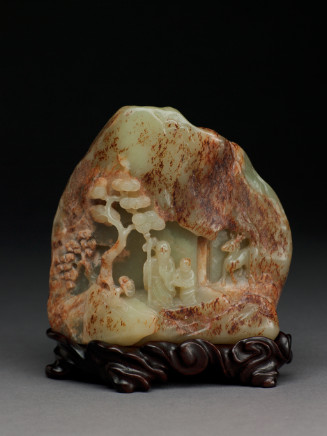
The boulder of irregular triangular shape, carved to one face with Shoulao and an attendant holding a peach, both on a path between a pine tree and lingzhi and a deer, the reverse with a boy beside a waterfall holding a peach branch opposite a peach tree and a crane, the stone of rich yellowish-green tones with extensive russet inclusions and a smooth polish
Chinese Artist
17th-18th century
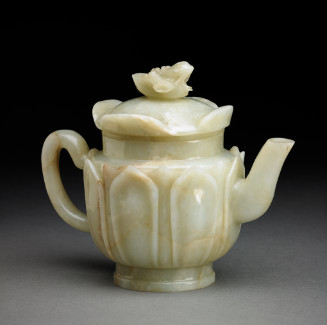
Of tapering globular shape, carved with two layers of eight lotus petals rising from the shallow, pedestal foot, with angular spout, curved handle and plain, straight-cut neck rising from the rounded shoulder, the cover carved as a lotus pad with a four up-turned leaves centered by a mandarin duck holding a lotus spray in its beak, some russet flaws and pale inclusions
Chinese Artist
Ming dynasty (1368-1644)
The recumbent ram finely carved in gently rounded form with its head turned to the side, flanked by two young tucked along its side, the stone of even celadon color with grey streaks
Chinese Artist
18th century or later
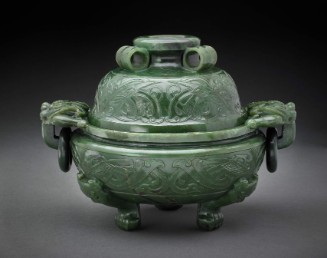
Raised on three monster mask and claw feet, well carved around the sides with three spaced foliate masks, interrupted by two horned monster mask handles suspending loose rings, the fitted, domed cover with matching decoration, encircling the hollowed ring knop with three tubular tabs, the dark green stone with typical black inclusions and white rivering.
Chinese Artist
18th-19th century
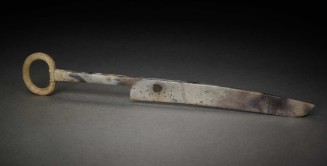
Carved as a long slender blade of slightly curved outline tapering in thickness towards the tip and the cutting edge from an upper, and thicker, flat edge which is a continuation of the narrow, beveled handle, fitted at its end with a short similar section set at the base of a slight saddle with raised edges from which issues a faceted oval ring, the blade now altered from burial to an opaque pale and dark mottled gray with a few translucent buff patches remaining, the ring section somewhat opaq…
Chinese Artist
Warring States Period (c. 475-221 BCE)
Cong with Taotie Designs
Chinese Artist
Ming dynasty (1368-1644) or later
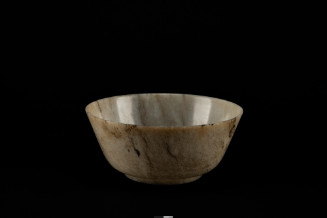
Well carved bowl with slightly flaring sides rising from a shallow foot ring, the stone of pale greyish-white tone with opaque white flecks and pale brown mottling and veining throughout, softly and evenly polished.
Chinese Artist
17th-18th century
null