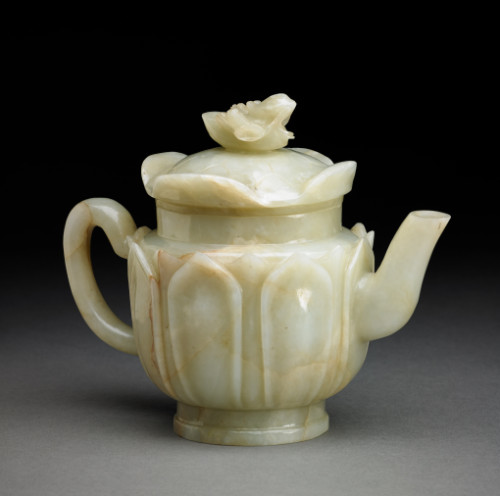
Of tapering globular shape, carved with two layers of eight lotus petals rising from the shallow, pedestal foot, with angular spout, curved handle and plain, straight-cut neck rising from the rounded shoulder, the cover carved as a lotus pad with a four up-turned leaves centered by a mandarin duck holding a lotus spray in its beak, some russet flaws and pale inclusions
Wine Ewer and Cover
Courtesy of the Harn Museum of Art, Photography by Randy Batista

Wine Ewer and Cover

Artist Chinese Artist
DateMing dynasty (1368-1644)
Place of originChina, Asia
MediumJade
Dimensions5 3/8 in. (13.7 cm)
ClassificationsSculpture
Credit LineBequest of Dr. David A. Cofrin
Object number2009.48.312
Collections
Visual DescriptionOf tapering globular shape, carved with two layers of eight lotus petals rising from the shallow, pedestal foot, with angular spout, curved handle and plain, straight-cut neck rising from the rounded shoulder, the cover carved as a lotus pad with a four up-turned leaves centered by a mandarin duck holding a lotus spray in its beak, some russet flaws and pale inclusions
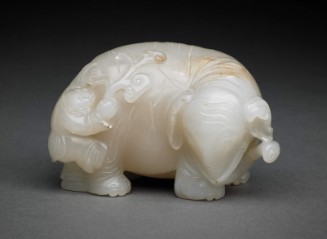
The beast well carved standing four square with the head turned to one side with a boy clambering over its back clasping a lotus sprig, the white jade with brown inclusions
Chinese Artist
Qing dynasty (1644-1911) or later
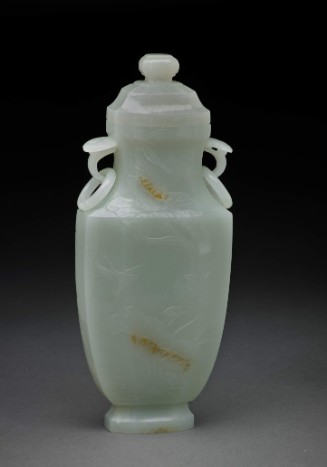
This striking octagonal vase is delicately worked from icy white jade with pale yellow surface skin markings. The artist has expertly incorporated the subtle yellow inclusions of the material with the edges of the broad graceful lotus leaves. The design extends the length of the vase to the concave neck. On either side, the covered vase is graced by handles in the shape of ruyi, or wish granting scepters. From each handle, circular rings are worked from the same jade boulder. In our opinion, the…
Chinese Artist
18th-19th century
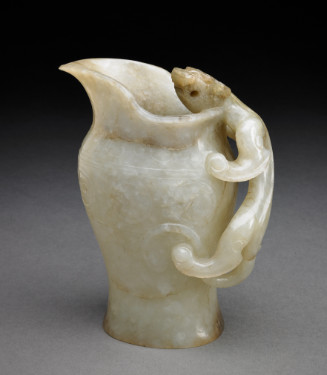
An oval vase-shaped ewer with curved spout elegantly carved from translucent jade. The mottled white material has greenish-gray tones and inclusions. The handle is carved aways from the cup in the sculptural from of a chih dragon with turned head clutching the rim. The dragon has a raised spine, spiraling articulations, and stylized wings on the thighs and shoulders.
Chinese Artist
possibly Ming Dynasty (1368-1644)
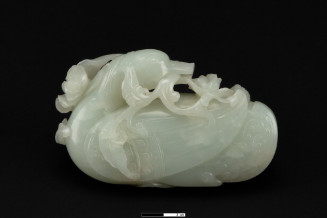
Finely carved with its head turned back over its wings folded back and incised with archaistic decoration, a long leafy lotus spray trailing from its beak, the underside detailed with webbed feet, the stone of even tone.
Chinese Artist
18th century
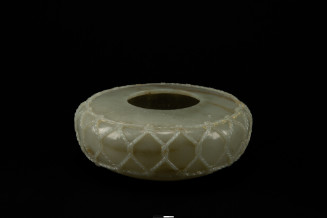
Of compressed globular form, finely carved with 'rope twist' strapwork around the body forming a pattern of lozenge-shaped panels on an otherwise plain ground, the stone of celadon tone with faint russet and white inclusions
Chinese Artist
18th-19th century or later
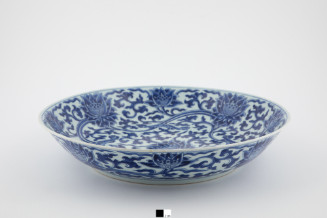
Scrolling lotus design on the surface of the charger forms a swastika shape; six character mark on base.

A large blue and white dish, the rounded sides rising from a channeled foot ring to a slightly everted rim, well painted in bright tones of underglaze blue on the interior and the exterior with a bold overall pattern of lotus scroll bearing large stylized blossoms.
Chinese Artist
Qing dynasty (1644-1911), Kangxi reign (1622-1722)
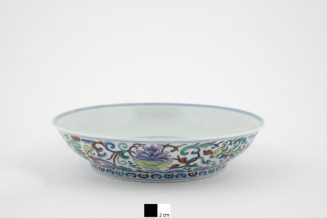
Interior of dish decorated with design of three phoenixes surrounding a stylized lotus blossom; the exterior also decorated with a band of phoenixes; six-character mark on base.

With shallow rounded sides rising to a slightly everted rim, brightly enameled with a central medallion of three archaistic phoenixes encircling a stylized lotus blossom borne on curling stems repeated in a frieze on the exterior, a border of C-shaped motifs enclosing a dot encircling the foot.
Chinese Artist
Qing dynasty (1644-1911), Daoguang reign (1821-1850)
A Mughal-style vase and cover carved from celadon green nephrite with lighter inclusions. The vase is carved in an unusual flattened and fluted form that is elliptical in cross-section. Either side of the vase is carved with three leafy acanthus scrolls and hanging loose rings. The long flaring neck is carved on either side
Chinese Artist
19th century or later
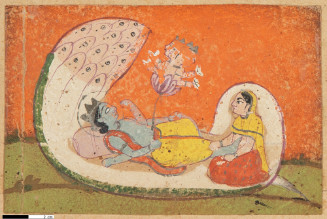
A colorful painting on an orange background showing a blue-skinned figure reclining on a multi-headed serpent, a woman seated at his feet, and a small figure rising from a lotus.
Indian Artist
19th Century
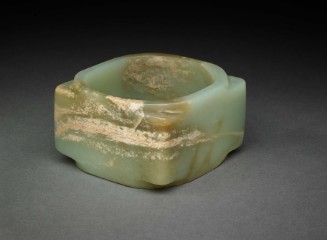
The yellowish-celadon stone well-polished and cut, of rectangular outline, the center with a circular aperture having a lip and base rising beyond the squared corners and forming a slight bevel, the stone with streaks of chalky inclusions and caramel colored patches
Chinese Artist
Zhou dynasty (1050-256 BCE)
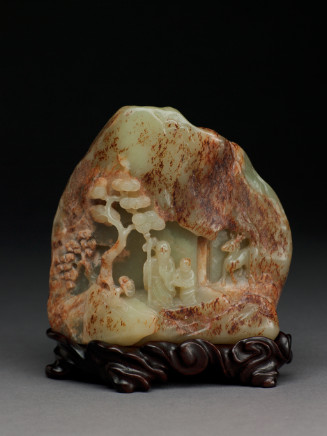
The boulder of irregular triangular shape, carved to one face with Shoulao and an attendant holding a peach, both on a path between a pine tree and lingzhi and a deer, the reverse with a boy beside a waterfall holding a peach branch opposite a peach tree and a crane, the stone of rich yellowish-green tones with extensive russet inclusions and a smooth polish
Chinese Artist
17th-18th century
null