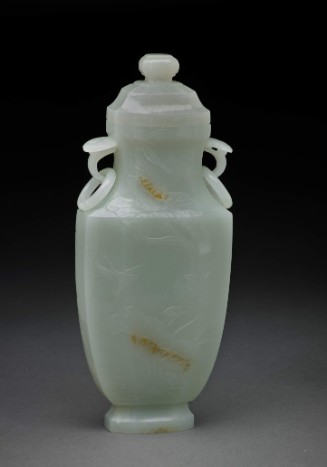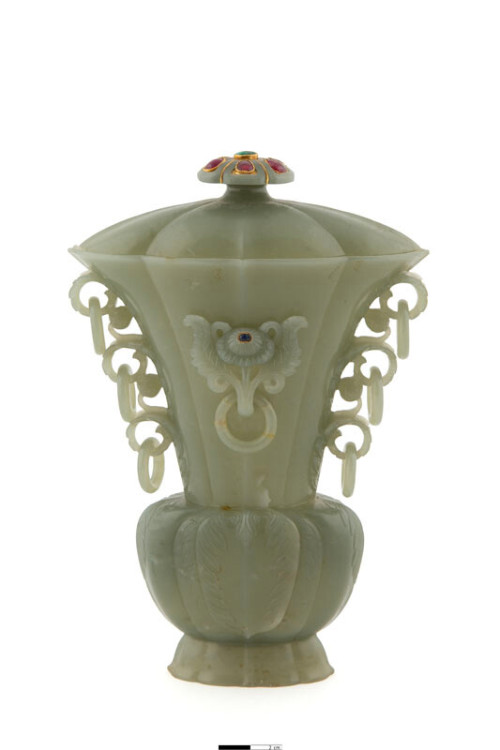
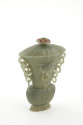
A Mughal-style vase and cover carved from celadon green nephrite with lighter inclusions. The vase is carved in an unusual flattened and fluted form that is elliptical in cross-section. Either side of the vase is carved with three leafy acanthus scrolls and hanging loose rings. The long flaring neck is carved on either side
Vase and Cover
Courtesy of the Harn Museum of Art, Photography by Foad Seyed Mohammadi

Vase and Cover

Artist Chinese Artist
Date19th century or later
Place of originChina
MediumJade, sapphire
Dimensions6 13/16 x 4 1/2 x 2 1/16 in. (17.3 x 11.4 x 5.2 cm)
ClassificationsSculpture
Credit LineBequest of Dr. David A. Cofrin
Object number2009.48.229
Collections
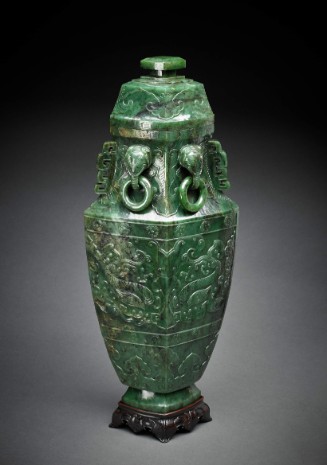
Visual DescriptionA Mughal-style vase and cover carved from celadon green nephrite with lighter inclusions. The vase is carved in an unusual flattened and fluted form that is elliptical in cross-section. Either side of the vase is carved with three leafy acanthus scrolls and hanging loose rings. The long flaring neck is carved on either side with a single flower and leaves in undercut relief, inset with a sapphire, with attached loose rings. The wide neck tapers dramatically to a narrow waist and rounded hips. The shortened body is carved with boughs of acanthus leaves. The cover is domed with a raised six-petal flower finial inset with rubies and an emerald, mounted in gold on each petal. The vessel is finished with a conforming raised foot. (Bernstein appraisal)
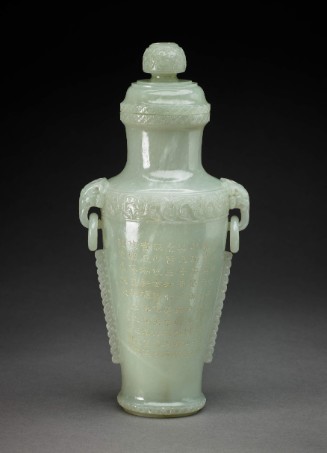
Carved with archaistic motifs
Chinese Artist
19th century
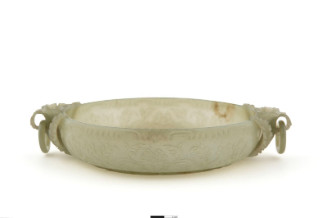
Bowl with shallow well-hollowed form, carved around the sides with feathery leaves and floral sprig springing from a collar of petals encircling the flat base, the underside with a flowerhead of overlapping radiating petals, the rim set with two upright floral sprig handles and loose rings, the thin translucent stone of yellowish green color, minute chips
Chinese Artist
18th-19th century
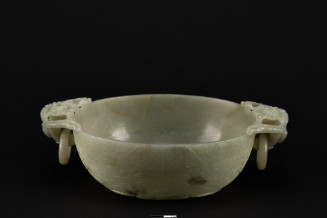
Well carved around the sides in low relief with a dense frieze of foliate blooms and furled leaves, issuing from a collar of petals encircling the base, forming a ring foot, the underside with a flowerhead, set with two flowerhead-form handles suspending loose rings, the interior center with a flowerhead, the greenish white stone striated with gray, minor chips.
Chinese Artist
Qing dynasty, 18th-19th century
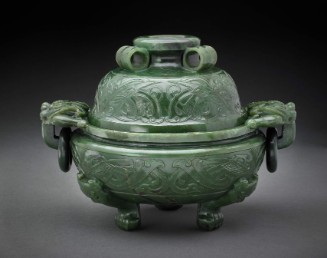
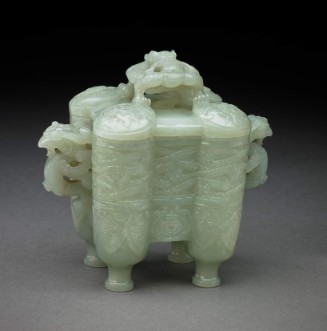
Raised on three monster mask and claw feet, well carved around the sides with three spaced foliate masks, interrupted by two horned monster mask handles suspending loose rings, the fitted, domed cover with matching decoration, encircling the hollowed ring knop with three tubular tabs, the dark green stone with typical black inclusions and white rivering.
Chinese Artist
18th-19th century
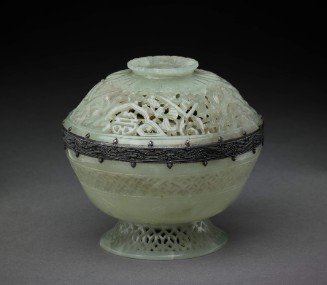
Reticulated Bowl
Chinese Artist
19th century or later
Covered Vase with Imperial Inscription
Chinese Artist
18th-19th century or later
This striking octagonal vase is delicately worked from icy white jade with pale yellow surface skin markings. The artist has expertly incorporated the subtle yellow inclusions of the material with the edges of the broad graceful lotus leaves. The design extends the length of the vase to the concave neck. On either side, the covered vase is graced by handles in the shape of ruyi, or wish granting scepters. From each handle, circular rings are worked from the same jade boulder. In our opinion, the…
Chinese Artist
18th-19th century
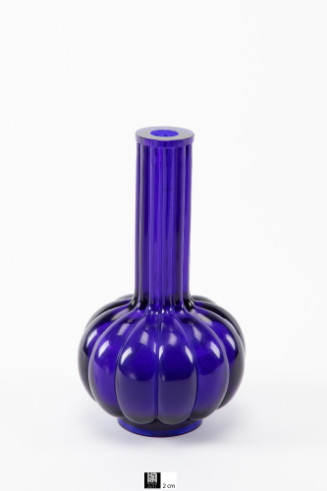
The bottle vase is exquisitely carved with twelve rounded lobes forming the globular lower body, continuing up the tall neck, surmounted by a disc-shaped mouth rim, all raised on a circular ring foot, the transparent glass of a deep sapphire-blue tone
Chinese Artist
Qing Dynasty (1644-1911), Qianlong period (1736-1795)
Well-hollowed with columnar corners and well-carved around the exterior with a wide band of numerous thin dragons, their finely incised scaly bodies intermeshing around the sides, above archaistic pendant leaves around the rounded corners, tapering sharply to the hollowed pad feet, two side with a ji character, the other two side with winged phoenix-form handles, the fitted cover of conforming shape with a central reticulated dragon-form knop, the claw on and extending to the four corners, the g…
Chinese Artist
Qing dynasty (1644-1911), 18th century
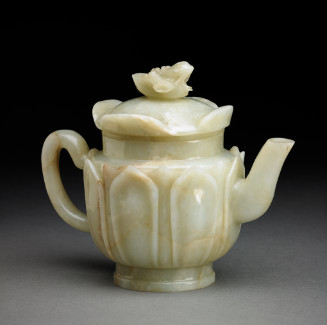
Of tapering globular shape, carved with two layers of eight lotus petals rising from the shallow, pedestal foot, with angular spout, curved handle and plain, straight-cut neck rising from the rounded shoulder, the cover carved as a lotus pad with a four up-turned leaves centered by a mandarin duck holding a lotus spray in its beak, some russet flaws and pale inclusions
Chinese Artist
Ming dynasty (1368-1644)
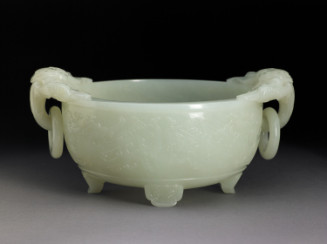
Of circular form, well-carved with two loop handles suspending rings formed from a pair of bats on either side of a ruyi-shaped terminal, the body carved in light relief with two pairs of diffused and stylized dragons and supported on four small scrolled feet, the stone of even white tone.
Chinese Artist
Qing Dynasty (1644-1911), Qianlong period (1736-1795)
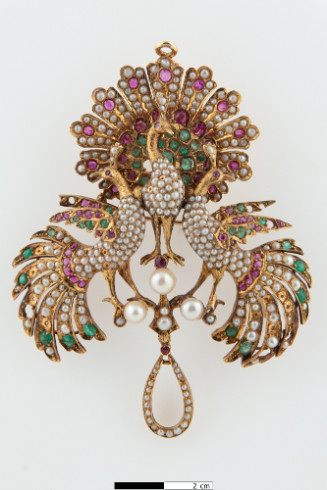
Three peacocks with plumage in pearls, emeralds, gold and rubies.
Indian Artist
late 19th-early 20th century
null