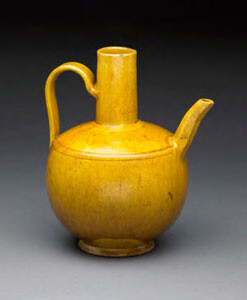
A yellow-glazed ewer with round body, cylindrical neck, strap handle, and octagonal-shaped spout.
Yellow Ewer
Courtesy of the Harn Museum of Art, Photography by Randy Batista

Yellow Ewer

Artist Chinese Artist
DateNorthern Song (960–1127), 10th-11th Century
Place of originChina, Asia
MediumGlazed stoneware
Dimensions9 5/8 x 8 x 6 1/4 in. (24.4 x 20.3 x 15.9 cm)
ClassificationsFurnishings and Equipment
Credit LineMuseum purchase, funds provided by the David A. Cofrin Art Acquisition Endowment
Object number2001.29.10
Collections
Visual DescriptionA yellow-glazed ewer with round body, cylindrical neck, strap handle, and octagonal-shaped spout.
Bibliography
The Samuel P. Harn Museum of Art
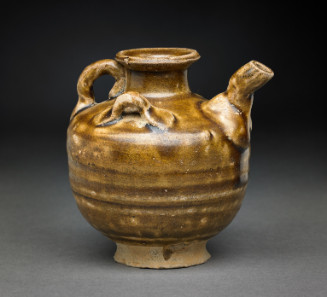
A small, brownish-yellow ceramic ewer with a short spout and two looped handles near the neck. The round body has horizontal ridges and sits on a footed base.
Thai, Si Satchanalai
15th - 17th century
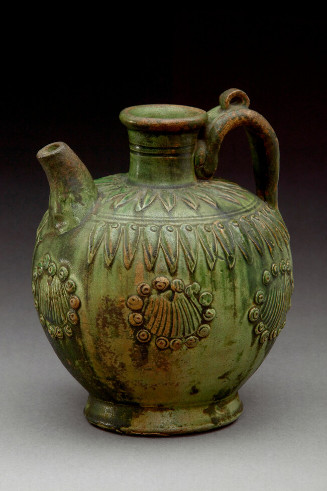
Ewer form with spout and handle, decoration of shells, "fish eggs" and leaves
Chinese Artist
Liao Dynasty (916-1125), 10th Century
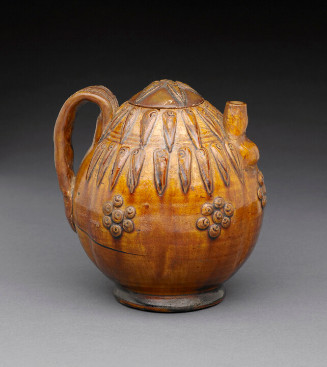
Ewer form with spout and handle; decoration includes "fish egg" design in floral motif and leaf motif
Chinese Artist
Liao Dynasty (907-1125), 10th Century
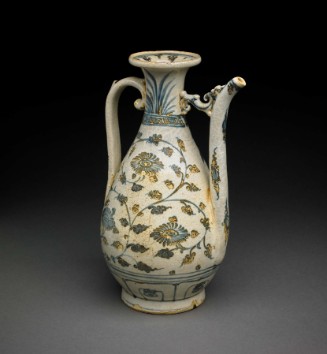
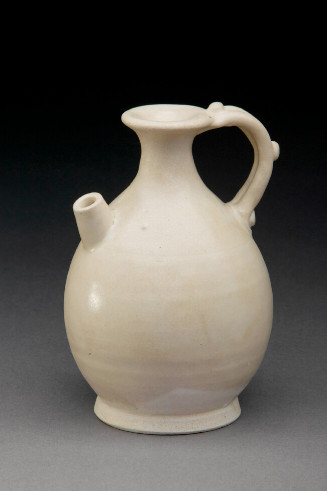
Persian style ewer with decoration of flowers, grass and trefoil design.
Vietnamese
15th-16th Century
Pear-shaped body with short spout and handle with three bosses.
Chinese Artist
Tang Dynasty (618-906)
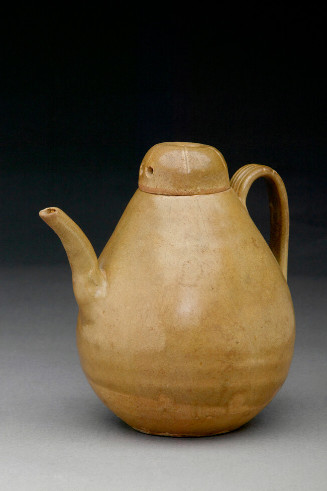
Cover and body divided into five lobes, curved spout and ribbed handle
Chinese Artist
Five Dynasties or Song Dynasty, 10th-12th century
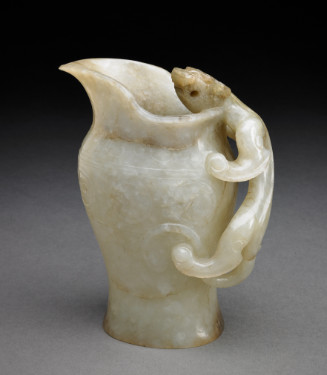
An oval vase-shaped ewer with curved spout elegantly carved from translucent jade. The mottled white material has greenish-gray tones and inclusions. The handle is carved aways from the cup in the sculptural from of a chih dragon with turned head clutching the rim. The dragon has a raised spine, spiraling articulations, and stylized wings on the thighs and shoulders.
Chinese Artist
possibly Ming Dynasty (1368-1644)
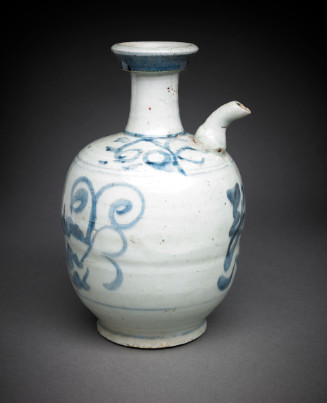
A ceramic ewer with a bulbous white body, tall neck, and short spout. It features blue painted designs, including curling, vine-like patterns on the body and shoulder.
Chinese Artist
Ming dynasty (1368-1644)
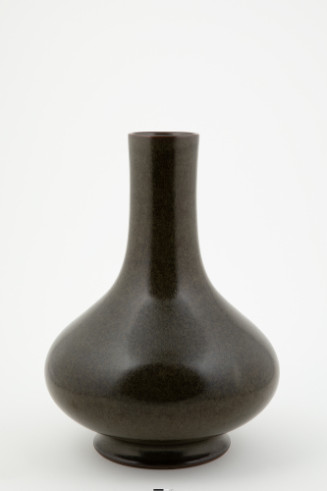
Vase with somewhat compressed lower body and wide cylindrical neck, covered inside and out with a dark mottled glaze of soft, grayish moss-green and olive-brown tone shading to deep russet brown on the mouth rim, the interior of the spreading pedestal foot similarly glazed, the glaze covering the nianhao also shading to russet brown.
Chinese Artist
Qing Dynasty (1644-1911), Qianlong period (1736-1795)
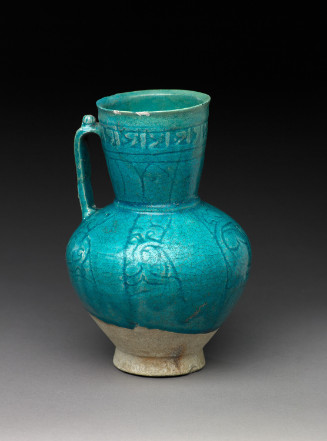
A bright turquoise-glazed ceramic pitcher with a single handle, flared neck, and rounded body. Faint relief carvings decorate the neck and body. The glaze stops unevenly near the bottom, exposing an unglazed tan base.
Iranian
Seljuk period, 12th-13th century
A dark green-glazed cylindrical ceramic vessel with a decorated flat lid, resting on three short, rounded feet. The body features horizontal ridged bands and molded side loops holding circular rings.
Chinese Artist
Han Dynasty (206 BCE-220 CE)
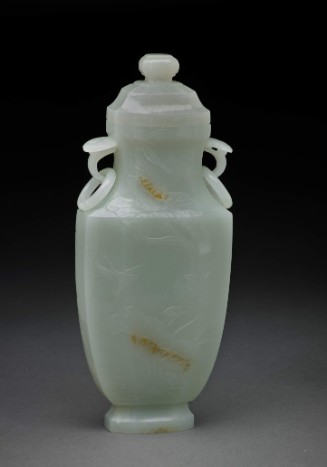
This striking octagonal vase is delicately worked from icy white jade with pale yellow surface skin markings. The artist has expertly incorporated the subtle yellow inclusions of the material with the edges of the broad graceful lotus leaves. The design extends the length of the vase to the concave neck. On either side, the covered vase is graced by handles in the shape of ruyi, or wish granting scepters. From each handle, circular rings are worked from the same jade boulder. In our opinion, the…
Chinese Artist
18th-19th century
null