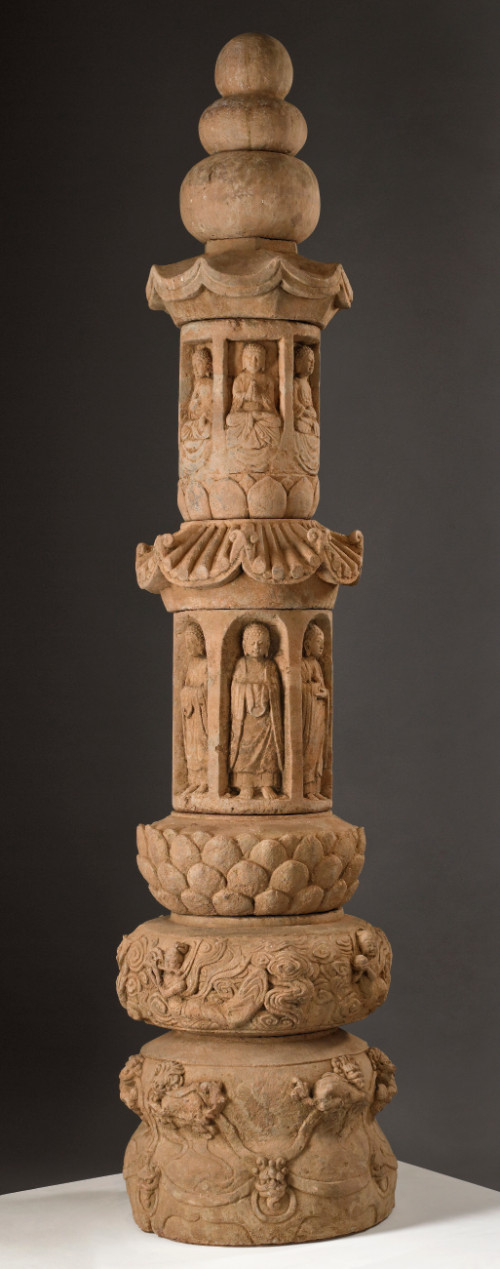
A tall sandstone pagoda with two relief bands of Buddhas resting on a lotus base and three ovate spaces on top.
Stupa Tower
Courtesy of the Harn Museum of Art, Photography by Randy Batista

Stupa Tower

Artist Chinese Artist
DateSong Dynasty (960-1279), 11th-12th Century
Place of originChina
MediumSandstone
Dimensions8 ft. 5 1/2 in. x 25 in. x 25 in. (257.8 x 63.5 x 63.5 cm)
ClassificationsSculpture
Credit LineMuseum purchase, gift of Michael A. Singer with additional funds provided by the Robert H. and Kathleen M. Axline Acquisition Endowment
Object number2005.1
Collections
Visual DescriptionA tall sandstone pagoda with two relief bands of Buddhas resting on a lotus base and three ovate spaces on top.
Bibliography
Realms of Faith
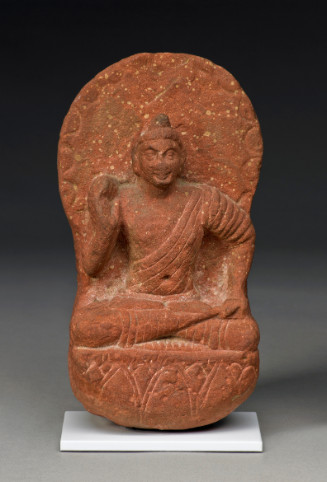
Sandstone sculpture depicting the Buddha siting on a throne with his robe worn over the left shoulder. His right hand is raised in the gesture of reassurance. A large halo is behind his head.
Indian Artist
Late 1st - early 2nd century
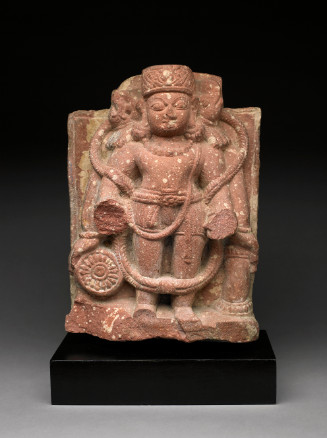
A sandstone high relief of a four-faced Vishnu. The central face is flanked by two faces in the form of a lion and a boar at either side. The fourth face is implied at the back. The ends of feet are broken off as well as two of four arms, at the elbow.
Indian Artist
Late 3rd - early 4th century
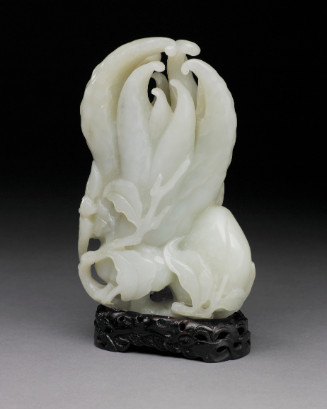
The emphasis on the smooth sensuous surface, fluidity of lines and the attention to detail are all typical elements of the eighteenth century carving tradition.  Fashioned of a pure white jade, the citron is entwined with leaves and accompanied by a bat and a peach. The long delicately carved tendrils bend gracefully at the tips, resembling Buddha's hand in the classic position. The citron symbolizes wishes for longevity as well as wealth, since it illustrates the gesture of grasping money. The …
Chinese Artist
18th-19th century
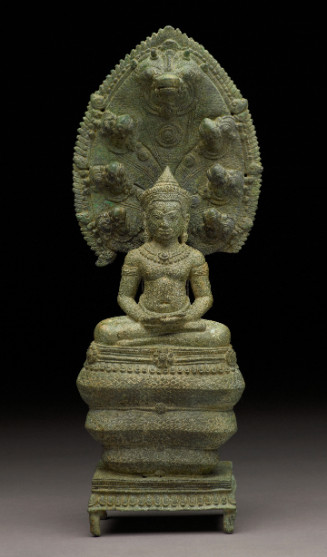
A sculpture cast in two parts, one being the seated bronze Buddha, deep in meditation, the other the seven-headed Naga snakes shielding surrounding Buddha’s head like a halo.
Thai Artist
Bayon period, 12th-13th century
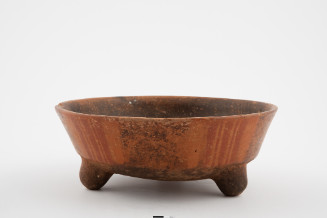
Deep dish with rounded bottom supported by large tripod nubbins, angle break at wall, rises vertical with outward slope to rim, interior is rounded; light orange-red slip with five wide vertical bands of black evenly spaces around side, separated by design of vertical red bands - three large bands with a thin stripe in between.
Quiché Maya Artist
950-1200
Boruca phase; black on white ware, alligator painted motif
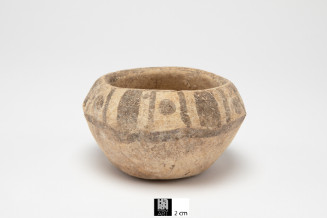
Small bowl with flat bottom - wall rises with outward slope to 2/3 height - uneven angle break around surface with wall curving inward to thick, rounded rim - interior smooth with flattened bottom.
Buff ware with black band around rim and angle break evenly spaced vertical lines connecting the two - spaces filled with alternating broad vertical black bands and large dots.
Diquis Artist
800-1500
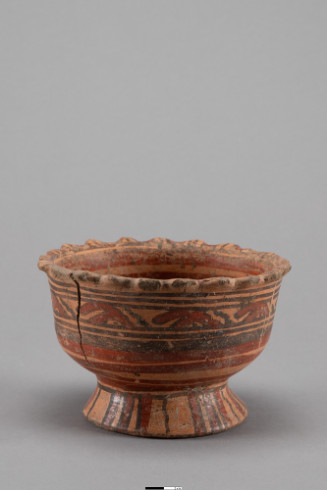
Rounded bowl with 1' raised footing ring sloping outward from attachment point to edge.  Bottom of bowl rounds up into wall to 1/3 height wall becomes straight with slight outward slope. Rim flares sharply outward, divided into rounded crenellations
Costa Rican Artist
800-1200
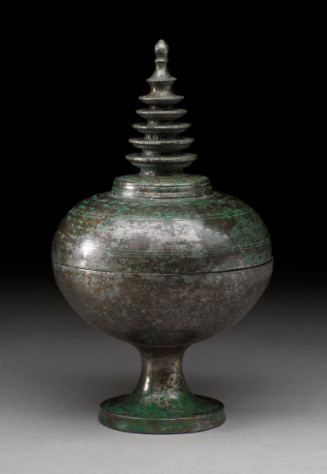
The domed cover has a raised central section surmounted by a five-storied stupa with a bud-shaped finial over two knobs; the cover is incised with bands of fine lines; the cup is on a waisted stem with a widely spread foot
Chinese Artist
Tang dynasty (618-907)
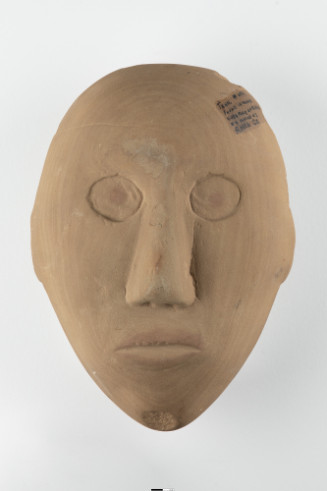
Large oval shaped mask, shallow by hollowed in back face carved in front with large round eyes, straight broad nose, slit mouth with large lips, slight rectangular extensions on sides for ears, pupils of eyes and lips have faded pigments, possibly red.
Mississippian Artist
1200-1450
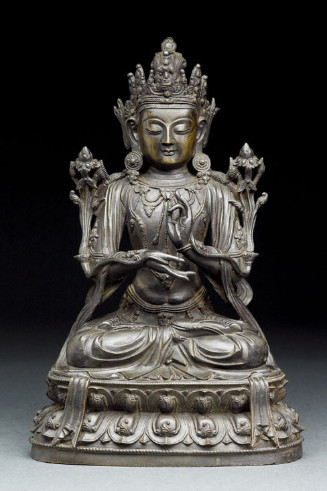
Figure of Avalokiteshvara seated in padmasana on lotus plinth. Right hand in varadamudra and left hand in vitarkamudra. Lotus stems held in each hand. Body adorned with beads and 5-pointed crown has image of seated Amitaba Buddha in center.
Chinese Artist
Ming Dynasty (1368-1644), 15th-16th century
null