Top-down view of a round, turquoise-glazed ceramic bowl. The dark blue center contains swirling black curved shapes. A continuous band of black Arabic script encircles the inner wall, bordered by a dark, patterned rim.
Bowl
Courtesy of the Harn Museum of Art, Photography by Randy Batista

Bowl

Maker Syrian (Raqqa)
DateSeljuk period (late 12th - mid 13th century CE)
Place of originSyria, Asia
MediumEarthenware with underglaze decoration
Dimensions3 7/8 x 8 1/2 x 8 1/2 in. (9.8 x 21.6 x 21.6 cm)
ClassificationsFurnishings and Equipment
Credit LineMuseum purchase, gift of Dr. and Mrs. David A. Cofrin
Object number1994.5.4
Collections
Visual DescriptionTop-down view of a round, turquoise-glazed ceramic bowl. The dark blue center contains swirling black curved shapes. A continuous band of black Arabic script encircles the inner wall, bordered by a dark, patterned rim.


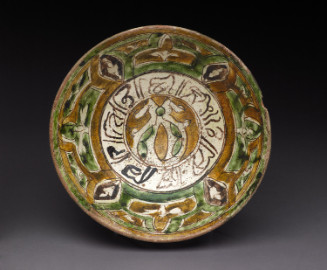
Top-down view of a ceramic bowl. Its white interior features a central abstract motif, encircled by a band of dark Arabic script. The wide border is decorated with a geometric and leaf-like pattern in green, yellow-brown, and black.
Iranian (Nishapur)
Abbasid period (ca. 9th - 10th century)
A footed ceramic bowl with off-white glaze and dark brown decorations. Large script-like markings encircle the exterior. The interior features a wide, densely patterned band punctuated by circular motifs near the rim.
Iranian (Kashan)
Seljuk period (13th century)
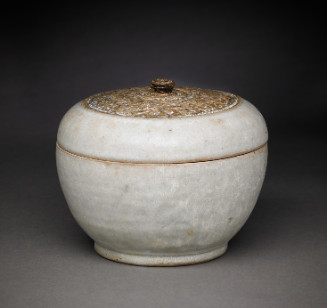
Dissolved celadon glaze, lid band incised with continuous floral band in brown, discrete knob; bowl plain, unglazed base displaying red brown clay, unglazed lid interior.
Thai, Si Satchanalai
15th-16th century
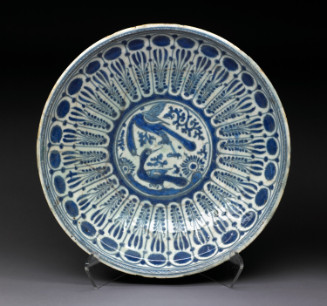
A round blue and white ceramic plate on a clear stand. The central medallion features an abstracted bird design, surrounded by a wide band of radiating, elongated floral shapes. The outer rim is decorated with solid blue ovals.
Iranian
Timurid period (1370-1506)
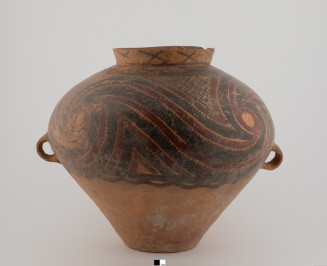
Painted Jar (Guan)  雙耳波濤紋彩陶罐, 馬家窯文化半山類型
Chinese Artist
Neolithic period, Majiayao culture, Banshan phase (c. 2600–2300 BCE)
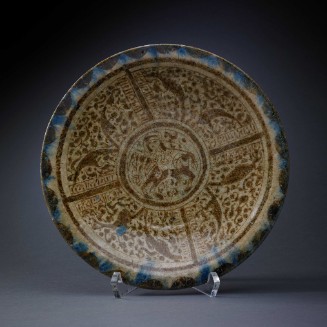
A round ceramic plate on a clear stand. The tan surface is decorated with intricate brown designs, featuring a central stylized creature. Six radial sections contain abstract leaf-like shapes, bordered by a dashed blue and brown rim.
Iranian (Kashan)
Seljuk period (13th century)
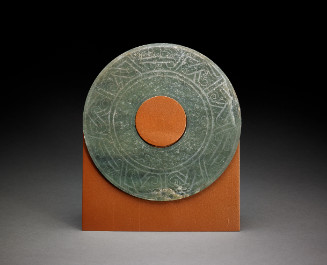
Carved from a light green jade with black inclusions, both sides of the disc are divided into two finely executed concentric decor zones. The inner band contains a grid of low relief curls within elevated hexagonal units, bordered by three "Bucraniums" that embellish the outer band. They stylized dragon forms are fluidly shaped from thick and thin incisions in a curvilinear pattern and separated by incised double brackets. Consistent with the practice of the time, cinnabar was applied to enhance…
Chinese Artist
Han Dynasty (206 BCE-220 CE)
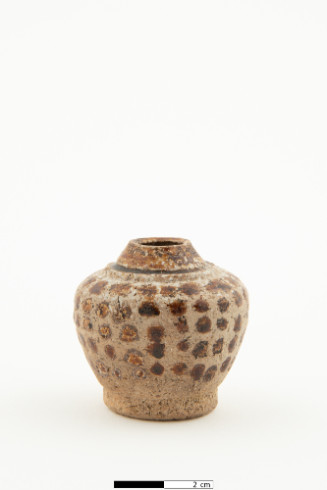
A small, round ceramic jar with a tapered neck and mouth. It has a beige or light brown base color and is covered in irregular dark brown polka dots or splotches arranged in rough rows. A thin dark band encircles the neck.
Thai, Si Satchanalai
15th-17th century
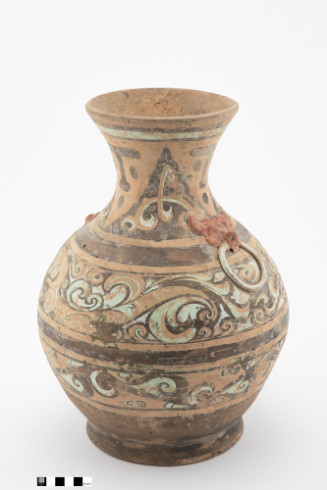
A pear-shaped vessel decorated with red and white pigment; dragon and phoenix motif
Chinese Artist
Western Han dynasty (206 BCE–9 CE)
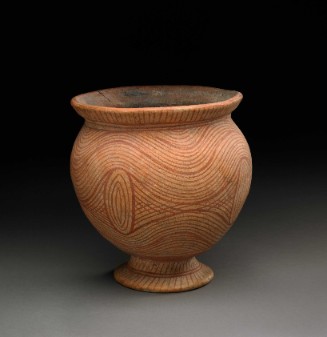
Red painted design on buff ceramic; the painted design is a series of parallel curving lines that form a wave pattern; this pattern includes enclosed areas of concentric oval lines; rounded globular body with flared foot and lip.
Thai Artist
c. 300 BCE - 200 CE
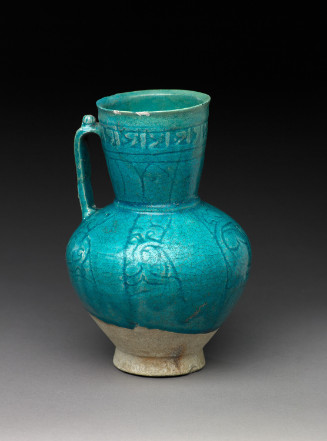
A bright turquoise-glazed ceramic pitcher with a single handle, flared neck, and rounded body. Faint relief carvings decorate the neck and body. The glaze stops unevenly near the bottom, exposing an unglazed tan base.
Iranian
Seljuk period, 12th-13th century
null