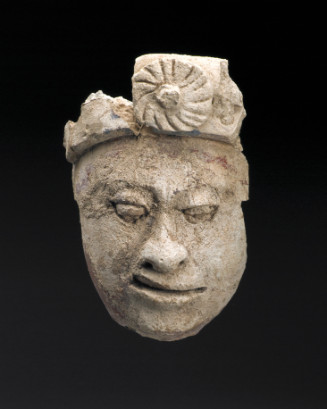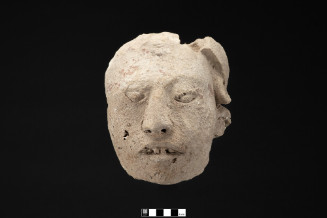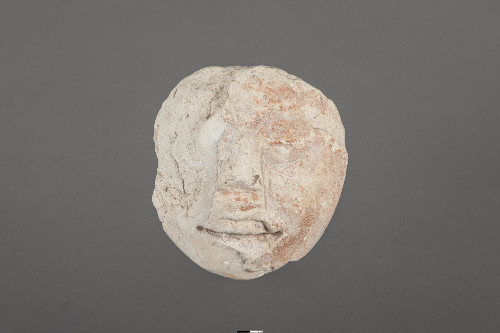
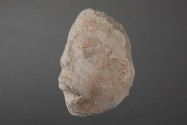
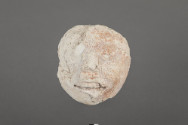
Stucco head with wide, flattened face, open mouth with well formed upper lip, prominent upper teeth (not defined though), lower lip is missing along with all the left side of face, nose is missing but nostril holes can be seen, right eye very shallowly defined; faded red pigment on remaining surface of face.
Stucco Head
Courtesy of the Harn Museum of Art, Photography by Foad Seyed Mohammadi

Stucco Head

Artist Maya Artist
Date500-800
Place of originYucatan Peninsula, Mexico, North and Central America
MediumStucco and pigments
Dimensions6 1/8 x 5 1/2 x 3 1/4 in. (15.6 x 14 x 8.3 cm)
ClassificationsSculpture
Credit LineGift of Lawrence J. Cassard, M.D.
Object numberS-82-65
Collections
Visual DescriptionStucco head with wide, flattened face, open mouth with well formed upper lip, prominent upper teeth (not defined though), lower lip is missing along with all the left side of face, nose is missing but nostril holes can be seen, right eye very shallowly defined; faded red pigment on remaining surface of face.
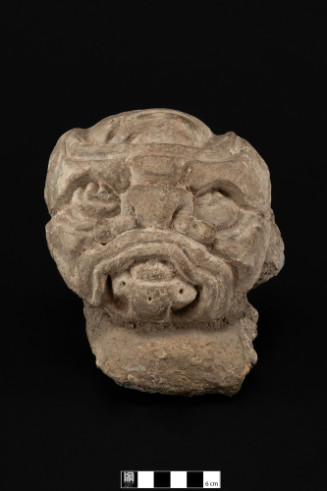
Architectural decoration.  Stucco head of jaguar modeled on stone slab armature.  Large "god eyes" with heavy brows, multiple creases in forehead, broad nose with creased bridge, nostrils with bulb-like extensions, heavy upper lip, open mouth with extended tongue, 3 holes in chin.
Maya Artist
600-800
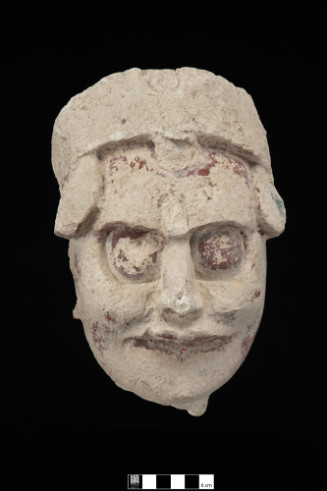
Stucco head with rounded features, large mouth with heavy lips; broad flat nose, eyes are puffed out with bottom half cut away, making appearance of double eye lids; heavy headdress with large thick brow band, central circular medallion with raised center and radiating grooves. (from accession worksheet)

White stucco molded over coarse aggregate; traces of red paint on the face, blue on headdress band.
Maya Artist
600-950
Stucco head of Sun God
Maya Artist
600 - 800
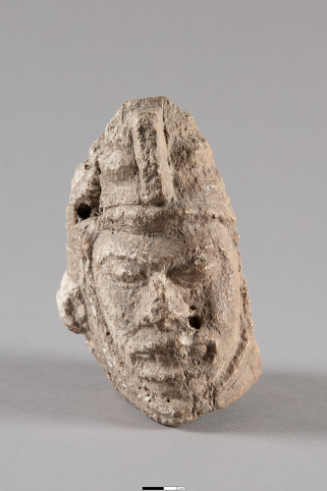
Carved stone head with grimacing mouth, lips pulled back, teeth exposed, wide flat nose, heavy lidded eyes, prominent brow, large headdress with central, vertical comb, extending down around face to chin, right side is squared off, as is bottom of jaw.
Maya Artist
600-950
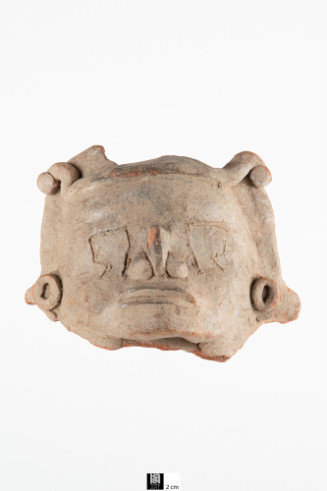
Small hollow dome with human face on one side.  Raised mouth area with sunken cheek and eye region.  Mouth is incised slit; nose is raised ridge with large pills of clay for nostrils.  Eyes inscribed with wide t-shape design, ear spools shown, large headdress runs as ridge laterally across head, red clay with light brown slip.
Maya Artist
700-850
Sculpture of a head of a man with a gold face, red lips, dark painted-on handlebar moustache and goatee, and wearing a tight-fitting black headpiece with a high crest.
Chinese Artist
Ming Dynasty (1368-1644 CE)
Head with modeled teeth, fragmentary headdress, traces of red paint over the white slip.
Maya Artist
680 - 750
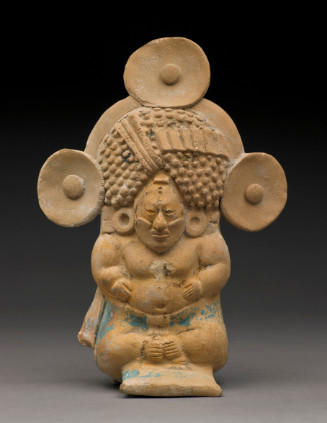
Mold-made hollow figurine of fat male, possibly a dwarf, sitting cross-legged with hands placed on abdomen, wears shirt with long loin cloth extending underneath legs. Large ear spools, huge headdress covered with small clay pills, lateral crest ridge with three large disks at top and sides, whistle in back bottom. Yellow pigment on upper face and body, blue pigments on shirt and loin cloth.
Maya Artist
700-950
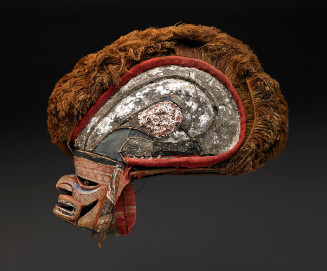
Human face mask with large arched superstructure of rattan, thick, fiber brush on top, with light pigment on side filling swirl motif; face has operculum shell eyes, with hook nose, mouth has lips that are parted and flattened to form perpendicular plane to face. Face is painted with finely lined motifs, varied pigments against light ground.
Papua New Guinea
late 19th - early 20th century
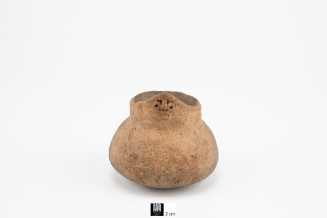
Period VI; brown ware with appliqued figure.
Small jar with wide, rounded base, slight concavity in middle - sharp curve up into wall that curves gradually inward - straight vertical raised rim, extending up to point on one side - hole in wall, 2/3 height, with raised broken area surrounding it, possible spout or handle.
Brown ware with traces of buff slip - applied effigy face on raised point of rim - circles for eyes, ridge with small poked nostrils for nose, ridges for upper and lower lips …
Diquis Artist
800-1550
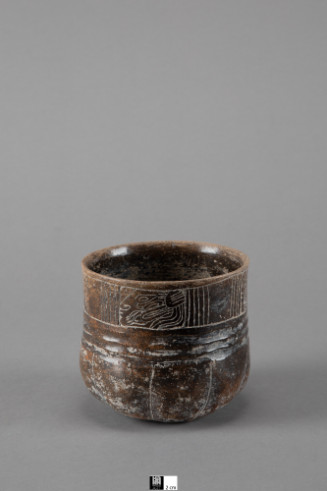
Tall bowl with flat bottom, rounded lower wall formed into nine lobes, rising into straight, vertical wall; upper frieze of four inscribed face glyphs separated by vertical lines, three wide inscribed bands below, vertical inscribed lines between each lobe.
Maya Artist
600-700
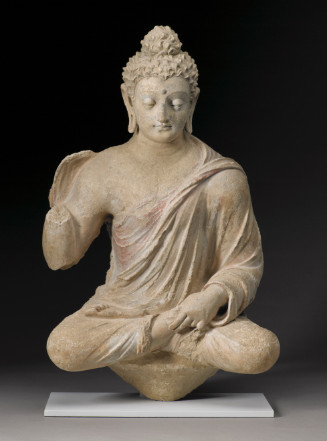
Seated Buddha, right forearm missing, his left hand holds the end of his robe, wearing a toga-like garment.
Gandharan
4th-5th Century
null