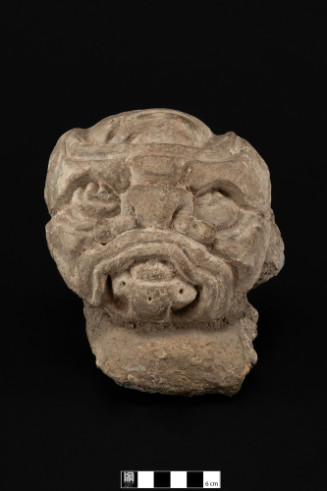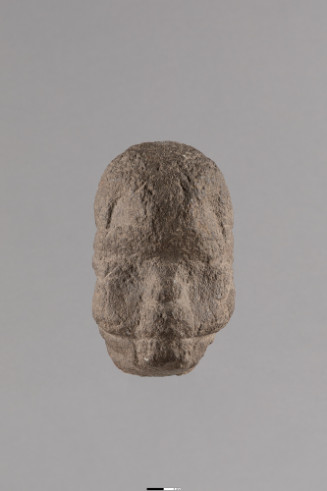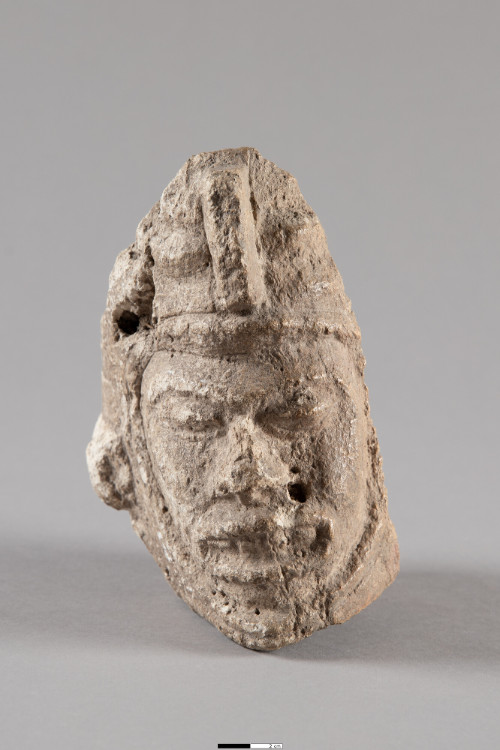
Carved stone head with grimacing mouth, lips pulled back, teeth exposed, wide flat nose, heavy lidded eyes, prominent brow, large headdress with central, vertical comb, extending down around face to chin, right side is squared off, as is bottom of jaw.
Stone Head
Courtesy of the Harn Museum of Art, Photography by Foad Seyed Mohammadi

Stone Head

Artist Maya Artist
Date600-950
Place of originYucatan Peninsula, Mexico, North and Central America
MediumLimestone
Dimensions6 1/2 x 4 x 4 5/8 in. (16.5 x 10.2 x 11.7 cm)
ClassificationsSculpture
Credit LineGift of Lawrence J. Cassard, M.D.
Object numberS-82-93
Collections
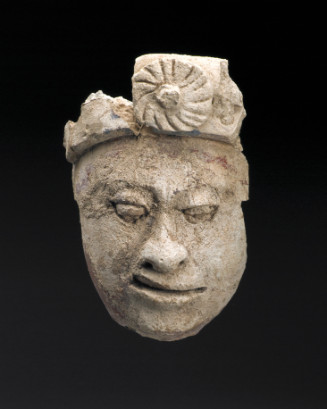
Visual DescriptionCarved stone head with grimacing mouth, lips pulled back, teeth exposed, wide flat nose, heavy lidded eyes, prominent brow, large headdress with central, vertical comb, extending down around face to chin, right side is squared off, as is bottom of jaw.
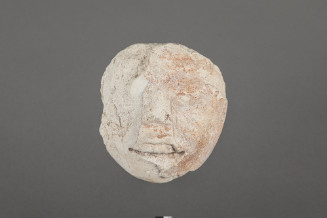
Stucco head with rounded features, large mouth with heavy lips; broad flat nose, eyes are puffed out with bottom half cut away, making appearance of double eye lids; heavy headdress with large thick brow band, central circular medallion with raised center and radiating grooves. (from accession worksheet)

White stucco molded over coarse aggregate; traces of red paint on the face, blue on headdress band.
Maya Artist
600-950
Architectural decoration.  Stucco head of jaguar modeled on stone slab armature.  Large "god eyes" with heavy brows, multiple creases in forehead, broad nose with creased bridge, nostrils with bulb-like extensions, heavy upper lip, open mouth with extended tongue, 3 holes in chin.
Maya Artist
600-800
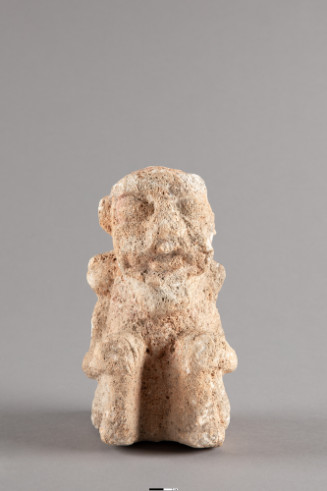
Seated male figure with legs flexed and pulled up torso, arms at side, hands on knees, wide bony shoulders, large head, jutting jaw, were-jaguar mouth with extended tongue, wide flat nose, bulbous rectangular eyes, low crown of head, back of figurine is very rough; traces of pigment on surface of figure.
Olmec Artist
1000-300 BCE
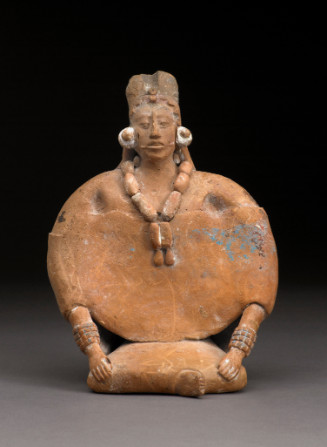
Seated hand-fashioned female figure, large wedged nose extending from center of forehead to full lips, almond-shaped eyes, large earrings with white slip, pilled necklace, mantle around shoulders down to waist, small arms with hands attached to folded legs, heavy bracelets on arms; white, red, and blue traces of paint.
Maya Artist
550-830
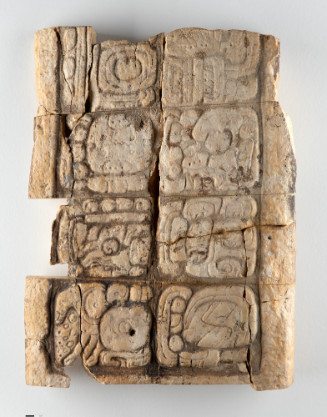
Carved stone panel containing eight Maya glyphs in two columns, border of smoothed, rounded stone on sides, small border on bottom, none on top.
Maya Artist
700-850
Stone hacha for ball player that sits on large belt in the form of a head with large, bulbous forehead and crown, skeletal features, prominent cheek bones, small jaw, protruding teeth, small flat nose, hook at top back of head
Totonac Artist
450-750
Stucco head with wide, flattened face, open mouth with well formed upper lip, prominent upper teeth (not defined though), lower lip is missing along with all the left side of face, nose is missing but nostril holes can be seen, right eye very shallowly defined; faded red pigment on remaining surface of face.
Maya Artist
500-800
Head of a finely carved Bodhisattva with arched brows, elongated eyes, broad nose, and full lips. Wearing jeweled headdress held in place by a ribbon.
Chinese Artist
Northern Qi or Sui Dynasty, late 6th Century
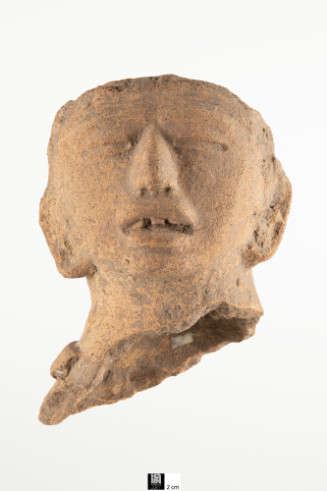
Raised head, broken at neck with partial of shoulder left, rounded features with open mouth, large lips, wide spaced teeth (possibly to represent filing), hooked nose, shallow eyes appearing as slits, large ears, rough forehead and crown (probably broken off headdress).
Totonac Artist
600-900
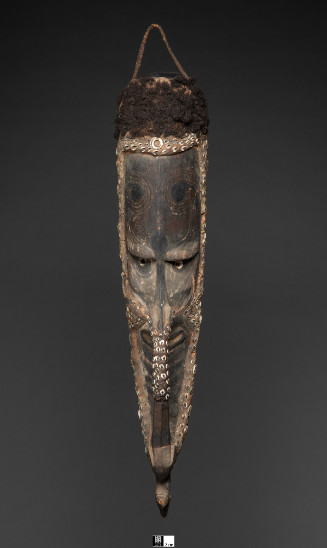
Traditional elongated facial mask with long nose pierced at septum with boar tusk extending to chin where bird protrudes down.  Face surrounded by shells embedded in clay.  Shells on nose extension.  Human hair at top of head beneath plaited raffia loop for hanging.  Small inset shells for eyes underneath carved protruding brows.  Dark stain.  Painted traditional designs.
Iatmul
20th century
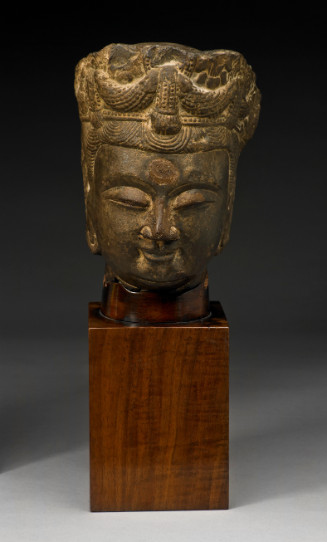
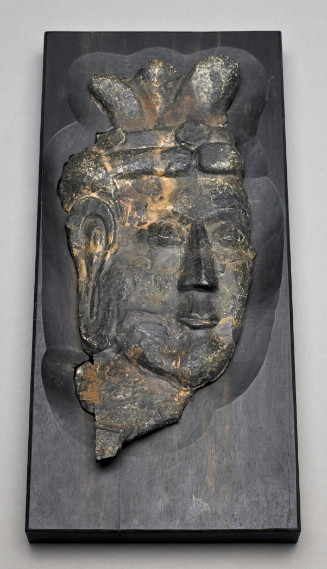
Dark gray limestone head of a Bodhisattva with polychrome traces carved in low relief as a three-quarter view depicting a slightly grinning bud-shaped mouth and hair-knot dressed with diadem
Chinese Artist
Northern Wei Dynasty 6th century (520s CE)
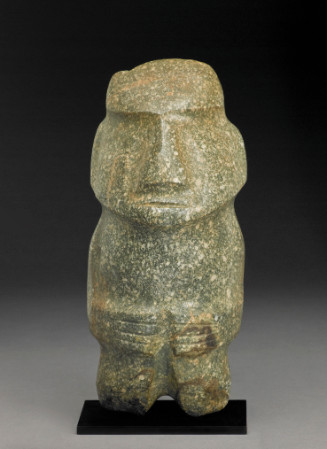
Standing anthropomorphic figure in the form of an axe head, feet form chisel end with grove carved between on front and back, arms indicated at side, hands across abdomen, figures shown by cut grooves, features shallow, wide flat nose, heavy brow, head tapers toward top
Mezcala Artist
300 - 100 B.C.
null