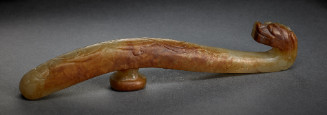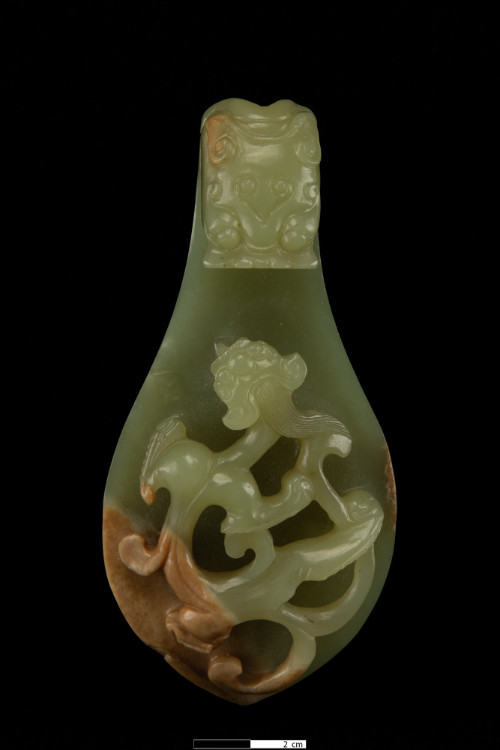
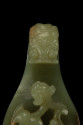
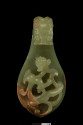
Hook carved on top with a dragon, with dragon-head hook.
Garment Hook
Courtesy of the Harn Museum of Art, Photography by Foad Seyed Mohammadi

Garment Hook

Artist Chinese Artist
Date18th century
Place of originChina
MediumJade
Dimensions4 3/16 x 1 15/16 x 1 1/16 in. (10.6 x 4.9 x 2.7 cm)
ClassificationsSculpture
Credit LineBequest of Dr. David A. Cofrin
Object number2009.48.203
Collections
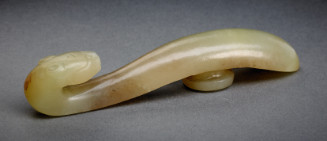
Visual DescriptionHook carved on top with a dragon, with dragon-head hook.
Yellowish tone jade, carved with flattened chi dragon head
Chinese Artist
18th-19th century
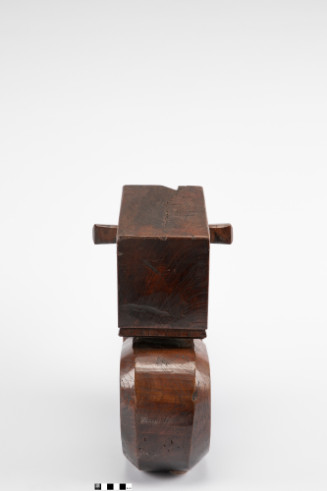
Jizai or hearth hanger hook in a Daikoku style with a high elongated cap proportionately equal to the rounded bottom hook, the curling edges of which are faceted. Carved of zelkova wood with a lacquer finish and warm patina.
Japanese Artist
Edo Period (1615-1868), 18th-early 19th century
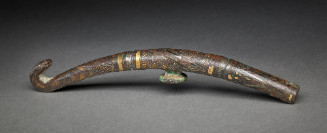
Silver and gold-inlaid bronze garment hook, Warring States, the arched shaft finely inlaid with dotted feather or scale pattern divided by cheveron and horizontal bands, with an animal-head hook at one end and an inlaid button on the underside, inlaid at one end with a bird
Chinese Artist
Warring States Period (c. 475-221 BCE)
Carved with a pair of intertwined archaistic dragons along the shaft, the stone suffused with russet sections to one side
Chinese Artist
18th-19th century
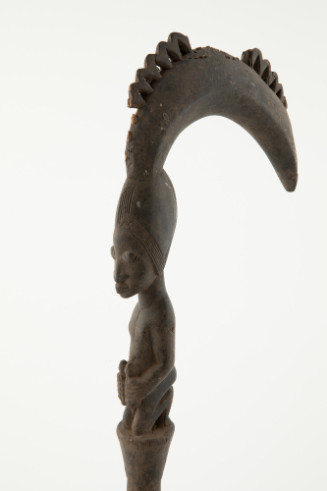
Hook surmounted by a kneeling figure holding possible rattles to the front, with finely carved facial features, parallel linear carved cap line, with long curving projection surmounted by zig-zag design, and with pigment.
Yoruba Artist
undated
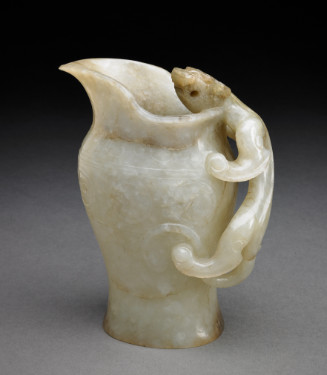
An oval vase-shaped ewer with curved spout elegantly carved from translucent jade. The mottled white material has greenish-gray tones and inclusions. The handle is carved aways from the cup in the sculptural from of a chih dragon with turned head clutching the rim. The dragon has a raised spine, spiraling articulations, and stylized wings on the thighs and shoulders.
Chinese Artist
possibly Ming Dynasty (1368-1644)
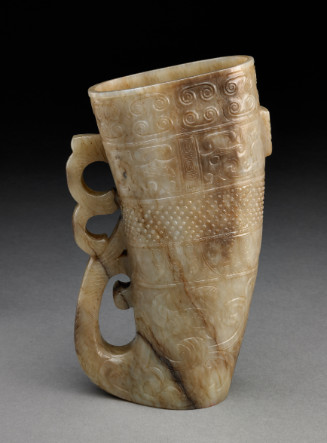
The well hollowed vessel carved in shallow relief with four bands of archaistic designs, including confronted C-scrolls, taotie masks separated by a taotie mask carved in high relief, bosses and mask-filled blades, all divided by rope twist borders and positioned above a phoenix and a dragon confronted on a vertical, keyfret band with a scrolling bird-like tail rising off center up one side from a pattern of intertwined swirls carved in a flat base, the stone of pale grayish brown color suffused…
Chinese Artist
Ming dynasty (1368-1644)
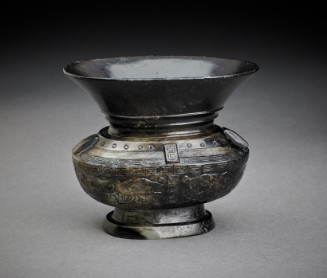
Of compressed zun form, the sides carved in shallow relief with two pairs of confronted dragons contained within keyfret borders, below four raised keyfret-incised flanges which divide the shoulder and interrupt a band of dots above, the widely flared neck encircled by two bowstring bands and carved on the interior with three grooved lines, intentionally altered to a blackish color with areas of the pale gray stone showing through, minor rim chips.
Chinese Artist
Song dynasty (960-1279)
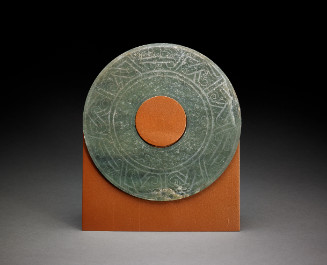
Carved from a light green jade with black inclusions, both sides of the disc are divided into two finely executed concentric decor zones. The inner band contains a grid of low relief curls within elevated hexagonal units, bordered by three "Bucraniums" that embellish the outer band. They stylized dragon forms are fluidly shaped from thick and thin incisions in a curvilinear pattern and separated by incised double brackets. Consistent with the practice of the time, cinnabar was applied to enhance…
Chinese Artist
Han Dynasty (206 BCE-220 CE)
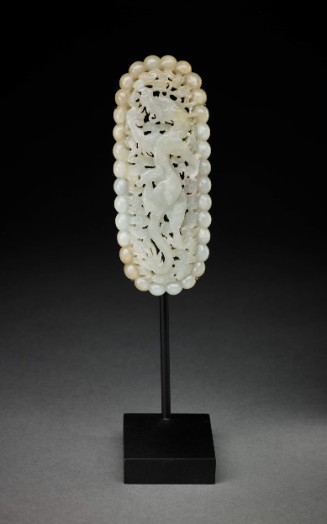
Carved with a dragon amidst swirling clouds, all within a beaded overall border, small nicks to edge of border
Chinese Artist
18th century or later
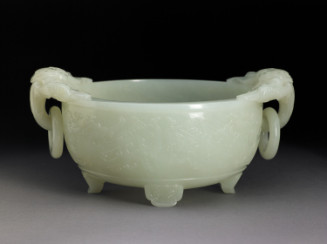
Of circular form, well-carved with two loop handles suspending rings formed from a pair of bats on either side of a ruyi-shaped terminal, the body carved in light relief with two pairs of diffused and stylized dragons and supported on four small scrolled feet, the stone of even white tone.
Chinese Artist
Qing Dynasty (1644-1911), Qianlong period (1736-1795)
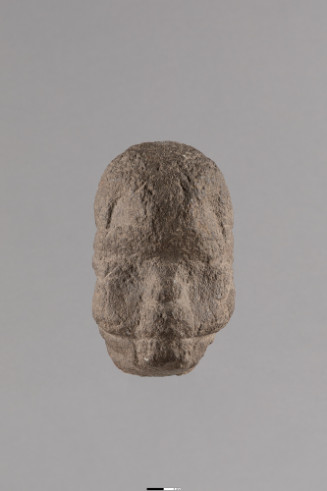
Stone hacha for ball player that sits on large belt in the form of a head with large, bulbous forehead and crown, skeletal features, prominent cheek bones, small jaw, protruding teeth, small flat nose, hook at top back of head
Totonac Artist
450-750
null