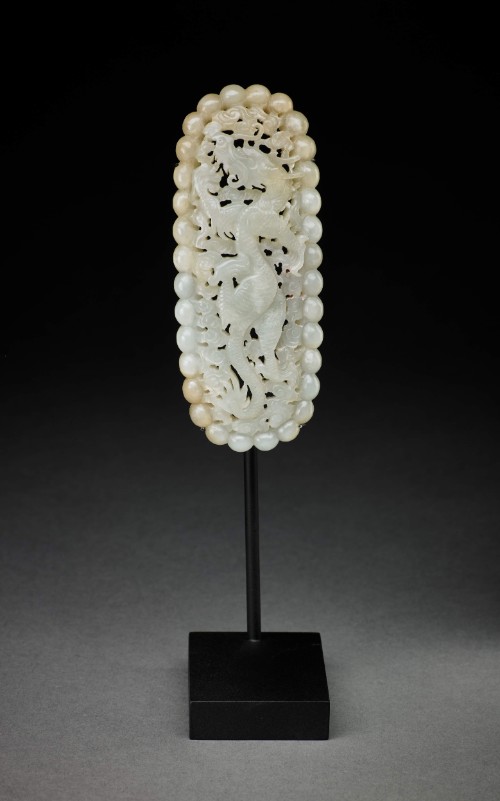
Carved with a dragon amidst swirling clouds, all within a beaded overall border, small nicks to edge of border
Openwork Oval Plaque
Courtesy of the Harn Museum of Art, Photography by Randy Batista

Openwork Oval Plaque

Artist Chinese Artist
Date18th century or later
Place of originChina, Asia
MediumJade
Dimensions4 1/16 x 1 5/8 x 7/16 in. (10.3 x 4.1 x 1.1 cm)
ClassificationsSculpture
Credit LineBequest of Dr. David A. Cofrin
Object number2009.48.33
Collections
Visual DescriptionCarved with a dragon amidst swirling clouds, all within a beaded overall border, small nicks to edge of border
Carved with grain pattern
Chinese Artist
Song and Ming dynasty (960-1644)
A cicada, the surface with simple incised linear details, the stone a translucent light green tone. Possible chip to mouth, nicks to tips of wings.
Chinese Artist
Han dynasty (206 BCE-220 CE)
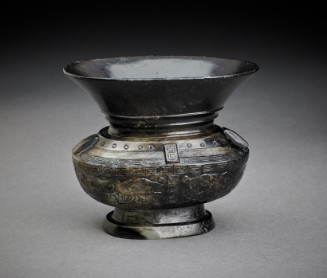
Of compressed zun form, the sides carved in shallow relief with two pairs of confronted dragons contained within keyfret borders, below four raised keyfret-incised flanges which divide the shoulder and interrupt a band of dots above, the widely flared neck encircled by two bowstring bands and carved on the interior with three grooved lines, intentionally altered to a blackish color with areas of the pale gray stone showing through, minor rim chips.
Chinese Artist
Song dynasty (960-1279)
The well hollowed vessel carved in shallow relief with four bands of archaistic designs, including confronted C-scrolls, taotie masks separated by a taotie mask carved in high relief, bosses and mask-filled blades, all divided by rope twist borders and positioned above a phoenix and a dragon confronted on a vertical, keyfret band with a scrolling bird-like tail rising off center up one side from a pattern of intertwined swirls carved in a flat base, the stone of pale grayish brown color suffused…
Chinese Artist
Ming dynasty (1368-1644)
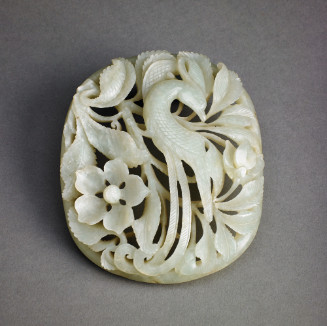
An oval white nephrite plaque, finely cut and pierced with a design of a long-tailed bird with half opened wings and crested head, perched amid the branches of a flowering leafy tree. With a later elaborate wood stand.
Chinese Artist
Ming dynasty (1368-1644)
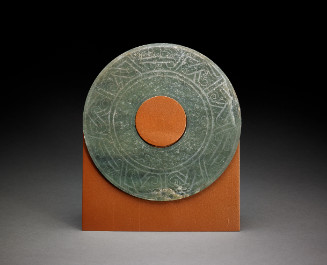
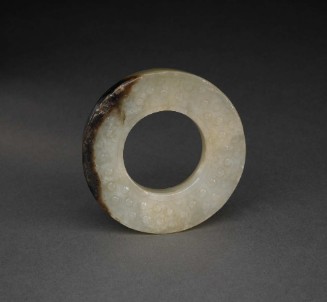
Carved from a light green jade with black inclusions, both sides of the disc are divided into two finely executed concentric decor zones. The inner band contains a grid of low relief curls within elevated hexagonal units, bordered by three "Bucraniums" that embellish the outer band. They stylized dragon forms are fluidly shaped from thick and thin incisions in a curvilinear pattern and separated by incised double brackets. Consistent with the practice of the time, cinnabar was applied to enhance…
Chinese Artist
Han Dynasty (206 BCE-220 CE)
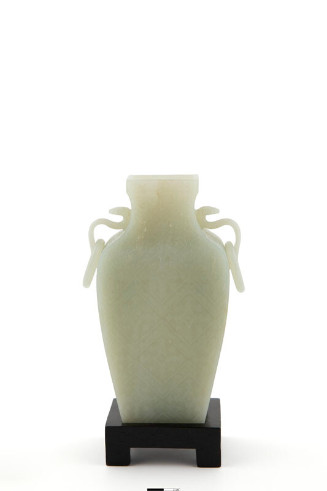
A jade vase of rectangular section, the sides gently tapering towards the slightly recessed base, the waisted neck with straight mouth rim, and worked in relief with two ruyi-sceptre handles from which loose rings are suspended. They body decorated overall in sunken relief with a geometric design of chevrons, clouds and squares. The stone a pale celadon stone. The base with an incised six-character reign mark Qianlong yu yong (for imperial use).
Chinese Artist
18th-19th century
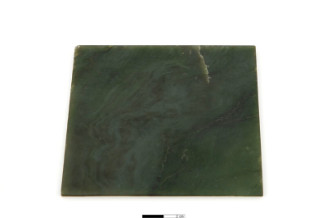
Green plaque with small chip in corner.
Chinese Artist
20th century
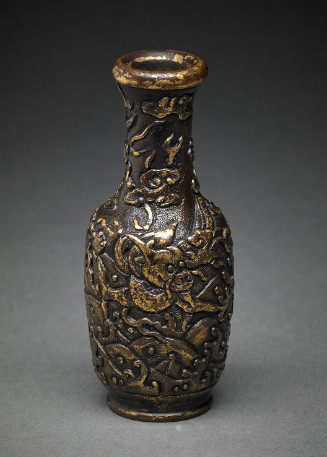
A fine and rare cast and chased parcel-gilt bronze incense tool vase, supported on a low foot rim, the body and slender neck decorate din gilded low relief with dragon amid clouds above a carp swimming amidst crested waves on a ring-punched ground. The underside of the recessed foot with a chiseled four-character mark in rounded seal script hu wen ming zhi (made by Hu Wenming) in a square gilded reserve.
Hu Wenming
17th century
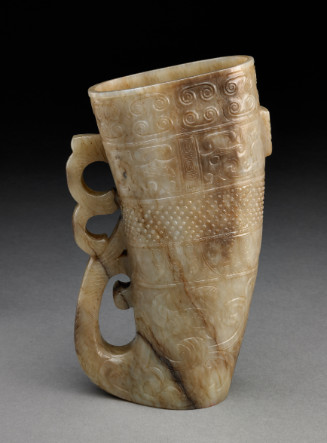
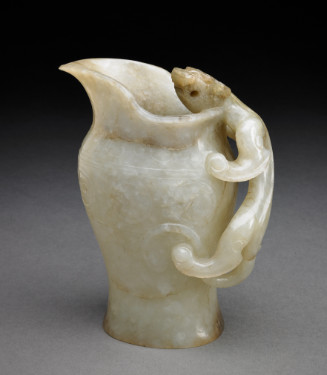
An oval vase-shaped ewer with curved spout elegantly carved from translucent jade. The mottled white material has greenish-gray tones and inclusions. The handle is carved aways from the cup in the sculptural from of a chih dragon with turned head clutching the rim. The dragon has a raised spine, spiraling articulations, and stylized wings on the thighs and shoulders.
Chinese Artist
possibly Ming Dynasty (1368-1644)
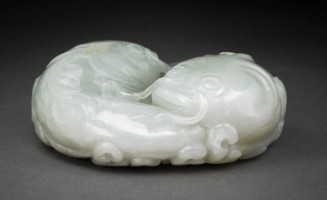
Naturalistically and finely carved as a pair of catfish coiled end to end, each with round eyes and long whiskers, above spiraling and swirling waves, the stone of even white tone suffused with small areas of russet
Chinese Artist
18th century
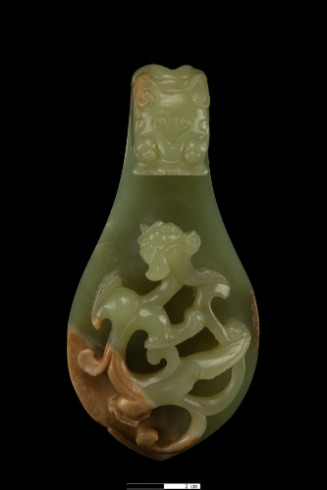
Hook carved on top with a dragon, with dragon-head hook.
Chinese Artist
18th century
null