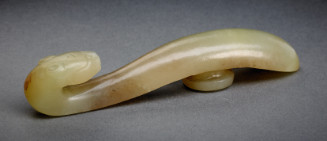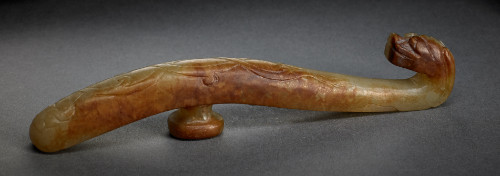
Carved with a pair of intertwined archaistic dragons along the shaft, the stone suffused with russet sections to one side
Belt Hook
Courtesy of the Harn Museum of Art, Photography by Randy Batista

Belt Hook

Artist Chinese Artist
Date18th-19th century
Place of originChina, Asia
MediumJade
Dimensions7/16 x 3 7/8 x 3/4 in. (1.1 x 9.8 x 1.9 cm)
ClassificationsClothing and accessories
Credit LineBequest of Dr. David A. Cofrin
Object number2009.48.5
Collections
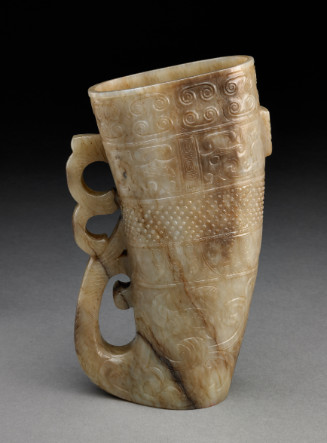
Visual DescriptionCarved with a pair of intertwined archaistic dragons along the shaft, the stone suffused with russet sections to one side
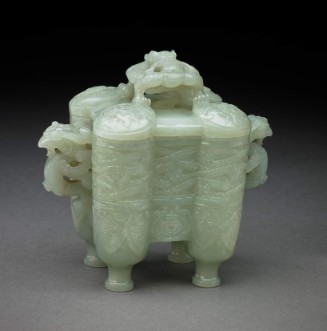
The well hollowed vessel carved in shallow relief with four bands of archaistic designs, including confronted C-scrolls, taotie masks separated by a taotie mask carved in high relief, bosses and mask-filled blades, all divided by rope twist borders and positioned above a phoenix and a dragon confronted on a vertical, keyfret band with a scrolling bird-like tail rising off center up one side from a pattern of intertwined swirls carved in a flat base, the stone of pale grayish brown color suffused…
Chinese Artist
Ming dynasty (1368-1644)
Yellowish tone jade, carved with flattened chi dragon head
Chinese Artist
18th-19th century
Well-hollowed with columnar corners and well-carved around the exterior with a wide band of numerous thin dragons, their finely incised scaly bodies intermeshing around the sides, above archaistic pendant leaves around the rounded corners, tapering sharply to the hollowed pad feet, two side with a ji character, the other two side with winged phoenix-form handles, the fitted cover of conforming shape with a central reticulated dragon-form knop, the claw on and extending to the four corners, the g…
Chinese Artist
Qing dynasty (1644-1911), 18th century
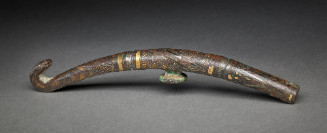
Silver and gold-inlaid bronze garment hook, Warring States, the arched shaft finely inlaid with dotted feather or scale pattern divided by cheveron and horizontal bands, with an animal-head hook at one end and an inlaid button on the underside, inlaid at one end with a bird
Chinese Artist
Warring States Period (c. 475-221 BCE)
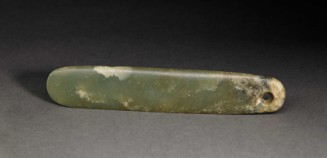
Of elongated form, slightly rounded on each side, with one end rounded opposite a pierced circular aperture, the green stone finely suffused with white in areas
Chinese Artist
Neolithic Period or later
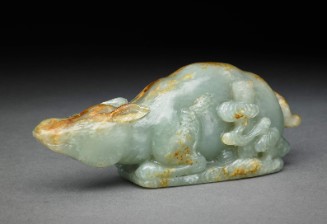
Carved as a crouching animal with extended head held forward with rounded snout and long ears held back, opposite a short tail, one side with a bitong enframed by cloud ribbons extending on to the underside, carved with cloud swirls, the green stone suffused with white and with russet splashes
Chinese Artist
18th-19th century or later
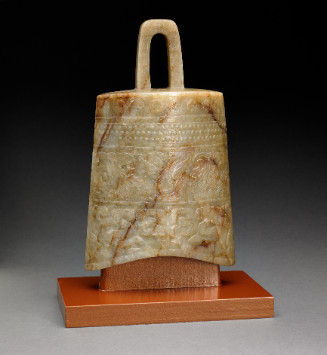
Bell is divided into sections which are reminiscent of the piece-mold technique of seaming the elements of the bronze bells together, seen on this jade bell as design elements. This archaistic bell is of greenish-gray jade with russet inclusions. In our opinion this archaistic bell expresses the refinement of design and technical workmanship of the late Song to early Ming period.
Chinese Artist
Song Dynasty (960-1279) or later
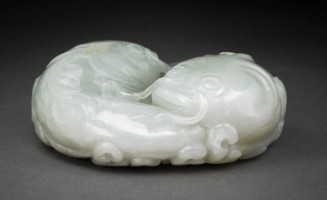
Naturalistically and finely carved as a pair of catfish coiled end to end, each with round eyes and long whiskers, above spiraling and swirling waves, the stone of even white tone suffused with small areas of russet
Chinese Artist
18th century
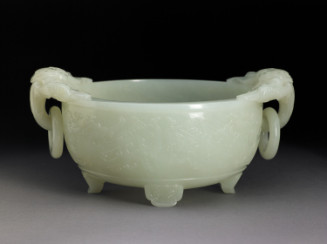
Of circular form, well-carved with two loop handles suspending rings formed from a pair of bats on either side of a ruyi-shaped terminal, the body carved in light relief with two pairs of diffused and stylized dragons and supported on four small scrolled feet, the stone of even white tone.
Chinese Artist
Qing Dynasty (1644-1911), Qianlong period (1736-1795)
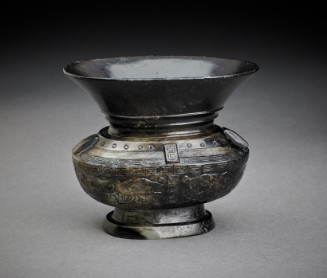
Of compressed zun form, the sides carved in shallow relief with two pairs of confronted dragons contained within keyfret borders, below four raised keyfret-incised flanges which divide the shoulder and interrupt a band of dots above, the widely flared neck encircled by two bowstring bands and carved on the interior with three grooved lines, intentionally altered to a blackish color with areas of the pale gray stone showing through, minor rim chips.
Chinese Artist
Song dynasty (960-1279)
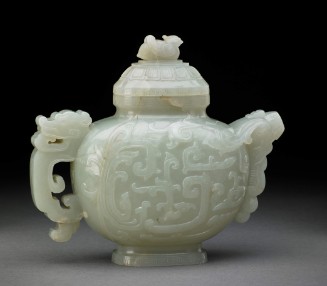
Of oval section, carved overall in low relief with bands of archaistic kuei dragons and keyfret, flanked by the thick handle and spout further carved as archaistic kuei, the domed cover decorated with pendant leaves surmounted by a quail-form knop, one body fissure
Chinese Artist
Qing dynasty (1644 -1911), 18th century
null