A fine jade arrow vase of celadon tone.  The sides carved with bats in high relief.
Arrow Vase with Bats
Courtesy of the Harn Museum of Art, Photography by Randy Batista

Arrow Vase with Bats

Artist Chinese Artist
DateQing dynasty (1644-1911), 18th-19th century
Place of originChina
MediumNephrite
Dimensions6 1/8 x 2 7/8 x 2 3/16 in. (15.6 x 7.3 x 5.6 cm)
ClassificationsFurnishings and Equipment
Credit LineBequest of Dr. David A. Cofrin
Object number2009.48.219
Collections
Visual DescriptionA fine jade arrow vase of celadon tone. The sides carved with bats in high relief.
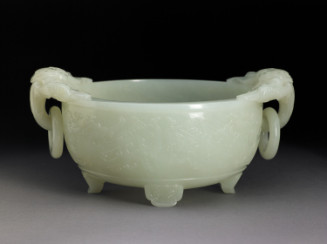
Of circular form, well-carved with two loop handles suspending rings formed from a pair of bats on either side of a ruyi-shaped terminal, the body carved in light relief with two pairs of diffused and stylized dragons and supported on four small scrolled feet, the stone of even white tone.
Chinese Artist
Qing Dynasty (1644-1911), Qianlong period (1736-1795)
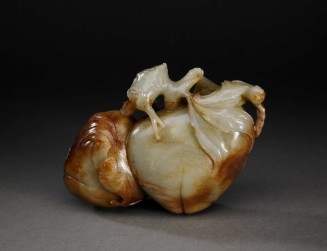
well carved as two fleshy peach fruit borne on a knotty leafy peach stem extending around the sides, with two bats, the pale green stone with brown skin overall.
Chinese Artist
Qing dynasty (1644-1911), 18th century
Vase of tapered square form, carved on the sides with two mock masks suspending loop rings, the stone of pale white tone.
Chinese Artist
Qing dynasty (1644 -1911)
A fine jade group of a pair of pomegranates worked in low relief with a bat and insect, the stone a subtle pale celadon green tone with russet markings
Chinese Artist
18th-19th century
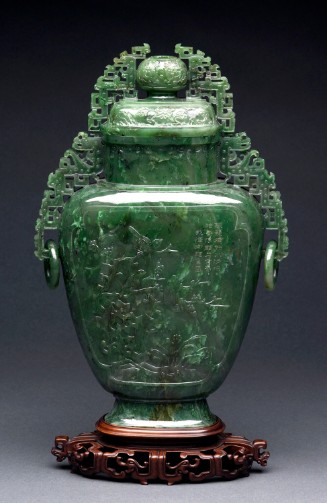
Covered Vase with Imperial Inscription
Chinese Artist
18th-19th century or later
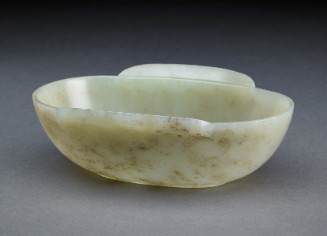
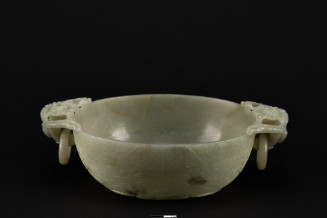
This ear cup reflects the Song period's profound interest in history in its characteristic design found in jades of the late Han period (206BC-AD220). The thinly worked oval cup has two flat handles projecting just below the rim at the longer sides, resting on an oval base with a raised foot ring. The highly translucent yellow jade possesses darker russet brown inclusions creating a desirable "skin" throughout the cup. The ear cup is of a fine, smooth polish. In our opinion, this ear cup is a fi…
Chinese Artist
Qing dynasty (1644-1911) or later
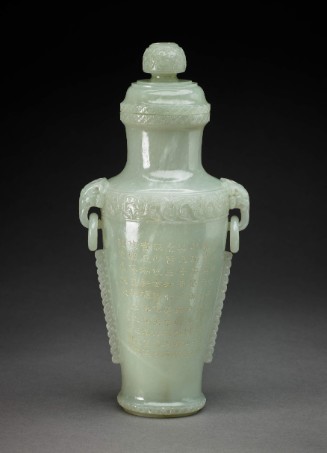
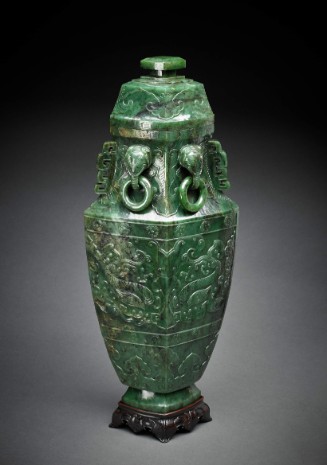
Green jade covered vase featuring etched designs and intricate, ornate handles that extend from the lid down the sides, resting on a dark brown stand.
Chinese Artist
Attributed to the Qing Dynasty (1644-1911), Qianlong reign (1736-1795)
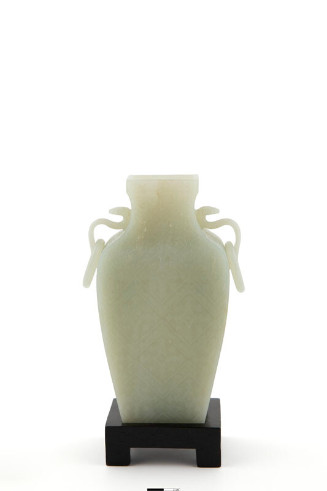
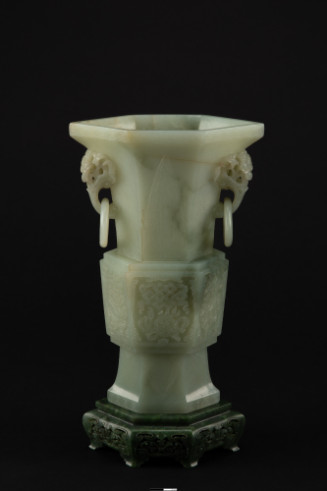
A jade vase of rectangular section, the sides gently tapering towards the slightly recessed base, the waisted neck with straight mouth rim, and worked in relief with two ruyi-sceptre handles from which loose rings are suspended. They body decorated overall in sunken relief with a geometric design of chevrons, clouds and squares. The stone a pale celadon stone. The base with an incised six-character reign mark Qianlong yu yong (for imperial use).
Chinese Artist
18th-19th century
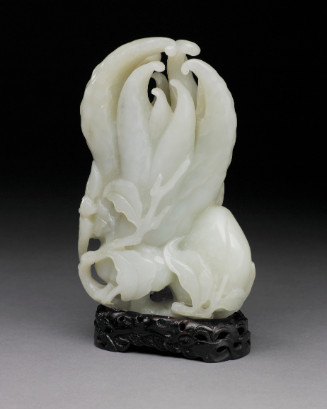
The emphasis on the smooth sensuous surface, fluidity of lines and the attention to detail are all typical elements of the eighteenth century carving tradition.  Fashioned of a pure white jade, the citron is entwined with leaves and accompanied by a bat and a peach. The long delicately carved tendrils bend gracefully at the tips, resembling Buddha's hand in the classic position. The citron symbolizes wishes for longevity as well as wealth, since it illustrates the gesture of grasping money. The …
Chinese Artist
18th-19th century
Well carved around the sides in low relief with a dense frieze of foliate blooms and furled leaves, issuing from a collar of petals encircling the base, forming a ring foot, the underside with a flowerhead, set with two flowerhead-form handles suspending loose rings, the interior center with a flowerhead, the greenish white stone striated with gray, minor chips.
Chinese Artist
Qing dynasty, 18th-19th century
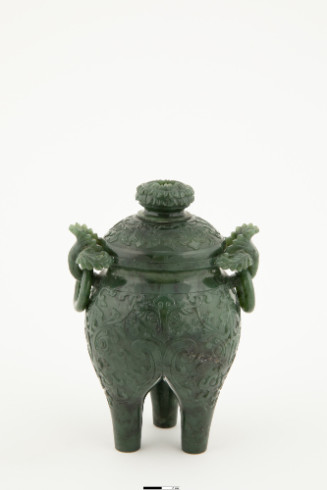
A rare spinach green jade incense burner and cover, the sides with floral relief ring handles, the body with low relief lotus scrolls above the three plain legs.
Chinese Artist
Qing dynasty (1644 -1911), 18th century
Carved with archaistic motifs
Chinese Artist
19th century
null