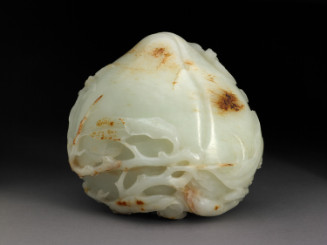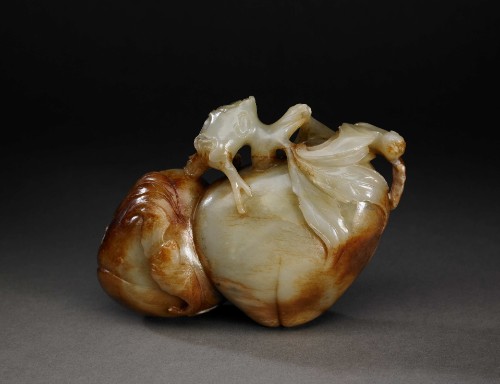
well carved as two fleshy peach fruit borne on a knotty leafy peach stem extending around the sides, with two bats, the pale green stone with brown skin overall.
Double Peach Group
Courtesy of the Harn Museum of Art, Photography by Randy Batista

Double Peach Group

Artist Chinese Artist
DateQing dynasty (1644-1911), 18th century
Place of originChina, Asia
MediumNephrite
Dimensions4 3/8 in. (11.1 cm)
ClassificationsSculpture
Credit LineBequest of Dr. David A. Cofrin
Object number2009.48.292
Collections
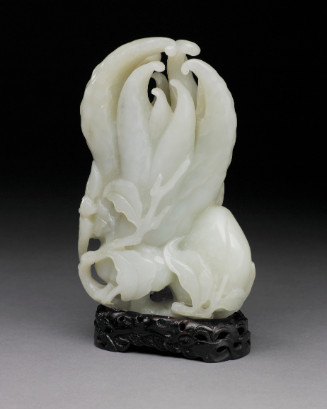
Visual Descriptionwell carved as two fleshy peach fruit borne on a knotty leafy peach stem extending around the sides, with two bats, the pale green stone with brown skin overall.
The emphasis on the smooth sensuous surface, fluidity of lines and the attention to detail are all typical elements of the eighteenth century carving tradition.  Fashioned of a pure white jade, the citron is entwined with leaves and accompanied by a bat and a peach. The long delicately carved tendrils bend gracefully at the tips, resembling Buddha's hand in the classic position. The citron symbolizes wishes for longevity as well as wealth, since it illustrates the gesture of grasping money. The …
Chinese Artist
18th-19th century
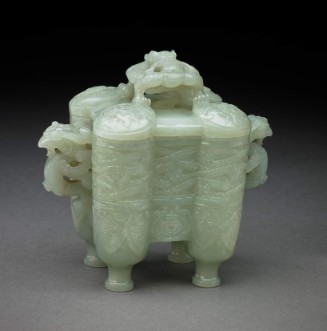
Well-hollowed with columnar corners and well-carved around the exterior with a wide band of numerous thin dragons, their finely incised scaly bodies intermeshing around the sides, above archaistic pendant leaves around the rounded corners, tapering sharply to the hollowed pad feet, two side with a ji character, the other two side with winged phoenix-form handles, the fitted cover of conforming shape with a central reticulated dragon-form knop, the claw on and extending to the four corners, the g…
Chinese Artist
Qing dynasty (1644-1911), 18th century
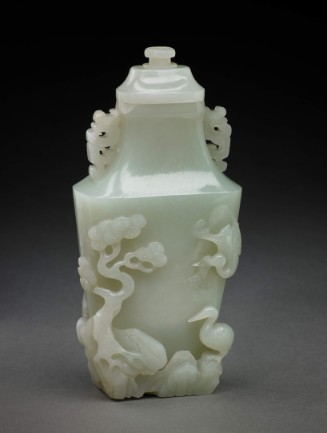
Well carved around the sides with a pine tree growing from the rocks that form the base and with five cranes, four grasping auspicious sprigs in their beaks, including prunus, lingzhi fungus, peach and bamboo, with archaistic bird scroll handles, the cover with rope-twist finial, the well-polished stone of pale greenish-white color
Chinese Artist
Qing Dynasty (1644 - 1911), 18th century
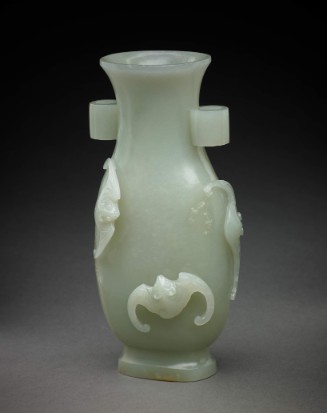
A fine jade arrow vase of celadon tone.  The sides carved with bats in high relief.
Chinese Artist
Qing dynasty (1644-1911), 18th-19th century
The gnarled leafy branches forming the base, with two bats in flight, with some added russet accents
Chinese Artist
18th-19th century
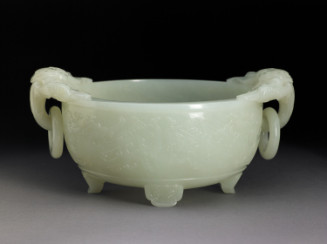
Of circular form, well-carved with two loop handles suspending rings formed from a pair of bats on either side of a ruyi-shaped terminal, the body carved in light relief with two pairs of diffused and stylized dragons and supported on four small scrolled feet, the stone of even white tone.
Chinese Artist
Qing Dynasty (1644-1911), Qianlong period (1736-1795)
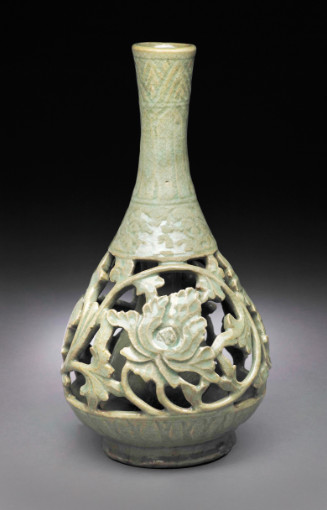
Double-walled vase, the outer wall carved with an openwork floral design. The whole vase covered with a bluish-green celadon glaze.

A rare reticulated 'Longquan' celadon bottle vase, the pear shaped body set with a tall neck carved with flowers and upright leaf lappets, the belly pierced through to the smaller inner vase to reveal on the exterior two elegant peonies borne on an undulating leafy stem, applied overall with an unctuous bluish-green glaze pooling in the recesses, all supported on…
Chinese Artist
Ming Dynasty (1368-1644)
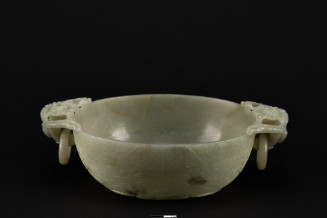
Well carved around the sides in low relief with a dense frieze of foliate blooms and furled leaves, issuing from a collar of petals encircling the base, forming a ring foot, the underside with a flowerhead, set with two flowerhead-form handles suspending loose rings, the interior center with a flowerhead, the greenish white stone striated with gray, minor chips.
Chinese Artist
Qing dynasty, 18th-19th century
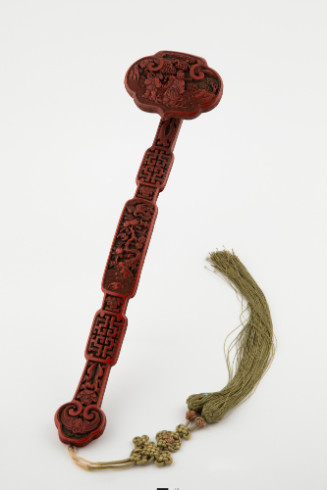
The long curved shaft well carved with a central panel enframing a crane soaring amid fruiting peach blossoms, between angular strapwork, foliate and soaring bat panels, the ruyi-head shaped terminal with Han Xiangzi and attendant floating on a log, the edges with keyfret, and the underside with a floret diaper.
Chinese Artist
18th-19th century
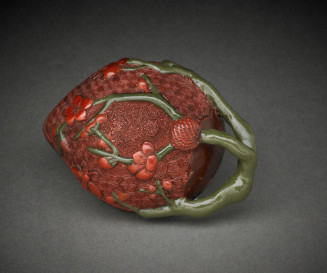
The miniature cup in the form of a peach, carved through the cinnabar lacquer on the floret-diaper ground and below a keyfret border with three green branches forged to the surface, each issuing smaller branches with blossoms and flowering buds, further carved with a butterfly to the side, the interior lined with silver, with a cylindrical fitted ivory box, inscribed j iusitang to the flattened cover
Chinese Artist
Qing Dynasty (1644 - 1911)
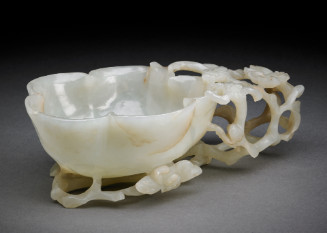
Whitish jade flower-form brushwasher, the deep, five-petaled blossom borne of a blossoming branch which forms an openwork handle to one side where tow chilong frolic with some opaque mottling and brown veining in the stone.
Chinese Artist
Ming dynasty (1368-1644) or later
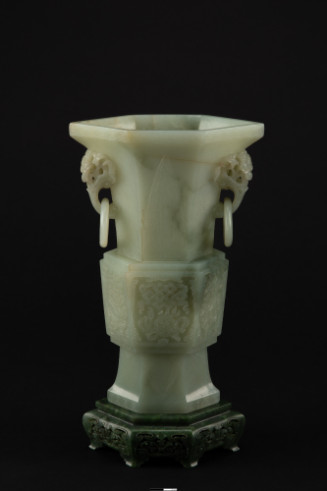
Vase of tapered square form, carved on the sides with two mock masks suspending loop rings, the stone of pale white tone.
Chinese Artist
Qing dynasty (1644 -1911)
null