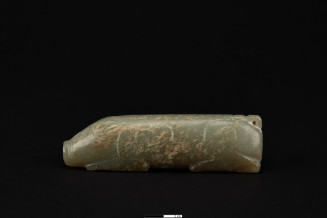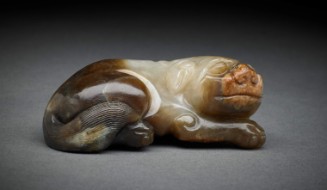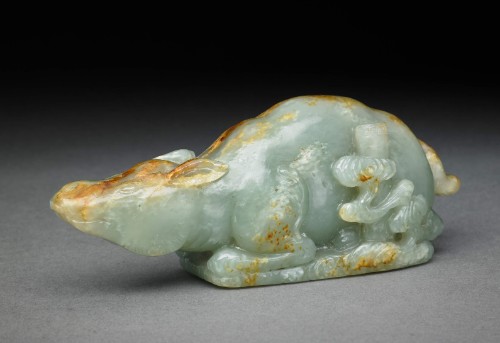
Carved as a crouching animal with extended head held forward with rounded snout and long ears held back, opposite a short tail, one side with a bitong enframed by cloud ribbons extending on to the underside, carved with cloud swirls, the green stone suffused with white and with russet splashes
Crouching Deer
Courtesy of the Harn Museum of Art, Photography by Randy Batista

Crouching Deer

Artist Chinese Artist
Date18th-19th century or later
Place of originChina
MediumJade
Dimensions1 3/4 x 4 7/16 x 1 5/16 in. (4.4 x 11.3 x 3.3 cm)
ClassificationsSculpture
Credit LineBequest of Dr. David A. Cofrin
Object number2009.48.222
Collections
Visual DescriptionCarved as a crouching animal with extended head held forward with rounded snout and long ears held back, opposite a short tail, one side with a bitong enframed by cloud ribbons extending on to the underside, carved with cloud swirls, the green stone suffused with white and with russet splashes
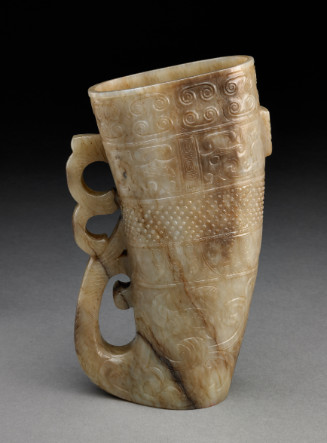
The well hollowed vessel carved in shallow relief with four bands of archaistic designs, including confronted C-scrolls, taotie masks separated by a taotie mask carved in high relief, bosses and mask-filled blades, all divided by rope twist borders and positioned above a phoenix and a dragon confronted on a vertical, keyfret band with a scrolling bird-like tail rising off center up one side from a pattern of intertwined swirls carved in a flat base, the stone of pale grayish brown color suffused…
Chinese Artist
Ming dynasty (1368-1644)
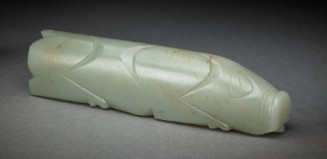
The slender crouching animal carved with deep slashes for the flat snout, haunches, ears and upturned tail, the tail and snout pierced with a hole for attachment, the stone of pale celadon color with areas of calcification
Chinese Artist
Han dynasty (206 BCE-220 CE)
The crouching animal carved with deep slashes to the flat snout, haunches, eyes and tail, the stone of pale celadon tone with russet rivering
Chinese Artist
Han dynasty (206 BCE-220 CE)
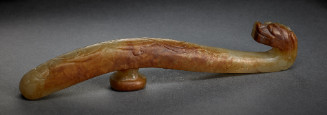
Carved with a pair of intertwined archaistic dragons along the shaft, the stone suffused with russet sections to one side
Chinese Artist
18th-19th century
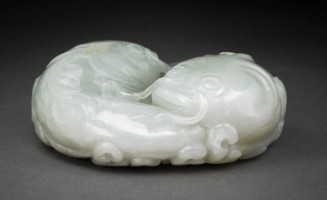
Naturalistically and finely carved as a pair of catfish coiled end to end, each with round eyes and long whiskers, above spiraling and swirling waves, the stone of even white tone suffused with small areas of russet
Chinese Artist
18th century
cleverly carved using the natural inclusions of the stone, its head turned to one side, its combed mane trailing over its ribbed back, opposite the tail flicked to one side, the underside detailed with padded paws, the stone of mottled brown, beige and white tones
Chinese Artist
Ming dynasty (1368-1644)
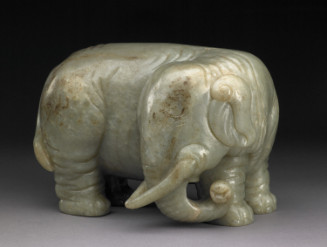
Of pale greyish-green stone, the standing elephant carved with head turned back, its trunk between its tusks meeting at the tips, its tail flicked forward on its right hind leg, its floppy ears and wrinkled skin well delineated
Chinese Artist
Ming dynasty (1368-1644)
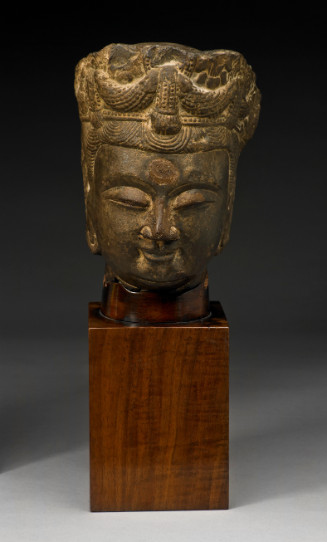
Head of a finely carved Bodhisattva with arched brows, elongated eyes, broad nose, and full lips. Wearing jeweled headdress held in place by a ribbon.
Chinese Artist
Northern Qi or Sui Dynasty, late 6th Century
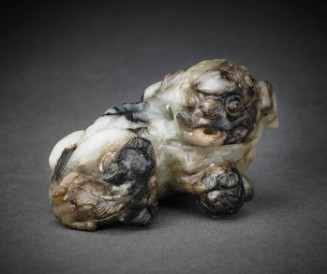
Carved as a recumbent lion, its paw resting on a brocade ball and head turned to one side, its long ears laid back flanking tufts of hair falling on either side of the ribbed backbone, opposite the tail flicked to one side, accompanied by a cub, the stone of mottled, black brown and white tones
Chinese Artist
18th-19th Century or later
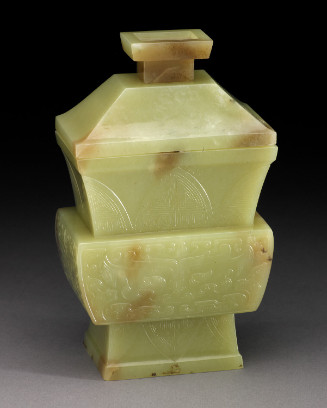
Of fang-gu form, the central section, well carved on each rounded side with a taotie mask, between leaf tip blades infilled with dense geometric motifs, the fitted, angled cover with rectangular knop, the stone of greenish yellow with splashes of taupe
Chinese Artist
Qing dynasty (1644 - 1911), 18th century
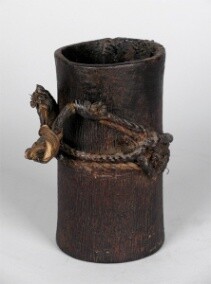
Urushi-oke or lacquer artisan's pail, of carved and assembled cypress wood with splashes and drips of the artisan's lacquer, and carrying rope.
Japanese Artist
early Meiji era, c. 1870
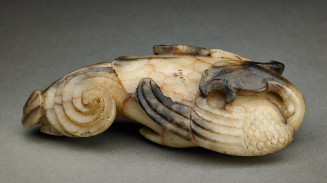
Shown with head arched back and resting on its body, some small chips to wings and tail feathers
Chinese Artist
Song and Ming dynasty (960-1644)
null