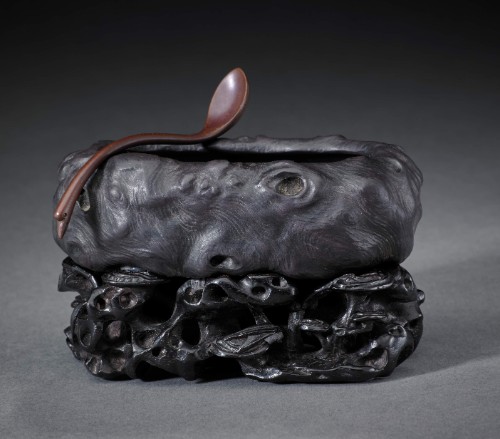
The shallow, grayish-brown stone naturalistically carved as an irregular oblong section of knotted rootwood, the stone of characteristic deep brownish-purple tone; together with a small spoon, the curved handle terminating in the head of a goose
Brush Washer
Courtesy of the Harn Museum of Art, Photography by Randy Batista

Brush Washer

Artist Chinese Artist
Date18th-19th century
Place of originChina, Asia
MediumCeramic, duan stone
Dimensions1 1/8 x 3 3/8 x 2 1/8 in. (2.9 x 8.6 x 5.4 cm)
ClassificationsFurnishings and Equipment
Credit LineBequest of Dr. David A. Cofrin
Object number2009.48.63
Collections
Visual DescriptionThe shallow, grayish-brown stone naturalistically carved as an irregular oblong section of knotted rootwood, the stone of characteristic deep brownish-purple tone; together with a small spoon, the curved handle terminating in the head of a goose

Duan stone is a highly sought-after type of shale mined at Duanxi in Guangdong province. It was most often, though not exclusively, used for the production of inkstones. It is rare to find a duan stone vessel other than an inkstone, and this unusual example would have been prized for its exceptional craftsmanship and strong sense of naturalism
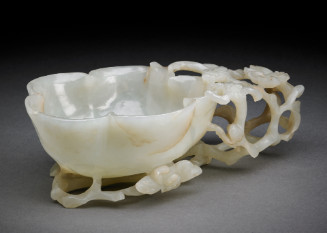
Whitish jade flower-form brushwasher, the deep, five-petaled blossom borne of a blossoming branch which forms an openwork handle to one side where tow chilong frolic with some opaque mottling and brown veining in the stone.
Chinese Artist
Ming dynasty (1368-1644) or later
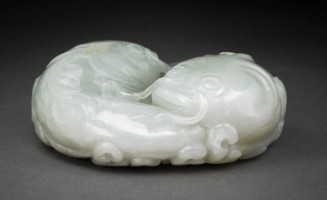
Naturalistically and finely carved as a pair of catfish coiled end to end, each with round eyes and long whiskers, above spiraling and swirling waves, the stone of even white tone suffused with small areas of russet
Chinese Artist
18th century
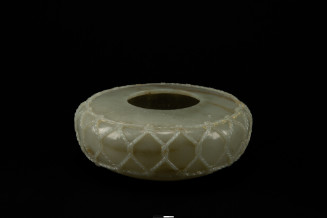
Of compressed globular form, finely carved with 'rope twist' strapwork around the body forming a pattern of lozenge-shaped panels on an otherwise plain ground, the stone of celadon tone with faint russet and white inclusions
Chinese Artist
18th-19th century or later
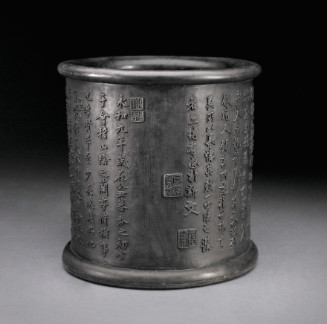
Of broad cylindrical form with two raised bands at the foot and rim, the exterior finely carved with inscription
Chinese Artist
19th-20th century
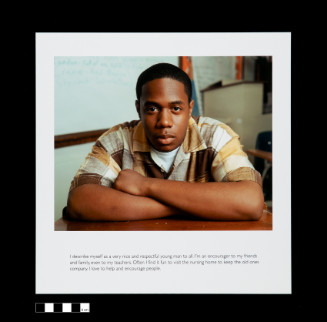
Portrait of a young man seated at a table/desk looking out at the viewer; he wears a short-sleeved, button-down brown plaid shirt; objects of a classroom in the background (white board, lectern, another classroom desk).  Text beneath image reads, "I describe myself as a very nice and respectful young man to all.  I'm an encourager to my friends and family, even to my teachers.  Often I find it fun to visit the nursing home to keep the old ones company.  I love to help and encourage people."
Dawoud Bey
2003
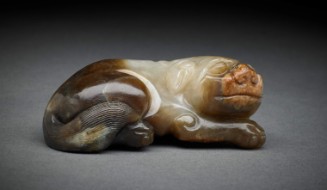
cleverly carved using the natural inclusions of the stone, its head turned to one side, its combed mane trailing over its ribbed back, opposite the tail flicked to one side, the underside detailed with padded paws, the stone of mottled brown, beige and white tones
Chinese Artist
Ming dynasty (1368-1644)
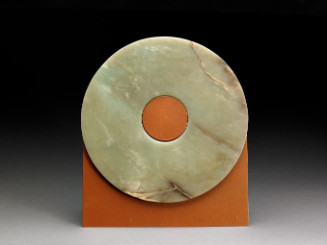
This semi-translucent stone of soft olive-green color with opaque buff mottling and some dark brown coloring in areas that show signs of alteration from burial, the inner and outer edges well finished and the stone with a high, soft polish, some chips
Chinese Artist
Zhou Dynasty (c.1050-256 BCE) or earlier
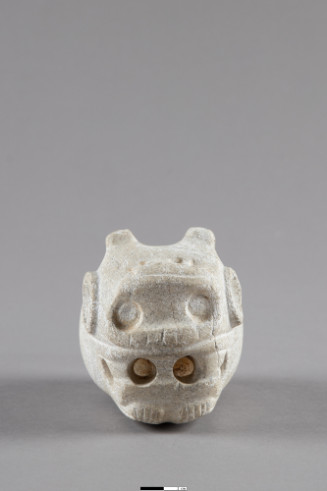
Stone mace head, half is spherical with cylindrical hole from top to bottom other half carved to resemble feline head with small ears, broad nose, open toothed mouth, large eyes on side; features formed by drilling, either partially or completely into stone - through ears and mouth, depressions for eyes and nostrils
Chorotegan Artist
100-300
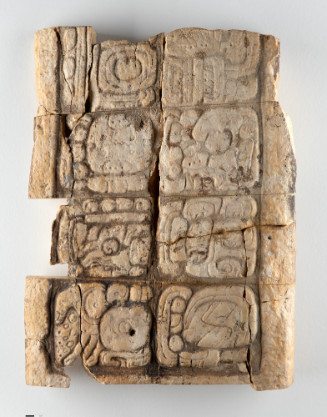
Carved stone panel containing eight Maya glyphs in two columns, border of smoothed, rounded stone on sides, small border on bottom, none on top.
Maya Artist
700-850
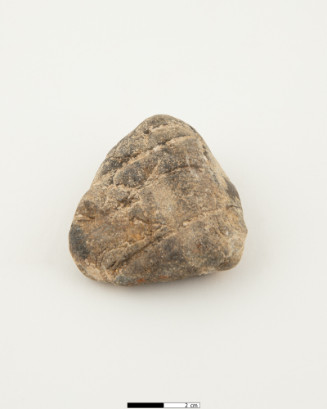
Flat stone, roughly triangular in shape with narrow lines carved into surface, two parallel lines ring the stone on opposite ends with crisscrossing lines in between.
Costa Rican Artist
undated
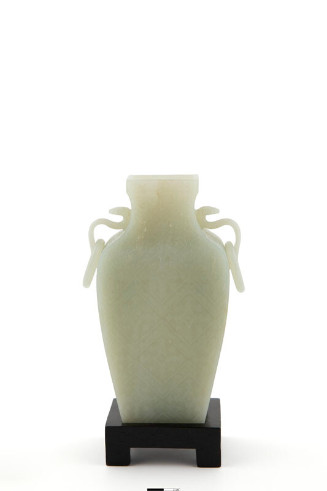
A jade vase of rectangular section, the sides gently tapering towards the slightly recessed base, the waisted neck with straight mouth rim, and worked in relief with two ruyi-sceptre handles from which loose rings are suspended. They body decorated overall in sunken relief with a geometric design of chevrons, clouds and squares. The stone a pale celadon stone. The base with an incised six-character reign mark Qianlong yu yong (for imperial use).
Chinese Artist
18th-19th century
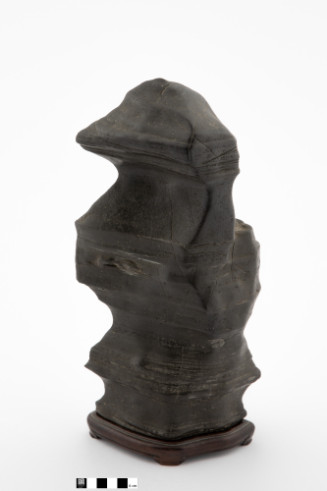
Scholar's Stone (suiseki)
Japanese Artist
19th century
null