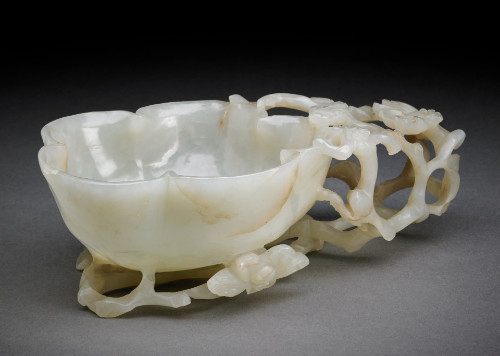
Whitish jade flower-form brushwasher, the deep, five-petaled blossom borne of a blossoming branch which forms an openwork handle to one side where tow chilong frolic with some opaque mottling and brown veining in the stone.
Brush Washer
Courtesy of the Harn Museum of Art, Photography by Randy Batista

Brush Washer

Artist Chinese Artist
DateMing dynasty (1368-1644) or later
Place of originChina
MediumNephrite
Dimensions2 1/8 x 6 3/16 x 3 11/16 in. (5.4 x 15.7 x 9.4 cm)
ClassificationsSculpture
Credit LineBequest of Dr. David A. Cofrin
Object number2009.48.193
Collections
Visual DescriptionWhitish jade flower-form brushwasher, the deep, five-petaled blossom borne of a blossoming branch which forms an openwork handle to one side where tow chilong frolic with some opaque mottling and brown veining in the stone.
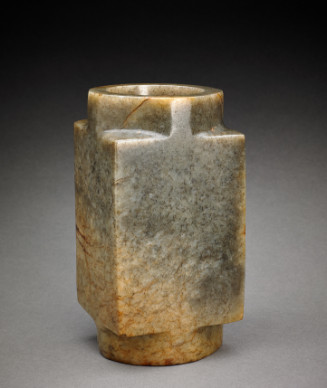
The semi-translucent stone of rich, dark olive-green color with brown mottling and veining, with areas of yellowish-buff color emanating from some of the veins and some opaque alteration from burial, carved as a rectangular block enclosing a cylindrical tube extending beyond the triangular shoulders at either end to form a collar, with a smooth satiny polish, some encrustation
Chinese Artist
Western Zhou dynasty (c. 1050-771 BCE)
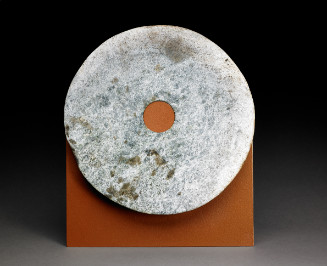
This semi-translucent stone of soft olive-green color with opaque buff mottling and some dark brown coloring in areas that show signs of alteration from burial, the inner and outer edges well finished and the stone with a high, soft polish, some chips
Chinese Artist
Zhou Dynasty (c.1050-256 BCE) or earlier
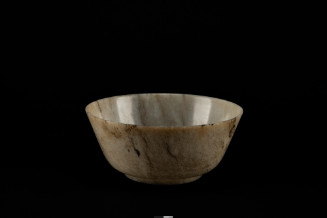
Well carved bowl with slightly flaring sides rising from a shallow foot ring, the stone of pale greyish-white tone with opaque white flecks and pale brown mottling and veining throughout, softly and evenly polished.
Chinese Artist
17th-18th century
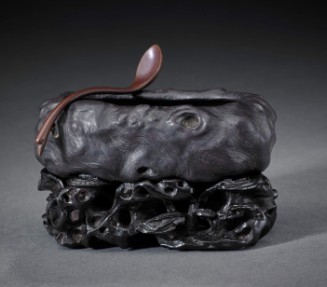
The shallow, grayish-brown stone naturalistically carved as an irregular oblong section of knotted rootwood, the stone of characteristic deep brownish-purple tone; together with a small spoon, the curved handle terminating in the head of a goose
Chinese Artist
18th-19th century
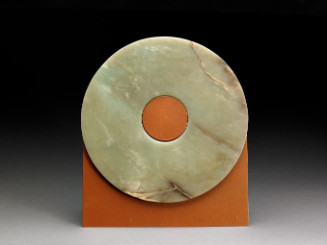
This large bi disc has been meticulously worked with a subtle concave rim rarely seen on bi discs of this size. Small circular bracelet-form jades from recent Liangzhu excavations show edges which are slightly concave in shape. This suggests an original bone-derived stylistic element. Although these wearable jades with concave edges are more frequently seen, this bi example of large size is most unusual. The surface of the bi disc is highly polished, and there has been much attention to both sha…
Chinese, Liangzhu culture
Neolithic period or later
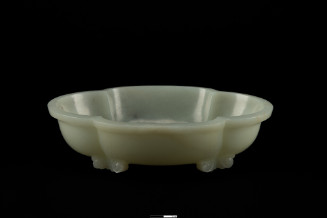
Dish with low sided quarter lobed outline, the interior in high relief with a grasshopper among prunus, on scroll-form bracket feet, areas of darker mottling
Chinese Artist
Qing dynasty (1644 -1911), 18th century
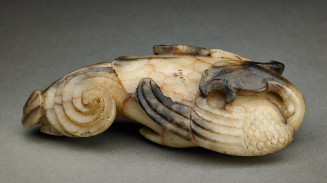
Shown with head arched back and resting on its body, some small chips to wings and tail feathers
Chinese Artist
Song and Ming dynasty (960-1644)
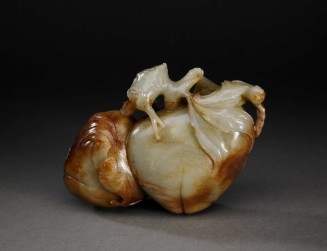
well carved as two fleshy peach fruit borne on a knotty leafy peach stem extending around the sides, with two bats, the pale green stone with brown skin overall.
Chinese Artist
Qing dynasty (1644-1911), 18th century
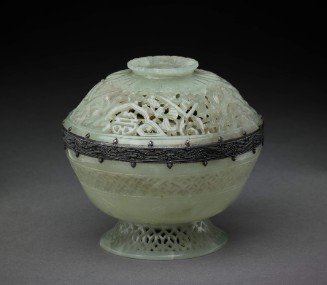
Reticulated Bowl
Chinese Artist
19th century or later
With the hind legs and front left leg folded under the body, and the right front leg flexed as the creature prepares to rise, the tail colored around to rest on the left haunch, the belly and neck faintly ribbed to indicate folds, the head facing forward with well-defined horns above ears delineated with fine incising, the greenish-gray stone with pale mottling.
Chinese Artist
Qing dynasty (1644 -1911)
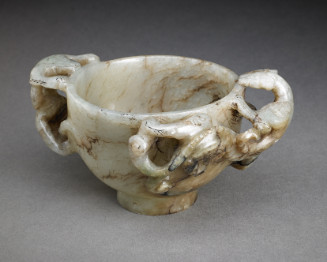
The vessel with a pair of deeply undercut and high relief chilong handles, each animal with finely rendered details and clutching the vessel lip, the stone suffused with dark brown veining throughout
Chinese Artist
Song and Ming Dynasty (960-1644)
null