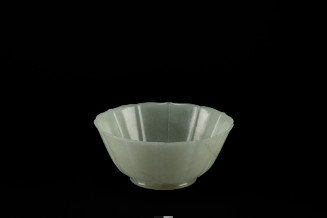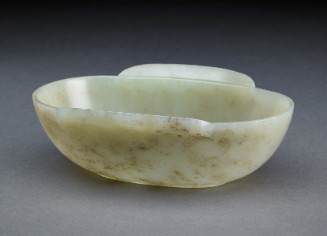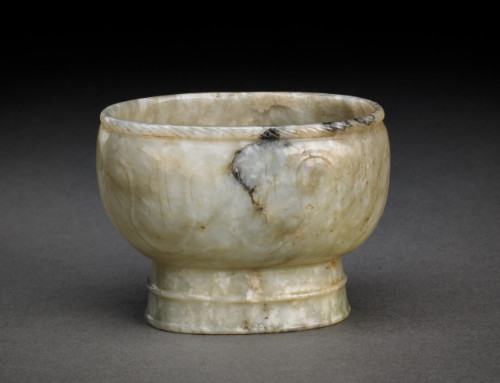
The deep, rounded sides carved on the exterior in shallow relief with a petal frieze pendant from a narrow rope-twist border at the rim, each petal incised with three vertical striations, the whole raised on a tall oval foot encircled by a bowstring band and with a raised border at the foot rim, the softly polished, semi-translucent stone of mottled grayish color
Cup
Courtesy of the Harn Museum of Art, Photography by Randy Batista

Cup

Artist Chinese Artist
DateSong and Yuan dynasty (960-1368)
Place of originChina, Asia
MediumJade
Dimensions1 3/4 x 2 3/16 x 1 5/8 in. (4.4 x 5.6 x 4.1 cm)
ClassificationsFurnishings and Equipment
Credit LineBequest of Dr. David A. Cofrin
Object number2009.48.97
Collections
Visual DescriptionThe deep, rounded sides carved on the exterior in shallow relief with a petal frieze pendant from a narrow rope-twist border at the rim, each petal incised with three vertical striations, the whole raised on a tall oval foot encircled by a bowstring band and with a raised border at the foot rim, the softly polished, semi-translucent stone of mottled grayish color
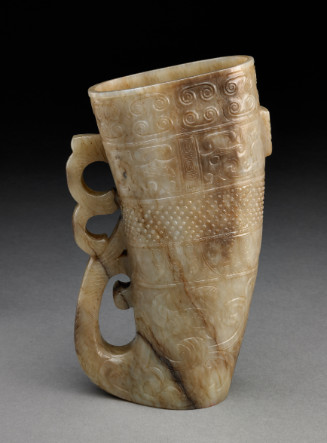
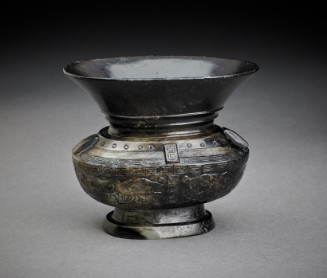
Of compressed zun form, the sides carved in shallow relief with two pairs of confronted dragons contained within keyfret borders, below four raised keyfret-incised flanges which divide the shoulder and interrupt a band of dots above, the widely flared neck encircled by two bowstring bands and carved on the interior with three grooved lines, intentionally altered to a blackish color with areas of the pale gray stone showing through, minor rim chips.
Chinese Artist
Song dynasty (960-1279)
Bowl of deep rounded form, the lobed sides well carved as six elongated petals rising from the shallow, flaring foot to the barbed rim, the semi-translucent stone of pale celadon tone.
Chinese Artist
Qing Dynasty (1644 - 1911), 18th century
The well hollowed vessel carved in shallow relief with four bands of archaistic designs, including confronted C-scrolls, taotie masks separated by a taotie mask carved in high relief, bosses and mask-filled blades, all divided by rope twist borders and positioned above a phoenix and a dragon confronted on a vertical, keyfret band with a scrolling bird-like tail rising off center up one side from a pattern of intertwined swirls carved in a flat base, the stone of pale grayish brown color suffused…
Chinese Artist
Ming dynasty (1368-1644)
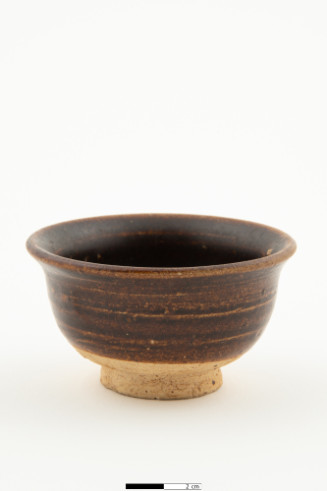
A small, deep ceramic bowl with a rich dark brown glaze featuring horizontal striations. It sits on a distinct, unglazed beige foot. The rim curves gently outward.
Cambodian, Khmer
Bayon Period (1181-1400)
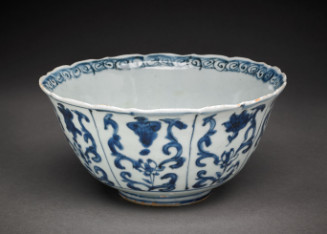
Round, deep bowl, slightly outward flaring rim, body flares inward to narrow ring foot, grey-white clay body, cobalt blue underglaze, clear gloss glaze over entire piece except base.  Inside: cavetto has diaper pattern (curl-work) border, Inner center: small branch w leaves & one fruit motif encircled w double lines.  Outside:  Body divided into 8 vertical panels--each with flower & scrolled leaves. Top center: decorated w eight treasures symbols.  Parallel lines encircle lower body & foot
Chinese Artist
Ming dynasty (1368-1644)
This ear cup reflects the Song period's profound interest in history in its characteristic design found in jades of the late Han period (206BC-AD220). The thinly worked oval cup has two flat handles projecting just below the rim at the longer sides, resting on an oval base with a raised foot ring. The highly translucent yellow jade possesses darker russet brown inclusions creating a desirable "skin" throughout the cup. The ear cup is of a fine, smooth polish. In our opinion, this ear cup is a fi…
Chinese Artist
Qing dynasty (1644-1911) or later
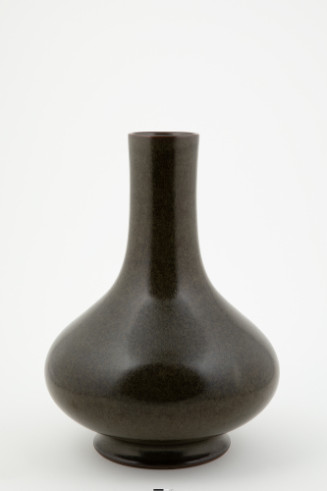
Vase with somewhat compressed lower body and wide cylindrical neck, covered inside and out with a dark mottled glaze of soft, grayish moss-green and olive-brown tone shading to deep russet brown on the mouth rim, the interior of the spreading pedestal foot similarly glazed, the glaze covering the nianhao also shading to russet brown.
Chinese Artist
Qing Dynasty (1644-1911), Qianlong period (1736-1795)
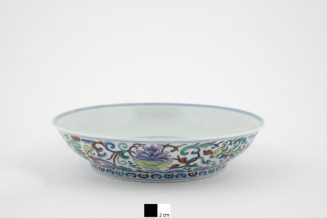
Interior of dish decorated with design of three phoenixes surrounding a stylized lotus blossom; the exterior also decorated with a band of phoenixes; six-character mark on base.

With shallow rounded sides rising to a slightly everted rim, brightly enameled with a central medallion of three archaistic phoenixes encircling a stylized lotus blossom borne on curling stems repeated in a frieze on the exterior, a border of C-shaped motifs enclosing a dot encircling the foot.
Chinese Artist
Qing dynasty (1644-1911), Daoguang reign (1821-1850)
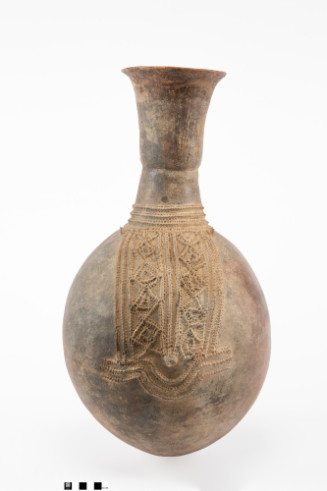
Spherical pot with long narrow neck and flared rim; raised designs with small pellets; vertical striations; lozenge pattern; "naval" on lower part of belly.
Ga'anda Artist
20th century
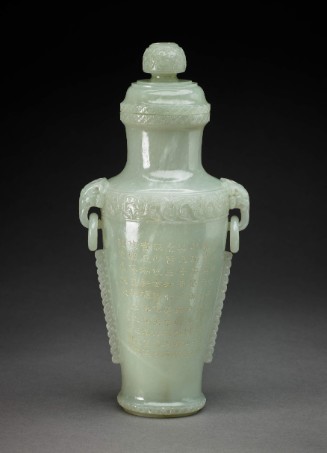
Covered Vase with Imperial Inscription
Chinese Artist
18th-19th century or later
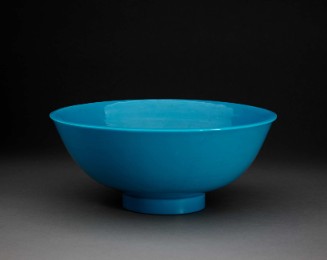
The deep bowl with thick sides flaring widely toward the everted rim, raised on a thick ring foot, the metal of opaque swirled turquoise color, the underside inscribed with four character mark within a double square, tiny polished rim chip, minor pitting
Chinese Artist
Qianlong Period (1736-1795)
A Mughal-style vase and cover carved from celadon green nephrite with lighter inclusions. The vase is carved in an unusual flattened and fluted form that is elliptical in cross-section. Either side of the vase is carved with three leafy acanthus scrolls and hanging loose rings. The long flaring neck is carved on either side
Chinese Artist
19th century or later
null