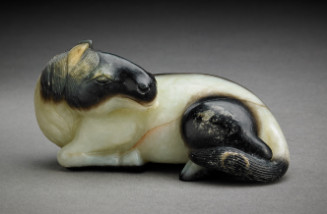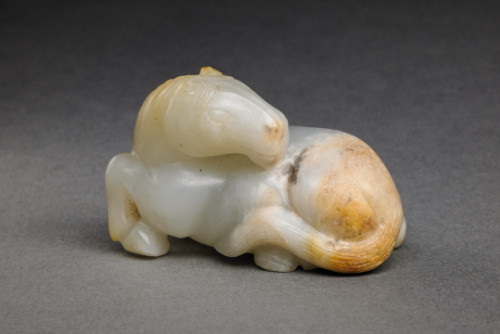
A small mottled white jade figure of a recumbent horse, with head turned to rest on its back, possibly Ming Dynasty
Recumbent Horse
Courtesy of the Harn Museum of Art, Photography by Randy Batista

Recumbent Horse

Artist Chinese Artist
DateMing dynasty (1368-1644) or later
Place of originChina, Asia
MediumJade
Dimensions15/16 x 1 9/16 x 3/4 in. (2.4 x 4 x 1.9 cm)
ClassificationsSculpture
Credit LineBequest of Dr. David A. Cofrin
Object number2009.48.101
Collections
Visual DescriptionA small mottled white jade figure of a recumbent horse, with head turned to rest on its back, possibly Ming Dynasty
A figure of a recumbent horse carved with its head turning over its shoulder, the stone a dark mottled tone.
Chinese Artist
Ming or Qing dynasty
Well carved along the natural curves of the stone, the head turned towards the back, the face framed by long locks of gently incised mane, seated on its haunches with its tail swished to one side, the underside well detailed hooves, the stone of white tone with dark brown highlights
Chinese Artist
Ming dynasty (1368-1644)
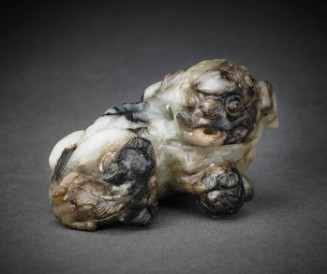
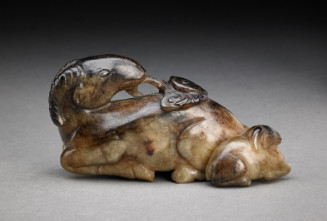
Carved as a recumbent lion, its paw resting on a brocade ball and head turned to one side, its long ears laid back flanking tufts of hair falling on either side of the ribbed backbone, opposite the tail flicked to one side, accompanied by a cub, the stone of mottled, black brown and white tones
Chinese Artist
18th-19th Century or later
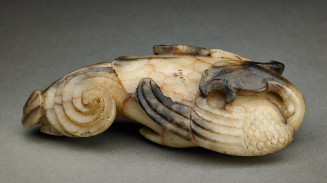
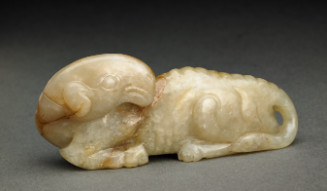
Shown with head arched back and resting on its body, some small chips to wings and tail feathers
Chinese Artist
Song and Ming dynasty (960-1644)
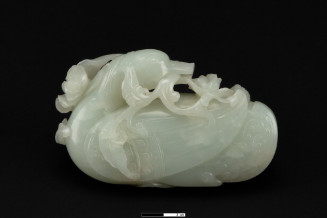
Finely carved with its head turned back over its wings folded back and incised with archaistic decoration, a long leafy lotus spray trailing from its beak, the underside detailed with webbed feet, the stone of even tone.
Chinese Artist
18th century
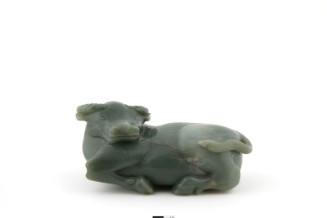
The thick stone well carved as a recumbent buffalo following the form of the boulder, the legs ticked beneath the body, the head turned to tone side, with broad snout and large curled horns, opposite the tail flicked to one side, the grayish green stone infused with a patch of white, small chip
Chinese Artist
19th-20th century
The thick stone carved as a recumbent buffalo following the form of the boulder, the legs tucked beneath the body, the head turned to one side, with broad snout and large curled horns, opposite the tail flicked to one side, the gray green stone with a broad suffusion of dark green and white on reverse.
Chinese Artist
19th century or later
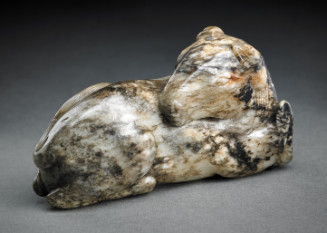
The recumbent beast with head turned over its back, the face delicately carved and the fur markings simply delineating the body with light ribs and softly polished vertebrae
Chinese Artist
possibly Song Dynasty (960-1279)
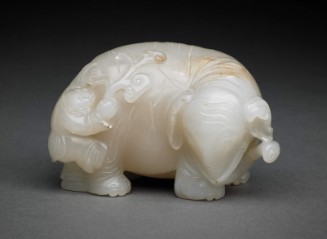
The beast well carved standing four square with the head turned to one side with a boy clambering over its back clasping a lotus sprig, the white jade with brown inclusions
Chinese Artist
Qing dynasty (1644-1911) or later
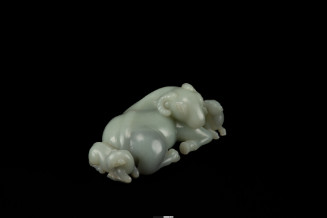
The recumbent ram finely carved in gently rounded form with its head turned to the side, flanked by two young tucked along its side, the stone of even celadon color with grey streaks
Chinese Artist
18th century or later
cleverly using the natural inclusions to depict a large recumbent horned ram, its head turned to one side and spewing forth a cloud vapor and yinyang medallion, accompanied by two young rams.
Chinese Artist
Ming dynasty (1368-1644)
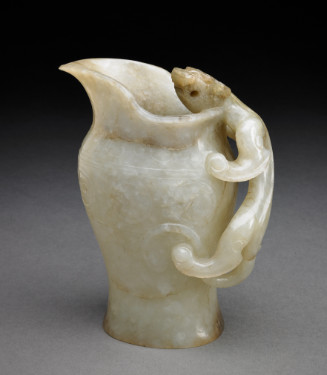
An oval vase-shaped ewer with curved spout elegantly carved from translucent jade. The mottled white material has greenish-gray tones and inclusions. The handle is carved aways from the cup in the sculptural from of a chih dragon with turned head clutching the rim. The dragon has a raised spine, spiraling articulations, and stylized wings on the thighs and shoulders.
Chinese Artist
possibly Ming Dynasty (1368-1644)
null