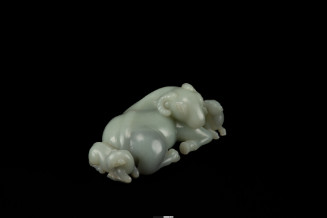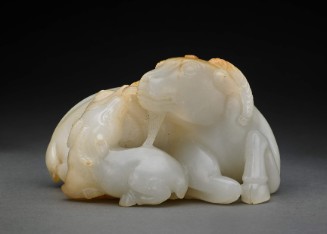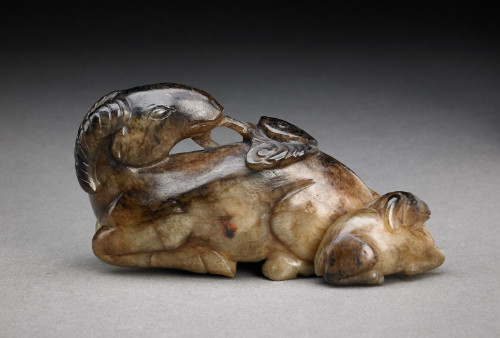
cleverly using the natural inclusions to depict a large recumbent horned ram, its head turned to one side and spewing forth a cloud vapor and yinyang medallion, accompanied by two young rams.
Ram Group
Courtesy of the Harn Museum of Art, Photography by Randy Batista

Ram Group

Artist Chinese Artist
DateMing dynasty (1368-1644)
Place of originChina, Asia
MediumBrown and white jade
Dimensions2 x 3 5/8 x 1 7/8 in. (5.1 x 9.2 x 4.8 cm)
ClassificationsSculpture
Credit LineBequest of Dr. David A. Cofrin
Object number2009.48.288
Collections
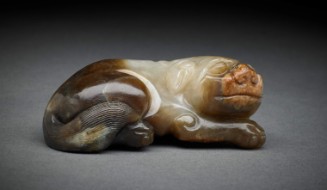
Visual Descriptioncleverly using the natural inclusions to depict a large recumbent horned ram, its head turned to one side and spewing forth a cloud vapor and yinyang medallion, accompanied by two young rams.
cleverly carved using the natural inclusions of the stone, its head turned to one side, its combed mane trailing over its ribbed back, opposite the tail flicked to one side, the underside detailed with padded paws, the stone of mottled brown, beige and white tones
Chinese Artist
Ming dynasty (1368-1644)
The recumbent ram finely carved in gently rounded form with its head turned to the side, flanked by two young tucked along its side, the stone of even celadon color with grey streaks
Chinese Artist
18th century or later
Depicting a recumbent ram holding a lingzhi stem and its, young, skillfully carved with russet coloring on the head and extending down the spine
Chinese Artist
18th century
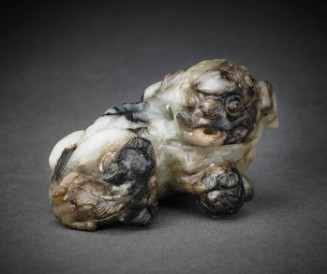
Carved as a recumbent lion, its paw resting on a brocade ball and head turned to one side, its long ears laid back flanking tufts of hair falling on either side of the ribbed backbone, opposite the tail flicked to one side, accompanied by a cub, the stone of mottled, black brown and white tones
Chinese Artist
18th-19th Century or later
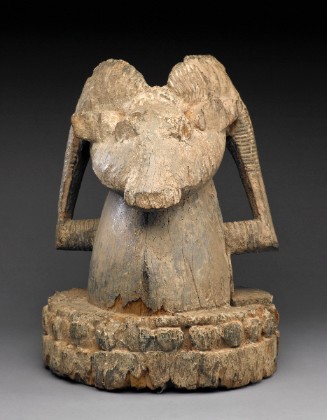
Ram's Head (osanmasinmi)
Yoruba Artist
20th Century
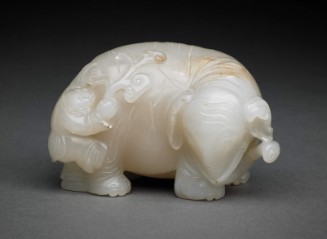
The beast well carved standing four square with the head turned to one side with a boy clambering over its back clasping a lotus sprig, the white jade with brown inclusions
Chinese Artist
Qing dynasty (1644-1911) or later
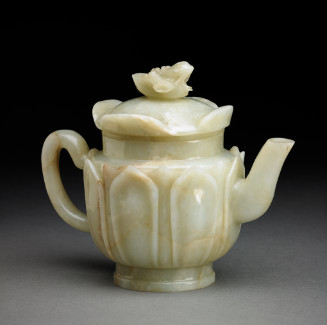
Of tapering globular shape, carved with two layers of eight lotus petals rising from the shallow, pedestal foot, with angular spout, curved handle and plain, straight-cut neck rising from the rounded shoulder, the cover carved as a lotus pad with a four up-turned leaves centered by a mandarin duck holding a lotus spray in its beak, some russet flaws and pale inclusions
Chinese Artist
Ming dynasty (1368-1644)
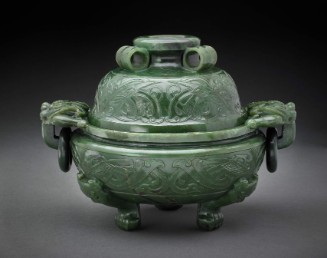
Raised on three monster mask and claw feet, well carved around the sides with three spaced foliate masks, interrupted by two horned monster mask handles suspending loose rings, the fitted, domed cover with matching decoration, encircling the hollowed ring knop with three tubular tabs, the dark green stone with typical black inclusions and white rivering.
Chinese Artist
18th-19th century
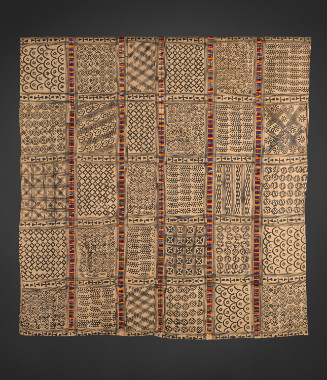
Sandy/light beige commercial cotton background with six panels with a band of embroidered threads in burgundy, black, yellow, blue, grey and green between each panel and this holds the panels together; w/black stamped Adinkra patterns done in squares which are outlined in five black lines framing these squares including: spider (ananse), unity (obi nka obie), fern (aya), spiritual cleanliness (musuyidie), circular house (fihankra), and rams' horns and other patterns.
Akan Artist
late 20th century
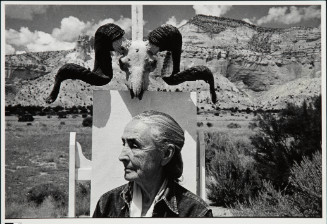
A woman, photographed from the shoulders up, stands in front of a canvas decorated with a ram’s skull. Behind her is a desert landscape.
Arnold Newman
1968, printed later
A detailed print centered on a glaring, bearded man. He is surrounded by a skull, a geometric crystal, bat wings, swirling smoke, a ram's head, an infinity loop, and large, hairy animal legs with hooves. At the top of the composition is the word "ALCHYMIA".
Oldrich Kulhánek
1989
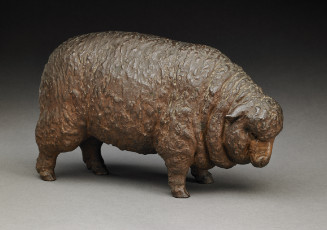
Pair of bronze sheep - one ram and one ewe
Numata Ichiga
circa 1912-1930
null