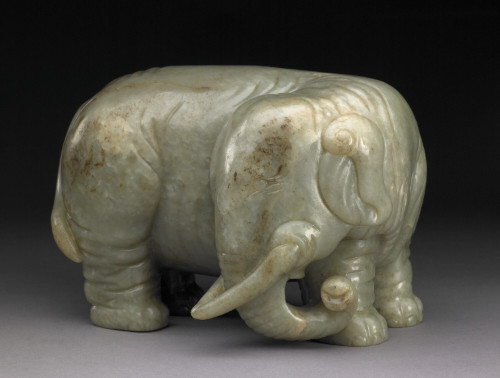
Of pale greyish-green stone, the standing elephant carved with head turned back, its trunk between its tusks meeting at the tips, its tail flicked forward on its right hind leg, its floppy ears and wrinkled skin well delineated
Elephant
Courtesy of the Harn Museum of Art, Photography by Randy Batista

Elephant

Artist Chinese Artist
DateMing dynasty (1368-1644)
Place of originChina, Asia
MediumJade
Dimensions5 3/4 x 8 1/2 x 5 5/8 in. (14.6 x 21.6 x 14.3 cm)
ClassificationsSculpture
Credit LineBequest of Dr. David A. Cofrin
Object number2009.48.113
Collections
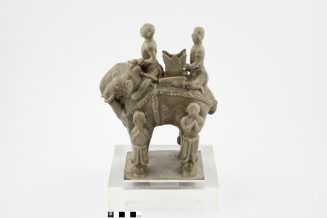
Visual DescriptionOf pale greyish-green stone, the standing elephant carved with head turned back, its trunk between its tusks meeting at the tips, its tail flicked forward on its right hind leg, its floppy ears and wrinkled skin well delineated
A grey ceramic sculpture of an elephant with tusks and carved harnesses. Two figures ride its back with a structure between them. Four more figures stand by its legs with clasped hands.
Thai, Si Satchanalai
14th-15th Century
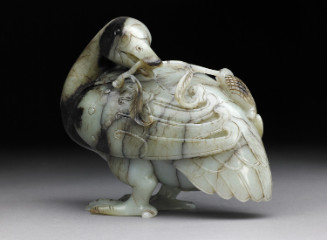
Shown standing with head turned backwards while grasping a millet stem in its beak, the wings carved with dots and curled tips, the tail feathers represented in two overlapping rows, the pale greyish-white stone with soft polish and blackish-brown staining
Chinese Artist
17th-18th century
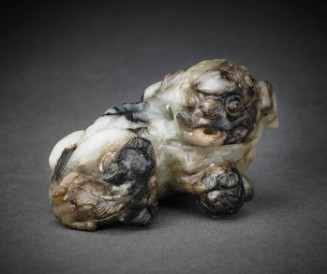
Carved as a recumbent lion, its paw resting on a brocade ball and head turned to one side, its long ears laid back flanking tufts of hair falling on either side of the ribbed backbone, opposite the tail flicked to one side, accompanied by a cub, the stone of mottled, black brown and white tones
Chinese Artist
18th-19th Century or later
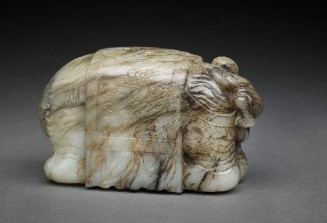
Well carved with an attendant holding a brush clinging to the rear haunches of the stocky elephant as it turns its head to the side, the blanket draped over its back decorated with fish leaping from waves below a yinyang symbol, the greyish-buff stone with dark brown veining (description taken from Christie's auction results, not donor appraisal
Chinese Artist
17th-18th century
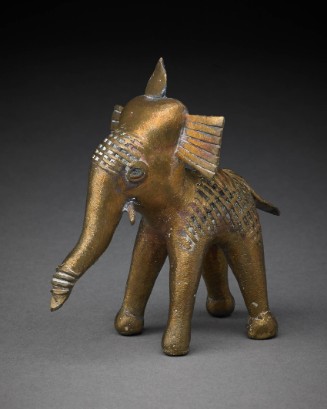
A small brass figurine of an elephant. It features textured, cross-hatched patterns on its body, large ears, and a long trunk curling downward.
Indian Artist
20th century
cleverly carved using the natural inclusions of the stone, its head turned to one side, its combed mane trailing over its ribbed back, opposite the tail flicked to one side, the underside detailed with padded paws, the stone of mottled brown, beige and white tones
Chinese Artist
Ming dynasty (1368-1644)
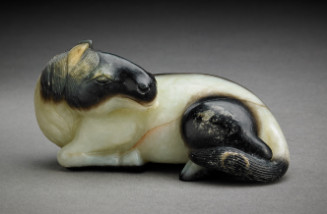
Well carved along the natural curves of the stone, the head turned towards the back, the face framed by long locks of gently incised mane, seated on its haunches with its tail swished to one side, the underside well detailed hooves, the stone of white tone with dark brown highlights
Chinese Artist
Ming dynasty (1368-1644)
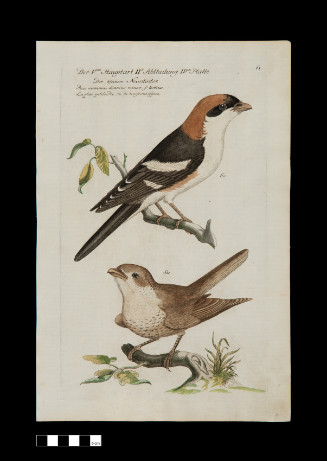
61 Der Heinere Neuntoder
Johann Leonhard Frisch
1817
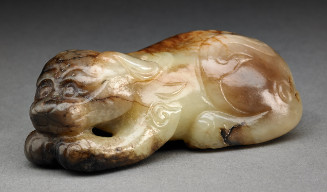
Shown in a recumbent position with head resting on its front paws and tail tucked under the body, with bulbous eyes, floppy ears, slightly knobby backbone and scrolls outlining the haunches, the stone of pale yellow, pale brown and dark brown color.
Chinese Artist
Yuan and Ming dynasty (1279-1644)
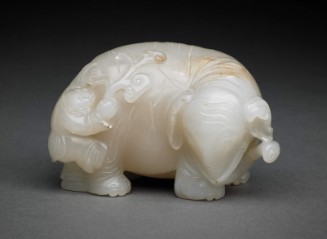
The beast well carved standing four square with the head turned to one side with a boy clambering over its back clasping a lotus sprig, the white jade with brown inclusions
Chinese Artist
Qing dynasty (1644-1911) or later
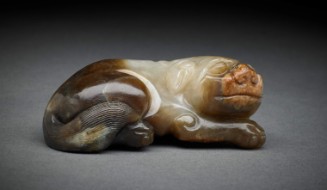
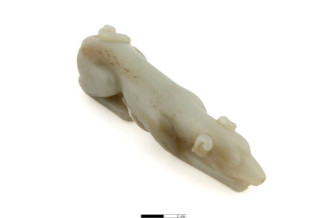
Carved as an elongated hound lying with its head resting between the out stretched front legs, the spine and folds on either side of the body articulated with delicate lines and ridges ending to the rear with a coiled tail, the underside  with well-carved details depicting the paw.
Chinese Artist
Ming dynasty (1368-1644) or earlier
null