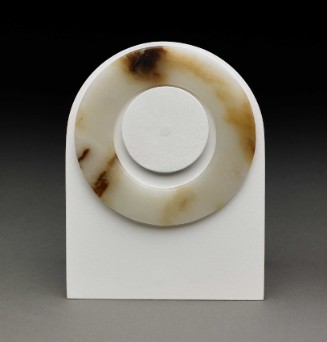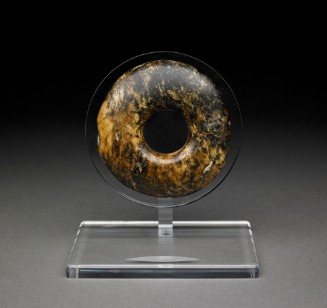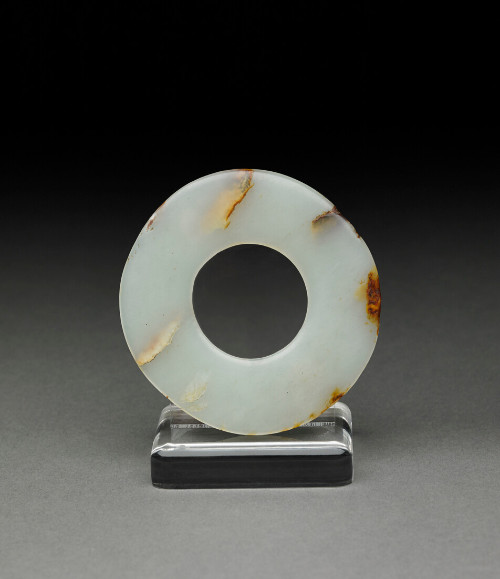
The smooth translucent stone, pierced with a circular aperture, with slightly rounded sides on both sides tapering to the inside and outside edges, the white stone with strong russet streaks
Bi
Courtesy of the Harn Museum of Art, Photography by Randy Batista

Bi

Artist Chinese Artist
DateNeolithic Period or later
Place of originChina, Asia
MediumJade
DimensionsThickness x Diameter: 1/8 x 2 3/4 in. (0.3 x 7 cm)
ClassificationsSculpture
Credit LineBequest of Dr. David A. Cofrin
Object number2009.48.136
Collections
Visual DescriptionThe smooth translucent stone, pierced with a circular aperture, with slightly rounded sides on both sides tapering to the inside and outside edges, the white stone with strong russet streaks
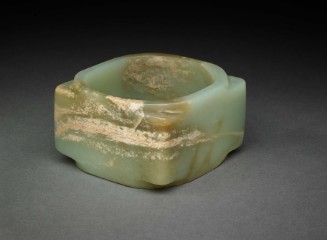
The yellowish-celadon stone well-polished and cut, of rectangular outline, the center with a circular aperture having a lip and base rising beyond the squared corners and forming a slight bevel, the stone with streaks of chalky inclusions and caramel colored patches
Chinese Artist
Zhou dynasty (1050-256 BCE)
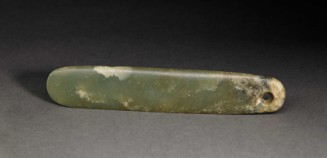
Of elongated form, slightly rounded on each side, with one end rounded opposite a pierced circular aperture, the green stone finely suffused with white in areas
Chinese Artist
Neolithic Period or later
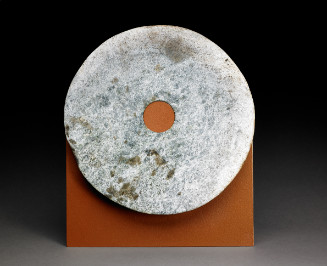
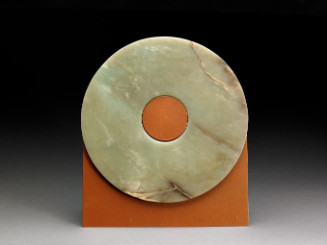
This large bi disc has been meticulously worked with a subtle concave rim rarely seen on bi discs of this size. Small circular bracelet-form jades from recent Liangzhu excavations show edges which are slightly concave in shape. This suggests an original bone-derived stylistic element. Although these wearable jades with concave edges are more frequently seen, this bi example of large size is most unusual. The surface of the bi disc is highly polished, and there has been much attention to both sha…
Chinese, Liangzhu culture
Neolithic period or later
Of flattened slightly irregular form, of uneven thickness and with a faint carving line on one side, the translucent white stone with some dark inclusions
Chinese Artist
Neolithic Period or later
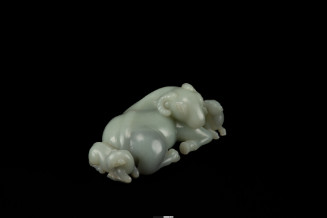
The recumbent ram finely carved in gently rounded form with its head turned to the side, flanked by two young tucked along its side, the stone of even celadon color with grey streaks
Chinese Artist
18th century or later
Disc
Chinese Artist
Neolithic Period or later
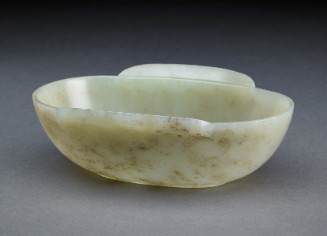
This ear cup reflects the Song period's profound interest in history in its characteristic design found in jades of the late Han period (206BC-AD220). The thinly worked oval cup has two flat handles projecting just below the rim at the longer sides, resting on an oval base with a raised foot ring. The highly translucent yellow jade possesses darker russet brown inclusions creating a desirable "skin" throughout the cup. The ear cup is of a fine, smooth polish. In our opinion, this ear cup is a fi…
Chinese Artist
Qing dynasty (1644-1911) or later
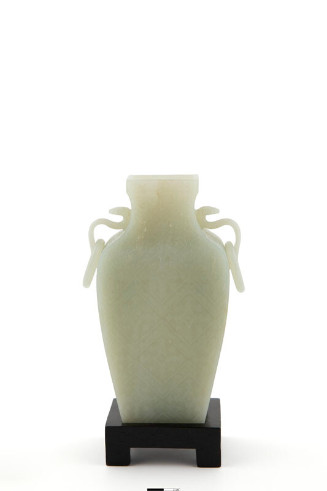
A jade vase of rectangular section, the sides gently tapering towards the slightly recessed base, the waisted neck with straight mouth rim, and worked in relief with two ruyi-sceptre handles from which loose rings are suspended. They body decorated overall in sunken relief with a geometric design of chevrons, clouds and squares. The stone a pale celadon stone. The base with an incised six-character reign mark Qianlong yu yong (for imperial use).
Chinese Artist
18th-19th century
This semi-translucent stone of soft olive-green color with opaque buff mottling and some dark brown coloring in areas that show signs of alteration from burial, the inner and outer edges well finished and the stone with a high, soft polish, some chips
Chinese Artist
Zhou Dynasty (c.1050-256 BCE) or earlier
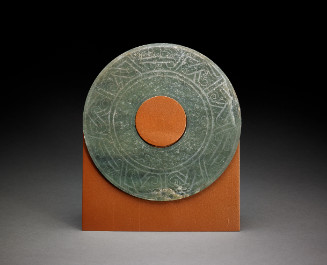
Carved from a light green jade with black inclusions, both sides of the disc are divided into two finely executed concentric decor zones. The inner band contains a grid of low relief curls within elevated hexagonal units, bordered by three "Bucraniums" that embellish the outer band. They stylized dragon forms are fluidly shaped from thick and thin incisions in a curvilinear pattern and separated by incised double brackets. Consistent with the practice of the time, cinnabar was applied to enhance…
Chinese Artist
Han Dynasty (206 BCE-220 CE)
The rounded sides flaring up from the small flat circular base, with incurved rounded lip, three chilongs in high relief clambering over the rim, their bifurcated tails trailing around the sides, the stone of mottled greenish white
Chinese Artist
Song Dynasty (960-1279) or later
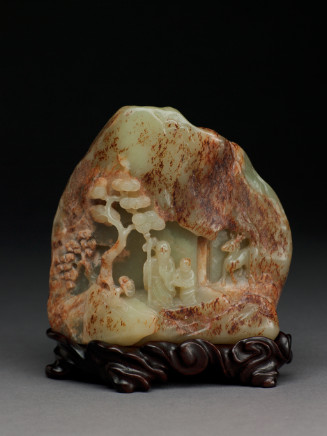
The boulder of irregular triangular shape, carved to one face with Shoulao and an attendant holding a peach, both on a path between a pine tree and lingzhi and a deer, the reverse with a boy beside a waterfall holding a peach branch opposite a peach tree and a crane, the stone of rich yellowish-green tones with extensive russet inclusions and a smooth polish
Chinese Artist
17th-18th century
null