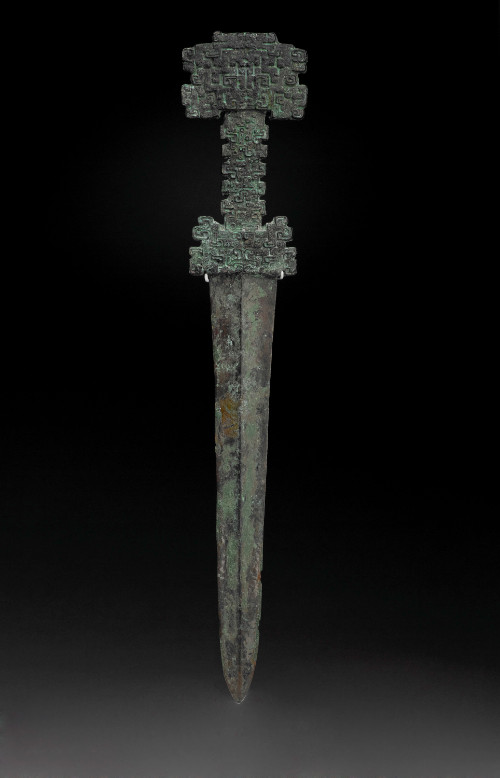
Dagger, cast in one piece, elaborately decorated hilt and pommel and a double-edged blade reinforced with a raised midrib.
Dagger
Courtesy of the Harn Museum of Art, Photography by Randy Batista

Dagger

Artist Chinese Artist
DateEastern Zhou Dynasty, Spring and Autumn Period (770-481 BCE)
Place of originChina, Asia
MediumBronze with patina
Dimensions13 7/16 x 2 1/2 in. (34.1 x 6.4 cm)
ClassificationsFurnishings and Equipment
Credit LineMuseum purchase, funds provided by the Robert H. and Kathleen M. Axline Acquisition Endowment
Object number1996.27
Collections
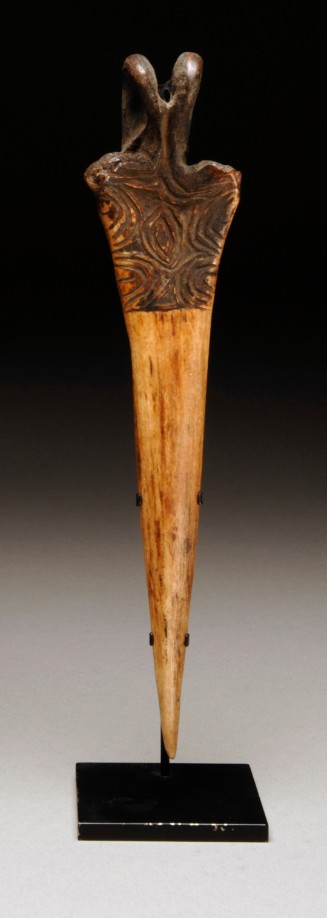
Visual DescriptionDagger, cast in one piece, elaborately decorated hilt and pommel and a double-edged blade reinforced with a raised midrib.
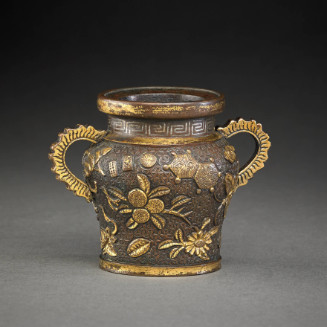
The sides cast with various auspicious emblems, flowers and fruit sprigs and a butterfly, the base with Hu Wenming mark, wear to gilding
Hu Wenming
17th century
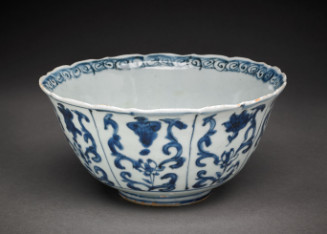
Round, deep bowl, slightly outward flaring rim, body flares inward to narrow ring foot, grey-white clay body, cobalt blue underglaze, clear gloss glaze over entire piece except base.  Inside: cavetto has diaper pattern (curl-work) border, Inner center: small branch w leaves & one fruit motif encircled w double lines.  Outside:  Body divided into 8 vertical panels--each with flower & scrolled leaves. Top center: decorated w eight treasures symbols.  Parallel lines encircle lower body & foot
Chinese Artist
Ming dynasty (1368-1644)
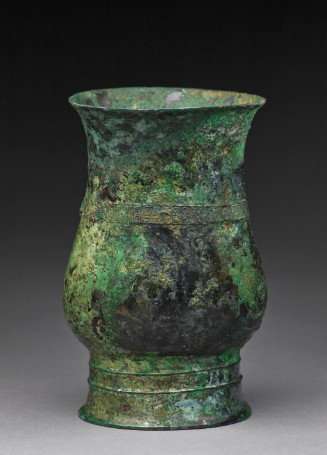
Pear-shaped body narrow scroll band in low relief at the base of the neck raised on a pedestal foot encircled by a double band, patina.
Chinese Artist
Western Zhou dynasty (c. 1050-771 BCE), 10th century BCE
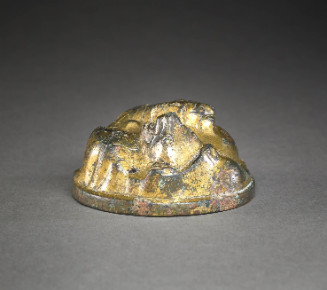
Solid bronze; cast in the shape of a bear and a tiger locked in combat; the bear is caught with open eyes and mouth; the tiger bites the bear's back with a ferocious demeanor; engraved details.
Chinese Artist
Han dynasty (206 BCE-220 CE)
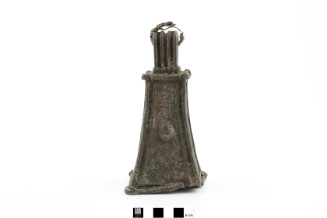
Bell with flaring square cross-section, with face, geometric designs, and loop.
Edo Artist
undated
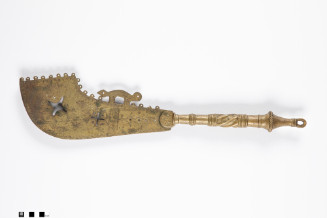
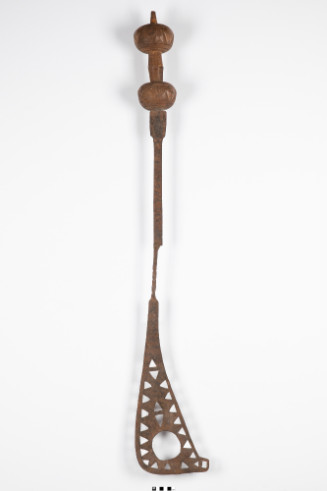
Forged curved blade with blunt end, and cast brass handle; cut out depiction of a chameleon on the inner curve, and cross cut-out in center of blade, with words engraved above: MK Balogu; Kent I of AL on one side and 23. 9 47 XX   MK Balogu AL on the opposite side. Engraved images of fish, serpents and possibly a frog, with borders of small circles. Edge of blade has rings, possible for attaching crotal bells (now missing).
Fon Artist
20th century
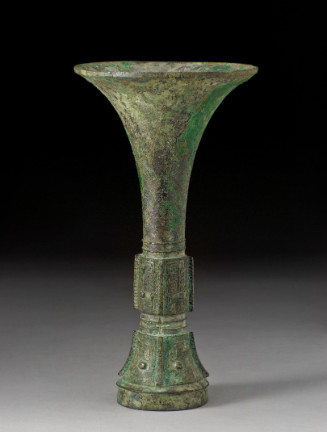
A tall, slender bronze vessel with a wide flared rim. Its narrow neck connects to a segmented midsection and splayed base, both decorated with raised geometric patterns and vertical ridges. The surface has a mottled green and brown patina.
Chinese Artist
Shang dynasty (c. 1600-1100 BCE), 12th century BCE
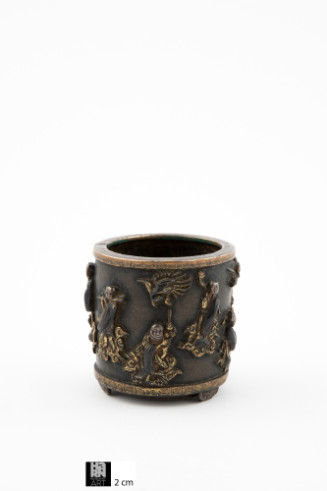
The sides of the bronze vessel decorated in high relief with the Eight Daoist Immortals, each with silver head and gilded body, with a pair of phoenixes and a pair of cranes in flight above, all reserved on a fine ring matted ground between gilt borders of key fret above and below, raised on three silver ruyi-head feet and with silver mouth rim
Chinese Artist
17th-18th century
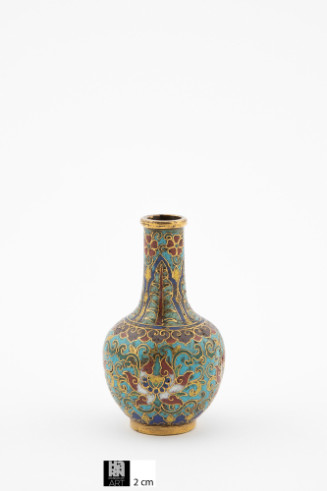
A fine cloisonné enamel vase of globular bottle form with a cylindrical neck and low gilt foot rim, decorated with ruyi-head lappets at the foot and around the shoulder; the body decorated with formalized lotus flowers, leaves and stems; the neck decorated with flowers above tall leaf-form lappets; all enameled in red, yellow, white, lapis blue, light and dark green, and aubergine on a turquoise ground.
Chinese Artist
18th Century
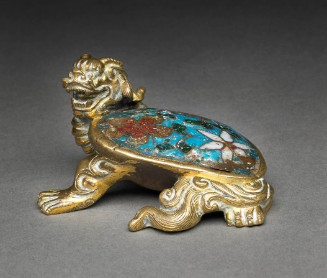
Heavily and finely cast as a three-legged bixi, a mythological dragon-tortoise with dragon-like head with forked antlers and bushy tail, the carapace inlaid with a cloisonné enamel fragment of 16th century date decorated with thee flower heads and green leafy tendrils reserved on a turquoise-blue ground
Chinese Artist
17th - 18th Century
null