Pig Dragon
Pig Dragon
Courtesy of the Harn Museum of Art, Photography by Randy Batista

Pig Dragon

Artist Chinese Artist
DateNeolithic period, c. 3500-3000 BCE or later
Place of originChina, Asia
MediumJade
Dimensions2 5/16 x 3/4 x 1 7/8 in. (5.9 x 1.9 x 4.8 cm)
ClassificationsClothing and accessories
Credit LineBequest of Dr. David A. Cofrin
Object number2009.48.278
Collections
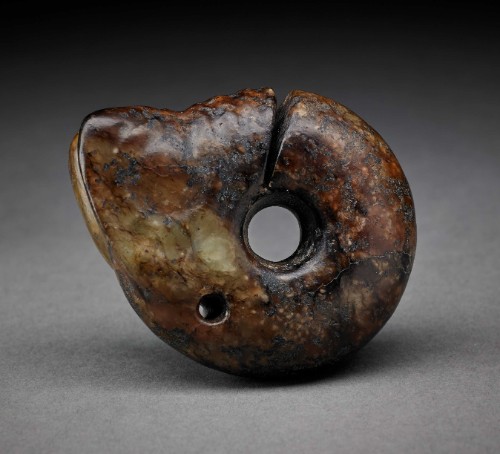
Visual DescriptionThis zhulong is of mottled brown-green jade which is consistent with archaeological excavations of Hongshan sites. Its thick, feline-like body is curled into a tubular circular form. The head is distinguished by two large circular eyes framed by key-hole shaped open loops. Its flat snout and forehead are characterized by grooves of short line which represent wrinkles. The tail sweeps around to almost meet the mouth. At the back of the head, a biconically-bored hole is drilled from both sides to hang the pendant. The piece has an overall soft, rounded polish. (Bernstein appraisal)
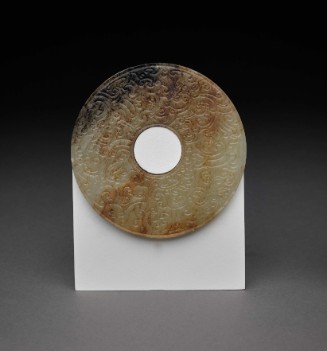
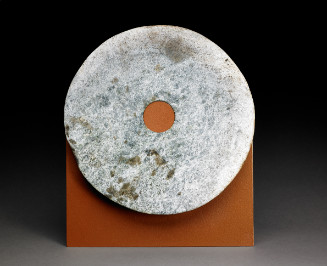
This large bi disc has been meticulously worked with a subtle concave rim rarely seen on bi discs of this size. Small circular bracelet-form jades from recent Liangzhu excavations show edges which are slightly concave in shape. This suggests an original bone-derived stylistic element. Although these wearable jades with concave edges are more frequently seen, this bi example of large size is most unusual. The surface of the bi disc is highly polished, and there has been much attention to both sha…
Chinese, Liangzhu culture
Neolithic period or later
Disc with Cloud Pattern
Chinese Artist
Eastern Zhou dynasty (770-256 BCE)
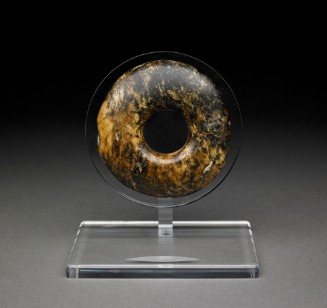
Disc
Chinese Artist
Neolithic Period or later
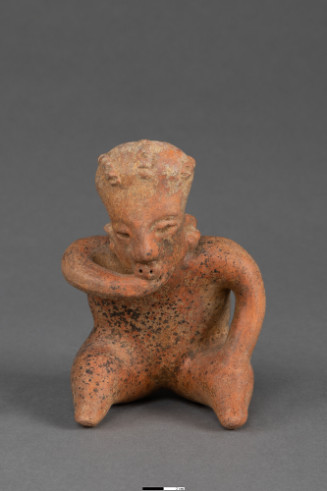
A speckled reddish-brown clay figurine of a seated figure. Its right arm is raised to its mouth, which has two small holes. The left arm rests downward. The head features slit eyes and small curled bumps on top.
West Mexican Artist
undated
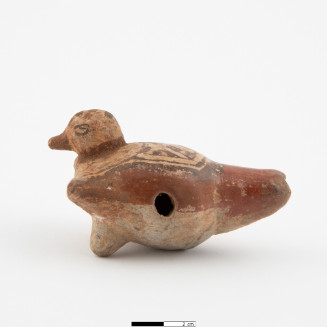
A bird-shaped clay whistle with a rounded body, straight tail, and short front legs. It features reddish-brown painted sections, dark geometric patterns on its tan back, a simple painted eye, and a prominent circular hole on its side.
Costa Rican Artist
c. 1200 - 1550
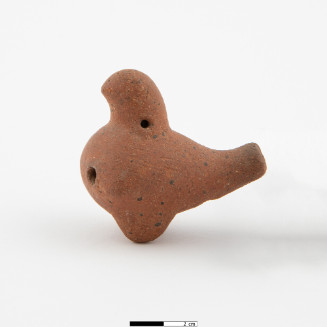
A speckled, reddish-brown clay whistle shaped like a bird. It has a rounded body, smooth head, projecting straight tail, and rests on a short, pointed base. Small circular holes are pierced through its chest and upper side.
Costa Rican Artist
undated
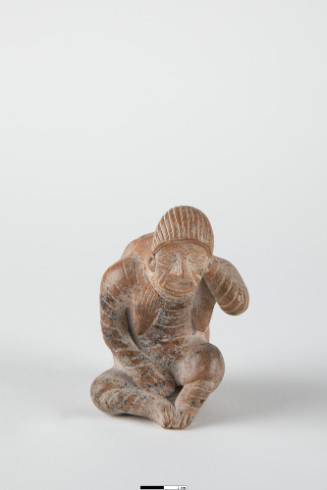
Seated figure of old woman, legs circled in front with feet touching left hand in lap, right hand up behind, hunch backed with spine and ribs distinct; pendulous breasts; body and face covered in inscribed lines symbolizing wrinkles; figure wearing skirt.
Totonac Artist
100 BCE-100 CE
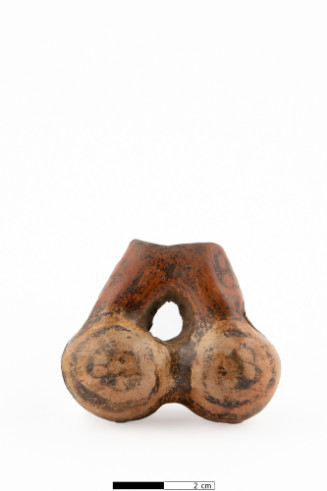
A ceramic whistle featuring two bulbous, tan lower lobes and reddish-brown arms that angle upward to meet at a single top opening, leaving a central hole. Dark brown painted circular designs decorate the lower lobes.
Panamanian
undated
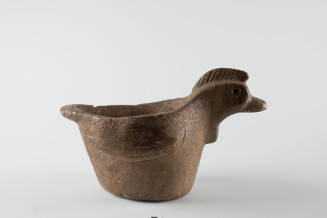
Stone bowl, flat bottom, circular, with walls sloping slightly outwards, effigy form of duck with crescent extension on rear rim for tail, raised panels shaped as wings wrap around upper side, head extending from front with rounded beak, drilled eye-holes, feather crest on head; carved lines delineating wings and tail, circling eyes, feather ridge, mouth opening.
Mississippian Artist
1000-1300
Monochrome print focusing on a tall, ornate stone lantern with Japanese characters carved into its cylindrical base. Behind it stands a traditional building characterized by a detailed tiled roof, grid-patterned windows, and a low wooden fence.
Ted Colyer
1977
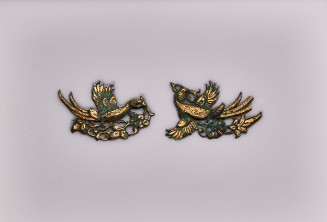
Long-tailed bird in flight; holding leafy branch from it's beak which trails underneath it's body; the design is punched from the ungilt reverse side.
Chinese Artist
Tang Dynasty (618-907), 8th century
Long-tailed bird in flight; holding leafy branch from it's beak which trails underneath it's body; the design is punched from the ungilt reverse side.
Chinese Artist
Tang Dynasty (618-907), 8th century
null