A woven silver basket with separate metal insert, with maker's seal on bottom.
Woven Flower Basket
Courtesy of the Harn Museum of Art, Photography by Randy Batista

Woven Flower Basket

Maker Japanese Artist
DateMeiji or Taisho periods, c. 1900-1925
Place of originJapan, Asia
MediumSilver
ClassificationsFurnishings and Equipment
Credit LineMuseum purchase, funds provided by the Robert H. and Kathleen M. Axline Acquisition Endowment
Object number2005.7a
Collections
Visual DescriptionA woven silver basket with separate metal insert, with maker's seal on bottom.
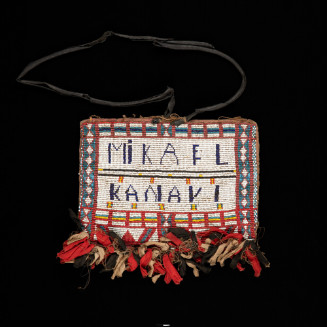
One beadwork rectangle, backed with printed cloth mounted on flexible material. Has rubber band attached to top for support. Black, red, white fringe at bottom. Beadwork consists of geometric frame of red, white, blue, yellow beads surrounding white field in which is spelled "Mikael Kanaki" in purple beads- believed to be maker's name.
Papua New Guinea
undated
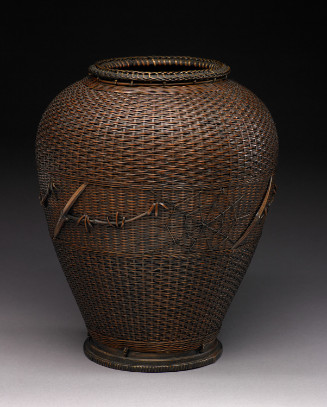
Urn-shaped bamboo flower basket, mat and complex mat plaiting, central band decorated with cobweb and bamboo designs. Karamono (Chinese style).
Japanese Artist
Taisho and Showa Period (1912-1989)
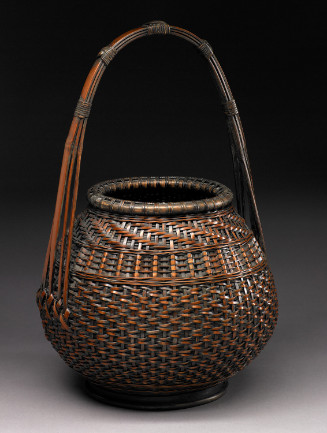
Globular shaped basket with multi-slat handle, rich sienna-colored bamboo, lightly sooted and woven in five different weaves
Japanese Artist
Taisho and Showa Period (1912-1989)
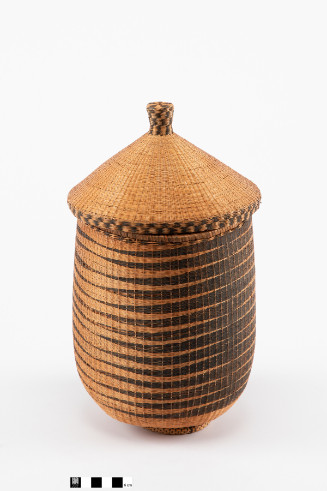
Basket with rounded bottom and conical lid, strips of cane used for substructure and fine overlaid weaving of natural and dark brown dyed grass. The body of the basket has a dark brown pattern of a double row of 14 triangles, and the lid has a checkboard pattern in the same natural dark brown dyed coloration on the rim and the cylindrical knob top.
Tutsi Artist
20th century
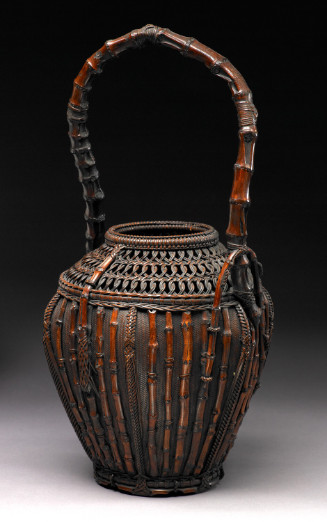
A karamono style bamboo basket of hexagonal form with seven jewel design at neck, curved bamboo segment handle and intricate knots.
Japanese Artist
Meiji period (1868-1912)
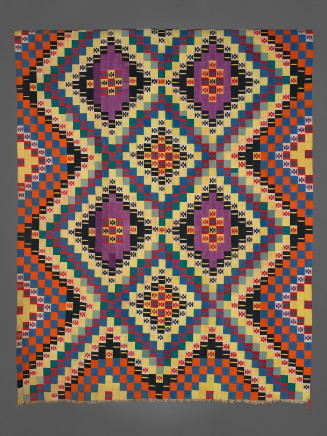
handwoven narrow strips of cotton, commercial cotton warp (?) handstitched together, weft-faced squares, polychrome (white, black, red, blue, lavender, pale green, blue yellow) form stepped diamond pattern, woven inserts in center of some squares
Bamana Artist
20th century
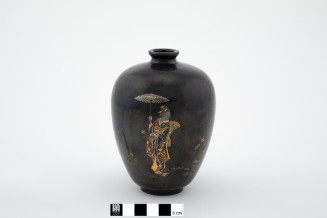
With an ovoid body finely worked in flat inlay (hon-zogan) in gold, silver, copper, shibuichi and shakudo with a bijin standing holding a parasol
Japanese Artist
c. 1900
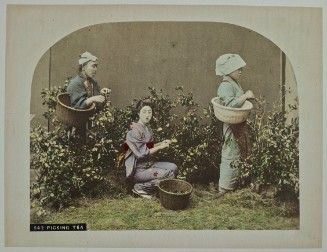
Three people in robes, a man and two women, gather from low green bushes. Two standing figures wear head coverings and carry woven baskets. A central kneeling woman places leaves into a ground basket. The photograph has an arched top.
Japanese Artist
late 19th century
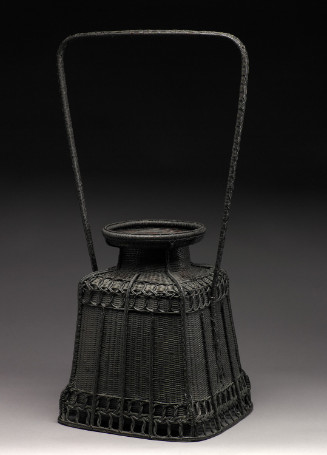
Flying Cranes Antiques: Rare ikebana basket of unusual form. Reminiscent of ancient bronze vessels, it has an elegant, tall and removable trapezodial handle sculpted with geometric wrapping. The flared skirt and neck are woven closely with thin strips of sooted bamboo, elaborate wraps and unique knots in the form of shrimp bordering the lower four sides at the base. Original kiriwood tombako signed "Made by Chikuyuusai I, karamono utsushi with handle, Tokugawa Family."
Chikuyuusai I
c. 1910-1920
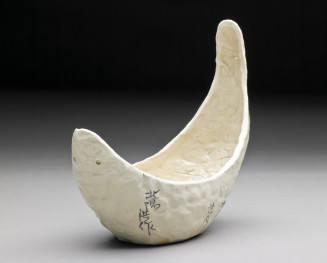
Milky white-glazed ceramic mimicking the shape of a crescent moon–shaped basket with calligraphic inscriptions on two sides.
Otagaki Rengetsu 太田垣蓮月
c. 1870
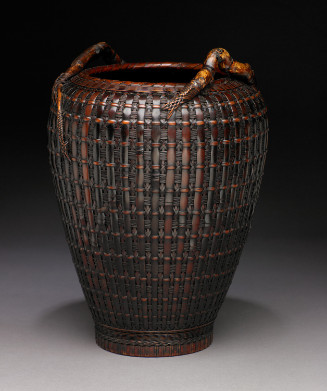
Of ovoid form in modified lozenge plaiting, with two low handles of bamboo root attached to the lip with insect wrapping and intricate knots, shoots from the rhizome descending from one handle and woven into the body of the basket on the shoulder, signed Chikushunsai.
Chikushunsai
undated
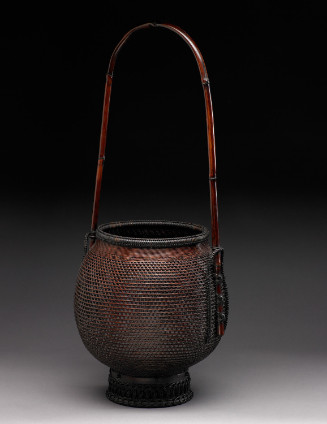
A large spherical basket with overall hexagonal plaiting woven in a swirling pattern over teh body. Set off by a stately pedestal base elaborately knotted, its tall rounded bamboo handle risews from arched supports of insect stitching along the side. Gengensai Zo signature, with original tomobako
Suzuki Gengensai
Taisho period (1868-1926), 1920s
null