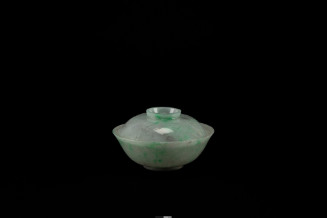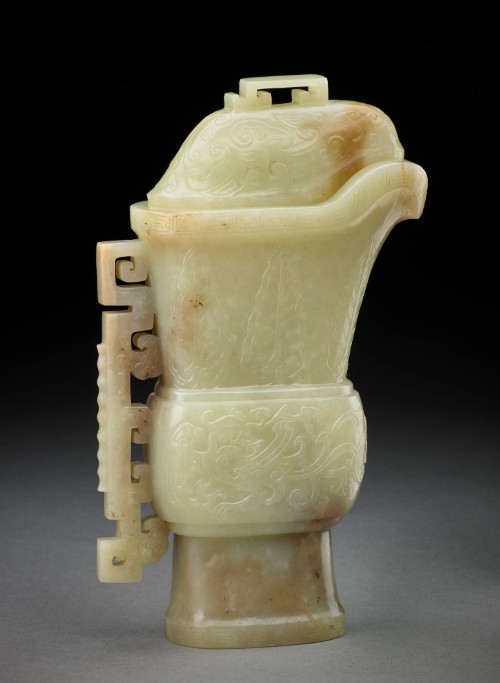
Small braise to cover, polished chip to edge of knop
Pouring Vessel and Cover
Courtesy of the Harn Museum of Art, Photography by Randy Batista

Pouring Vessel and Cover

Artist Chinese Artist
DateQing dynasty (1644 - 1911), 18th-19th century
Place of originChina
MediumJade
Dimensions7 9/16 x 4 7/16 x 1 3/4 in. (19.2 x 11.3 x 4.4 cm)
ClassificationsSculpture
Credit LineBequest of Dr. David A. Cofrin
Object number2009.48.204
Collections
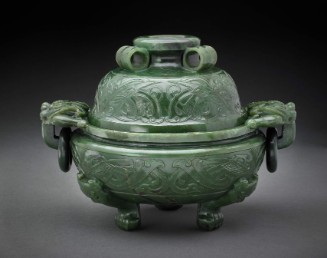
Visual DescriptionSmall braise to cover, polished chip to edge of knop
Raised on three monster mask and claw feet, well carved around the sides with three spaced foliate masks, interrupted by two horned monster mask handles suspending loose rings, the fitted, domed cover with matching decoration, encircling the hollowed ring knop with three tubular tabs, the dark green stone with typical black inclusions and white rivering.
Chinese Artist
18th-19th century
Bowl and Cover
Chinese Artist
late 19th- early 20th century
A Mughal-style vase and cover carved from celadon green nephrite with lighter inclusions. The vase is carved in an unusual flattened and fluted form that is elliptical in cross-section. Either side of the vase is carved with three leafy acanthus scrolls and hanging loose rings. The long flaring neck is carved on either side
Chinese Artist
19th century or later
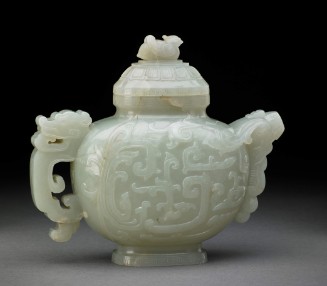
Of oval section, carved overall in low relief with bands of archaistic kuei dragons and keyfret, flanked by the thick handle and spout further carved as archaistic kuei, the domed cover decorated with pendant leaves surmounted by a quail-form knop, one body fissure
Chinese Artist
Qing dynasty (1644 -1911), 18th century
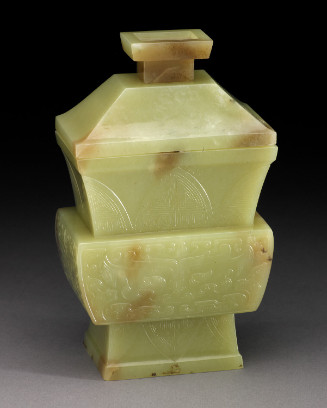
Of fang-gu form, the central section, well carved on each rounded side with a taotie mask, between leaf tip blades infilled with dense geometric motifs, the fitted, angled cover with rectangular knop, the stone of greenish yellow with splashes of taupe
Chinese Artist
Qing dynasty (1644 - 1911), 18th century
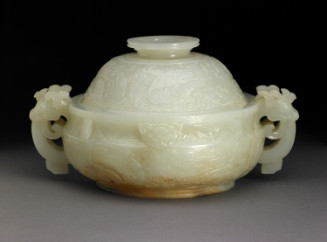
The bowl carved in archaistic style on each side with broad taotie masks on a leiwen ground, divided by dragon heads issuing loop handles, the domed cover with matching motif below a stepped knop, the thick white stone with a pale cloudy amber patch in the interior of the bowl
Chinese Artist
Qing dynasty (1644 -1911), 18th century
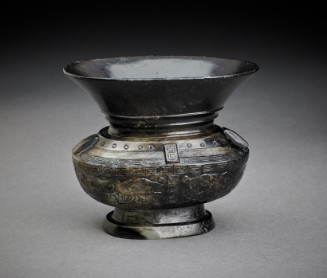
Of compressed zun form, the sides carved in shallow relief with two pairs of confronted dragons contained within keyfret borders, below four raised keyfret-incised flanges which divide the shoulder and interrupt a band of dots above, the widely flared neck encircled by two bowstring bands and carved on the interior with three grooved lines, intentionally altered to a blackish color with areas of the pale gray stone showing through, minor rim chips.
Chinese Artist
Song dynasty (960-1279)
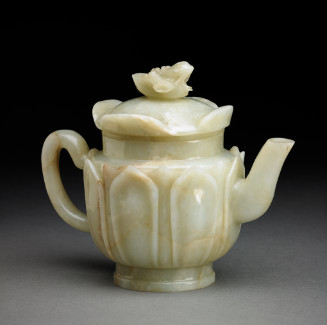
Of tapering globular shape, carved with two layers of eight lotus petals rising from the shallow, pedestal foot, with angular spout, curved handle and plain, straight-cut neck rising from the rounded shoulder, the cover carved as a lotus pad with a four up-turned leaves centered by a mandarin duck holding a lotus spray in its beak, some russet flaws and pale inclusions
Chinese Artist
Ming dynasty (1368-1644)
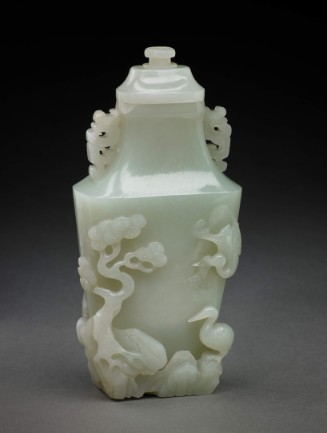
Well carved around the sides with a pine tree growing from the rocks that form the base and with five cranes, four grasping auspicious sprigs in their beaks, including prunus, lingzhi fungus, peach and bamboo, with archaistic bird scroll handles, the cover with rope-twist finial, the well-polished stone of pale greenish-white color
Chinese Artist
Qing Dynasty (1644 - 1911), 18th century
Jade Prism (Cong) 玉琮
Chinese Artist
Zhou dynasty (1050–256 BCE) or later
Disc
Chinese Artist
Neolithic Period or later
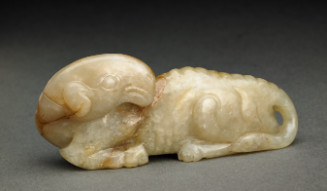
The recumbent beast with head turned over its back, the face delicately carved and the fur markings simply delineating the body with light ribs and softly polished vertebrae
Chinese Artist
possibly Song Dynasty (960-1279)
null