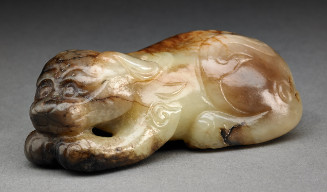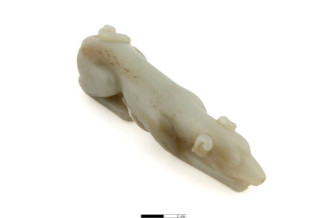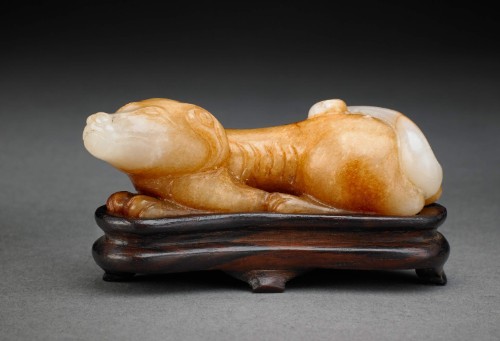
Well carved in a recumbent position with head raised above the front paws and long tail curled atop the back, the softly polished whit stone with extensive russet staining of varying intensity
Hound
Courtesy of the Harn Museum of Art, Photography by Randy Batista

Hound

Artist Chinese Artist
Date17th-18th century or later
Place of originChina
MediumNephrite
Dimensions1 x 2 11/16 x 1 3/16 in. (2.5 x 6.8 x 3 cm)
ClassificationsSculpture
Credit LineBequest of Dr. David A. Cofrin
Object number2009.48.237
Collections
Visual DescriptionWell carved in a recumbent position with head raised above the front paws and long tail curled atop the back, the softly polished whit stone with extensive russet staining of varying intensity
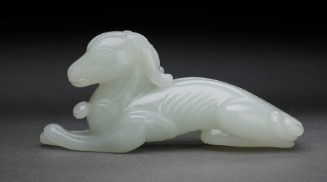
The graceful greyhound shown in a recumbent position with forepaws crossed and back legs tucked beneath the body, with long ears and coiled tail, one end of the long, bell-hung ribbon tied around the arched neck trailing beneath the belly, the slender body carved with pronounced ribs and backbone, the stone well polished and of even white tone.
Chinese Artist
Qing dynasty (1644-1911), 18th-19th century
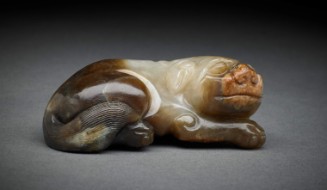
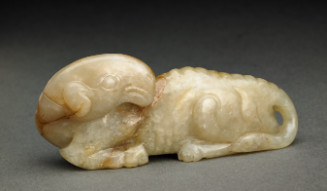
Shown in a recumbent position with head resting on its front paws and tail tucked under the body, with bulbous eyes, floppy ears, slightly knobby backbone and scrolls outlining the haunches, the stone of pale yellow, pale brown and dark brown color.
Chinese Artist
Yuan and Ming dynasty (1279-1644)
cleverly carved using the natural inclusions of the stone, its head turned to one side, its combed mane trailing over its ribbed back, opposite the tail flicked to one side, the underside detailed with padded paws, the stone of mottled brown, beige and white tones
Chinese Artist
Ming dynasty (1368-1644)
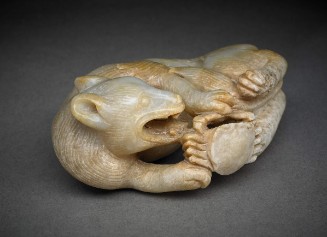
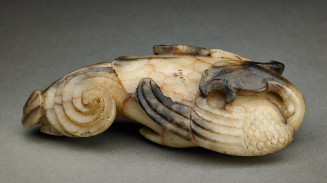
Lying in a playful coiled position with tail tucked between his hind legs tossing a crab with his paws, the bear's mouth open but wary of the crab's claws
Chinese Artist
Qing dynasty (1644 -1911)
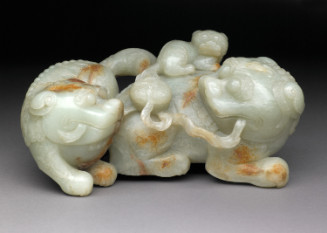
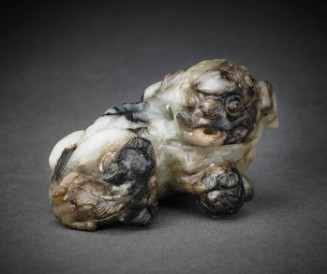
The massive stone well carved as a pair of recumbent fu lions turned to face each other, a beribboned brocade ball trailing from one of the lion's closed jaws, the 'snail' curled mane trailing over each lion's back to meet the bushy tails, one small cub poised on the back, the underside detailed with clawed feet, the stone of celadon tone with patches of russet highlights
Chinese Artist
17th-18th century
Shown with head arched back and resting on its body, some small chips to wings and tail feathers
Chinese Artist
Song and Ming dynasty (960-1644)
Carved as an elongated hound lying with its head resting between the out stretched front legs, the spine and folds on either side of the body articulated with delicate lines and ridges ending to the rear with a coiled tail, the underside  with well-carved details depicting the paw.
Chinese Artist
Ming dynasty (1368-1644) or earlier
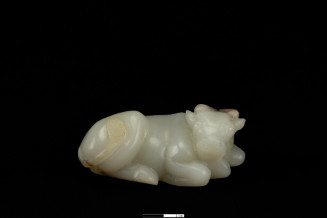
Buffalo carved in a recumbent position with its forelegs tucked underneath and tail coiled to the front, with incised lines to depict details on the horns, tail and hooves, the stone of even white tone with areas of russet and black speckling highlighting the carving
Chinese Artist
18th century
Carved as a recumbent lion, its paw resting on a brocade ball and head turned to one side, its long ears laid back flanking tufts of hair falling on either side of the ribbed backbone, opposite the tail flicked to one side, accompanied by a cub, the stone of mottled, black brown and white tones
Chinese Artist
18th-19th Century or later
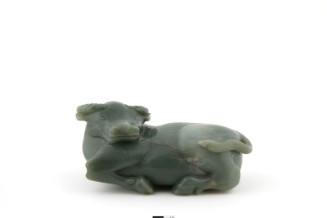
With the hind legs and front left leg folded under the body, and the right front leg flexed as the creature prepares to rise, the tail colored around to rest on the left haunch, the belly and neck faintly ribbed to indicate folds, the head facing forward with well-defined horns above ears delineated with fine incising, the greenish-gray stone with pale mottling.
Chinese Artist
Qing dynasty (1644 -1911)
The thick stone well carved as a recumbent buffalo following the form of the boulder, the legs ticked beneath the body, the head turned to tone side, with broad snout and large curled horns, opposite the tail flicked to one side, the grayish green stone infused with a patch of white, small chip
Chinese Artist
19th-20th century
The recumbent beast with head turned over its back, the face delicately carved and the fur markings simply delineating the body with light ribs and softly polished vertebrae
Chinese Artist
possibly Song Dynasty (960-1279)
null