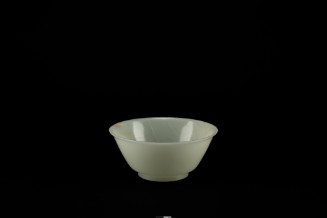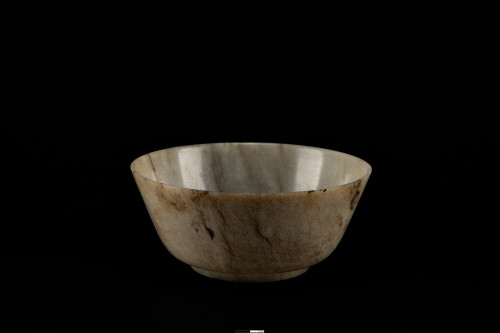
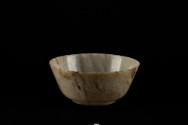
Well carved bowl with slightly flaring sides rising from a shallow foot ring, the stone of pale greyish-white tone with opaque white flecks and pale brown mottling and veining throughout, softly and evenly polished.
Bowl
Courtesy of the Harn Museum of Art, Photography by Foad Seyed Mohammadi

Bowl

Artist Chinese Artist
Date17th-18th century
Place of originChina
MediumJade
DimensionsHeight x Diameter: 3 1/16 x 7 1/16 in. (7.8 x 17.9 cm)
ClassificationsFurnishings and Equipment
Credit LineBequest of Dr. David A. Cofrin
Object number2009.48.239
Collections
Visual DescriptionWell carved bowl with slightly flaring sides rising from a shallow foot ring, the stone of pale greyish-white tone with opaque white flecks and pale brown mottling and veining throughout, softly and evenly polished.
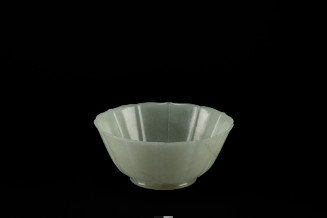
Bowl of deep rounded form, the lobed sides well carved as six elongated petals rising from the shallow, flaring foot to the barbed rim, the semi-translucent stone of pale celadon tone.
Chinese Artist
Qing Dynasty (1644 - 1911), 18th century
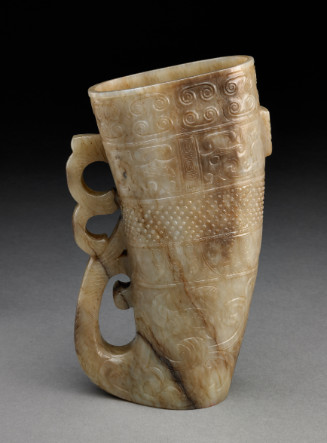
The well hollowed vessel carved in shallow relief with four bands of archaistic designs, including confronted C-scrolls, taotie masks separated by a taotie mask carved in high relief, bosses and mask-filled blades, all divided by rope twist borders and positioned above a phoenix and a dragon confronted on a vertical, keyfret band with a scrolling bird-like tail rising off center up one side from a pattern of intertwined swirls carved in a flat base, the stone of pale grayish brown color suffused…
Chinese Artist
Ming dynasty (1368-1644)
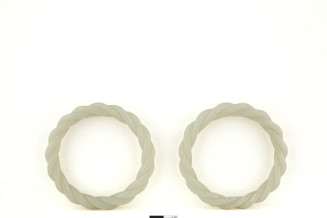
Pair of Rope-Twist Bangles
Chinese Artist
Ming dynasty (1368-1644) or Qing Dynasty (1644-1911), 17th century
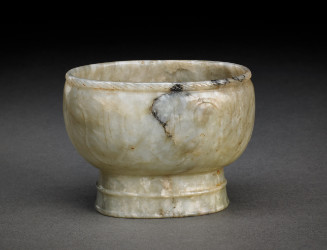
The deep, rounded sides carved on the exterior in shallow relief with a petal frieze pendant from a narrow rope-twist border at the rim, each petal incised with three vertical striations, the whole raised on a tall oval foot encircled by a bowstring band and with a raised border at the foot rim, the softly polished, semi-translucent stone of mottled grayish color
Chinese Artist
Song and Yuan dynasty (960-1368)
Bowl with steep sides rising from the angled beveled foot ring to the slightly flared lip, the underside inscribed with a Qianlong nian zhi mark, the base of the foot ring inscribed with a jia character, the muted white stone with discolored fissures.
Chinese Artist
Qing dynasty (1644-1911), Qianlong period (1736-1795)
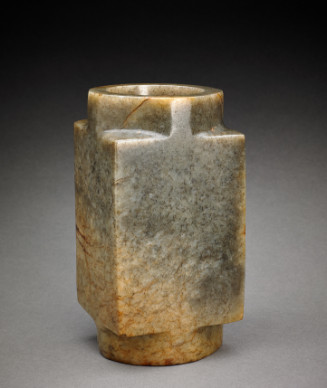
The semi-translucent stone of rich, dark olive-green color with brown mottling and veining, with areas of yellowish-buff color emanating from some of the veins and some opaque alteration from burial, carved as a rectangular block enclosing a cylindrical tube extending beyond the triangular shoulders at either end to form a collar, with a smooth satiny polish, some encrustation
Chinese Artist
Western Zhou dynasty (c. 1050-771 BCE)
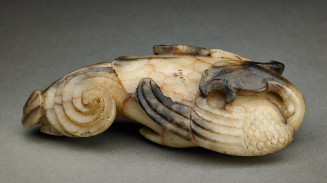
Shown with head arched back and resting on its body, some small chips to wings and tail feathers
Chinese Artist
Song and Ming dynasty (960-1644)
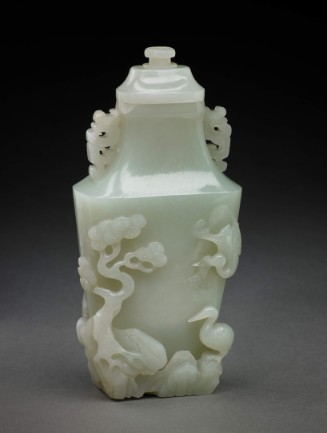
Well carved around the sides with a pine tree growing from the rocks that form the base and with five cranes, four grasping auspicious sprigs in their beaks, including prunus, lingzhi fungus, peach and bamboo, with archaistic bird scroll handles, the cover with rope-twist finial, the well-polished stone of pale greenish-white color
Chinese Artist
Qing Dynasty (1644 - 1911), 18th century
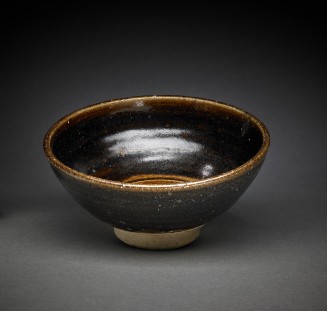
A shallow, wide ceramic bowl with a dark, glossy brown glaze speckled with lighter tan flecks. It rests on a small, unglazed foot.
Vietnamese
Tran dynasty (1225-1400)
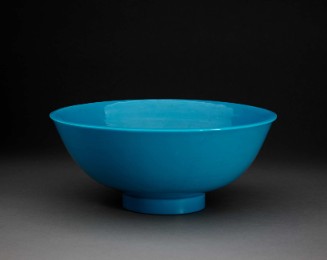
The deep bowl with thick sides flaring widely toward the everted rim, raised on a thick ring foot, the metal of opaque swirled turquoise color, the underside inscribed with four character mark within a double square, tiny polished rim chip, minor pitting
Chinese Artist
Qianlong Period (1736-1795)
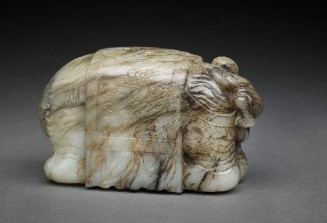
Well carved with an attendant holding a brush clinging to the rear haunches of the stocky elephant as it turns its head to the side, the blanket draped over its back decorated with fish leaping from waves below a yinyang symbol, the greyish-buff stone with dark brown veining (description taken from Christie's auction results, not donor appraisal
Chinese Artist
17th-18th century
Of patra form, well carved with thick walls flaring from the flat foot ring to the high rounded shoulder, the four dark grey areas of the stone spaced vertically around the sides, Qianlong four-character seal mark inscribed on the base
Chinese Artist
17th-18th century
null