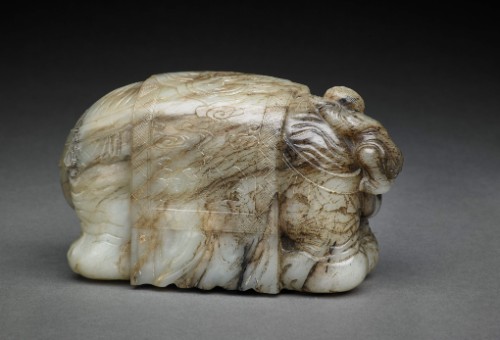
Well carved with an attendant holding a brush clinging to the rear haunches of the stocky elephant as it turns its head to the side, the blanket draped over its back decorated with fish leaping from waves below a yinyang symbol, the greyish-buff stone with dark brown veining (description taken from Christie's auction results, not donor appraisal
Elephant
Courtesy of the Harn Museum of Art, Photography by Randy Batista

Elephant

Artist Chinese Artist
Date17th-18th century
Place of originChina, Asia
MediumJade
Dimensions2 3/4 x 4 5/8 x 2 in. (7 x 11.7 x 5.1 cm)
ClassificationsSculpture
Credit LineBequest of Dr. David A. Cofrin
Object number2009.48.16
Collections
Visual DescriptionWell carved with an attendant holding a brush clinging to the rear haunches of the stocky elephant as it turns its head to the side, the blanket draped over its back decorated with fish leaping from waves below a yinyang symbol, the greyish-buff stone with dark brown veining (description taken from Christie's auction results, not donor appraisal
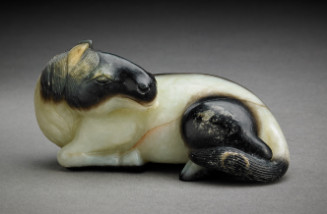
Well carved along the natural curves of the stone, the head turned towards the back, the face framed by long locks of gently incised mane, seated on its haunches with its tail swished to one side, the underside well detailed hooves, the stone of white tone with dark brown highlights
Chinese Artist
Ming dynasty (1368-1644)
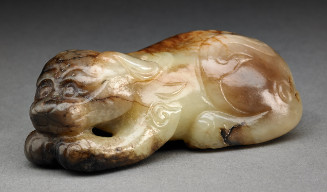
Shown in a recumbent position with head resting on its front paws and tail tucked under the body, with bulbous eyes, floppy ears, slightly knobby backbone and scrolls outlining the haunches, the stone of pale yellow, pale brown and dark brown color.
Chinese Artist
Yuan and Ming dynasty (1279-1644)
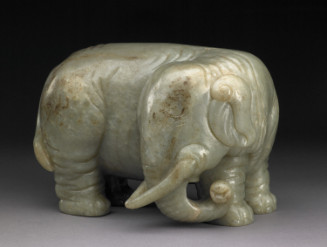
Of pale greyish-green stone, the standing elephant carved with head turned back, its trunk between its tusks meeting at the tips, its tail flicked forward on its right hind leg, its floppy ears and wrinkled skin well delineated
Chinese Artist
Ming dynasty (1368-1644)
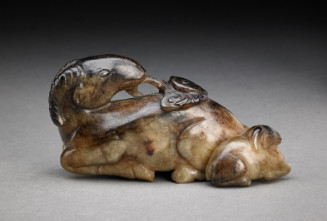
cleverly using the natural inclusions to depict a large recumbent horned ram, its head turned to one side and spewing forth a cloud vapor and yinyang medallion, accompanied by two young rams.
Chinese Artist
Ming dynasty (1368-1644)
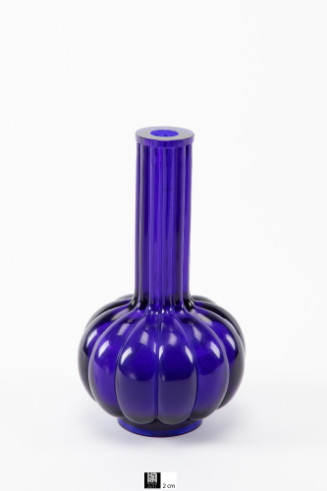
The bottle vase is exquisitely carved with twelve rounded lobes forming the globular lower body, continuing up the tall neck, surmounted by a disc-shaped mouth rim, all raised on a circular ring foot, the transparent glass of a deep sapphire-blue tone
Chinese Artist
Qing Dynasty (1644-1911), Qianlong period (1736-1795)
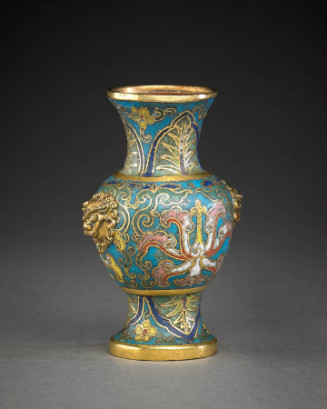
A fine miniature cloisonné enamel vase of baluster form, the rounded body set with two high relief gilt-bronze mask handles and decorated with lotus flowers and leaves, the tall flared foot decorated with flower heads and leaf lappets, the tall flared neck similarly decorated. All enameled in red, yellow, white, light and dark green, pink, and lapis blue on a turquoise blue ground.
Chinese Artist
18th Century
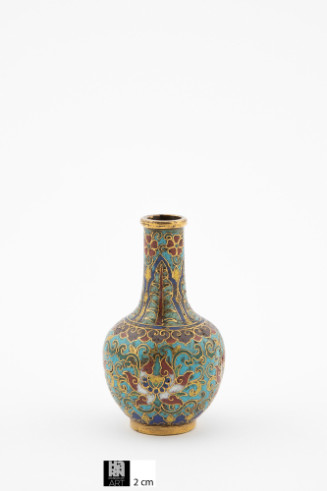
A fine cloisonné enamel vase of globular bottle form with a cylindrical neck and low gilt foot rim, decorated with ruyi-head lappets at the foot and around the shoulder; the body decorated with formalized lotus flowers, leaves and stems; the neck decorated with flowers above tall leaf-form lappets; all enameled in red, yellow, white, lapis blue, light and dark green, and aubergine on a turquoise ground.
Chinese Artist
18th Century
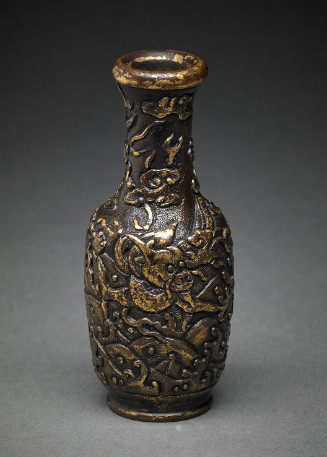
A fine and rare cast and chased parcel-gilt bronze incense tool vase, supported on a low foot rim, the body and slender neck decorate din gilded low relief with dragon amid clouds above a carp swimming amidst crested waves on a ring-punched ground. The underside of the recessed foot with a chiseled four-character mark in rounded seal script hu wen ming zhi (made by Hu Wenming) in a square gilded reserve.
Hu Wenming
17th century
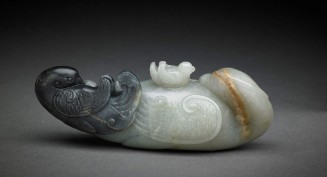
Carved as a large recumbent phoenix with a small phoenix perched in its back and another phoenix at its rear carved from a dark blackish-grey section of the stone
Chinese Artist
18th century
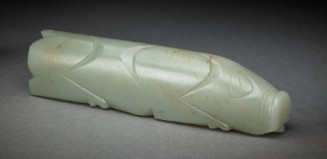
The crouching animal carved with deep slashes to the flat snout, haunches, eyes and tail, the stone of pale celadon tone with russet rivering
Chinese Artist
Han dynasty (206 BCE-220 CE)
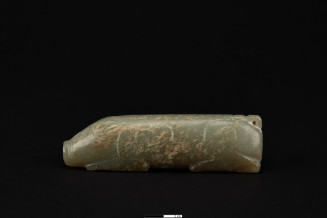
The slender crouching animal carved with deep slashes for the flat snout, haunches, ears and upturned tail, the tail and snout pierced with a hole for attachment, the stone of pale celadon color with areas of calcification
Chinese Artist
Han dynasty (206 BCE-220 CE)
null