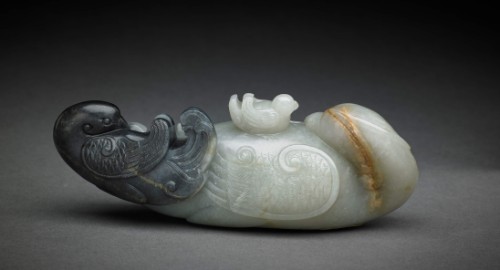
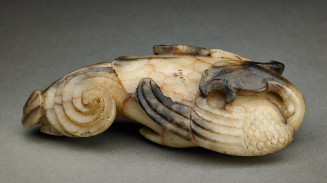
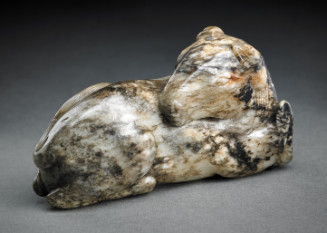
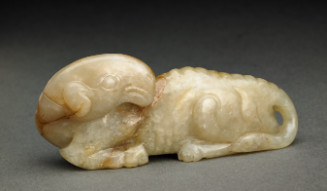
Carved as a large recumbent phoenix with a small phoenix perched in its back and another phoenix at its rear carved from a dark blackish-grey section of the stone
Phoenix Group
Courtesy of the Harn Museum of Art, Photography by Randy Batista

Phoenix Group

Artist Chinese Artist
Date18th century
Place of originChina, Asia
MediumJade
Dimensions2 x 5 x 1 5/8 in. (5.1 x 12.7 x 4.1 cm)
ClassificationsSculpture
Credit LineBequest of Dr. David A. Cofrin
Object number2009.48.3
Collections
Visual DescriptionCarved as a large recumbent phoenix with a small phoenix perched in its back and another phoenix at its rear carved from a dark blackish-grey section of the stone
Shown with head arched back and resting on its body, some small chips to wings and tail feathers
Chinese Artist
Song and Ming dynasty (960-1644)
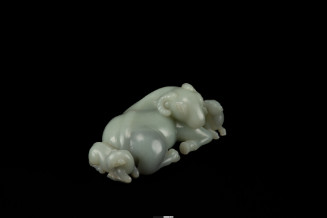
The recumbent ram finely carved in gently rounded form with its head turned to the side, flanked by two young tucked along its side, the stone of even celadon color with grey streaks
Chinese Artist
18th century or later
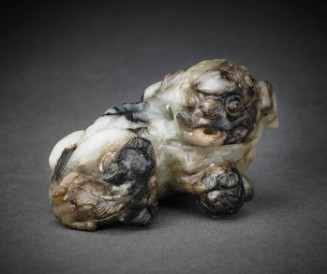
Carved as a recumbent lion, its paw resting on a brocade ball and head turned to one side, its long ears laid back flanking tufts of hair falling on either side of the ribbed backbone, opposite the tail flicked to one side, accompanied by a cub, the stone of mottled, black brown and white tones
Chinese Artist
18th-19th Century or later
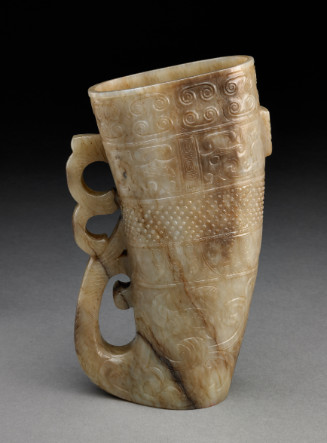
The well hollowed vessel carved in shallow relief with four bands of archaistic designs, including confronted C-scrolls, taotie masks separated by a taotie mask carved in high relief, bosses and mask-filled blades, all divided by rope twist borders and positioned above a phoenix and a dragon confronted on a vertical, keyfret band with a scrolling bird-like tail rising off center up one side from a pattern of intertwined swirls carved in a flat base, the stone of pale grayish brown color suffused…
Chinese Artist
Ming dynasty (1368-1644)
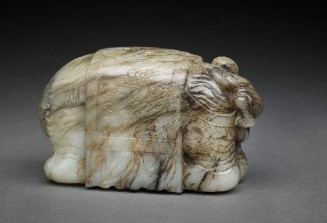
Well carved with an attendant holding a brush clinging to the rear haunches of the stocky elephant as it turns its head to the side, the blanket draped over its back decorated with fish leaping from waves below a yinyang symbol, the greyish-buff stone with dark brown veining (description taken from Christie's auction results, not donor appraisal
Chinese Artist
17th-18th century
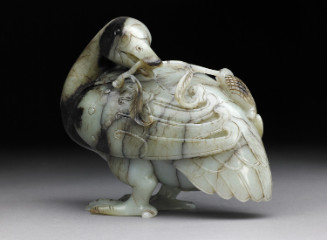
Shown standing with head turned backwards while grasping a millet stem in its beak, the wings carved with dots and curled tips, the tail feathers represented in two overlapping rows, the pale greyish-white stone with soft polish and blackish-brown staining
Chinese Artist
17th-18th century
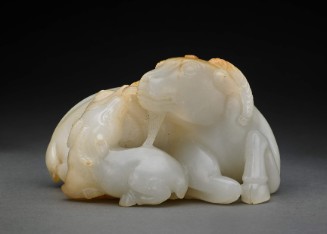
Depicting a recumbent ram holding a lingzhi stem and its, young, skillfully carved with russet coloring on the head and extending down the spine
Chinese Artist
18th century
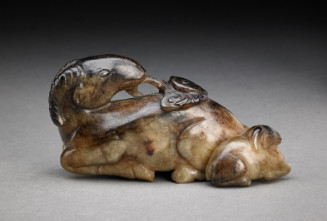
A figure of a recumbent horse carved with its head turning over its shoulder, the stone a dark mottled tone.
Chinese Artist
Ming or Qing dynasty
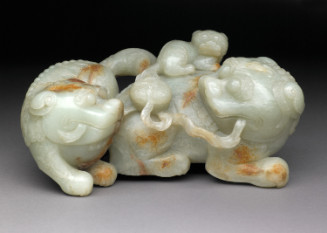
The massive stone well carved as a pair of recumbent fu lions turned to face each other, a beribboned brocade ball trailing from one of the lion's closed jaws, the 'snail' curled mane trailing over each lion's back to meet the bushy tails, one small cub poised on the back, the underside detailed with clawed feet, the stone of celadon tone with patches of russet highlights
Chinese Artist
17th-18th century
cleverly using the natural inclusions to depict a large recumbent horned ram, its head turned to one side and spewing forth a cloud vapor and yinyang medallion, accompanied by two young rams.
Chinese Artist
Ming dynasty (1368-1644)
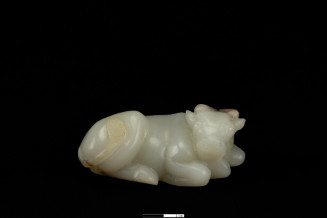
Buffalo carved in a recumbent position with its forelegs tucked underneath and tail coiled to the front, with incised lines to depict details on the horns, tail and hooves, the stone of even white tone with areas of russet and black speckling highlighting the carving
Chinese Artist
18th century
The recumbent beast with head turned over its back, the face delicately carved and the fur markings simply delineating the body with light ribs and softly polished vertebrae
Chinese Artist
possibly Song Dynasty (960-1279)
null