The square dish well carved overall to imitate a straw woven basket, the off-white stone with russet rivering
Dish
Courtesy of the Harn Museum of Art, Photography by Randy Batista

Dish

Artist Chinese Artist
DateSong and Ming dynasty (960 - 1644)
Place of originChina, Asia
MediumJade
Dimensions1 x 2 11/16 x 2 5/8 in. (2.5 x 6.8 x 6.7 cm)
ClassificationsFurnishings and Equipment
Credit LineBequest of Dr. David A. Cofrin
Object number2009.48.23
Collections
Visual DescriptionThe square dish well carved overall to imitate a straw woven basket, the off-white stone with russet rivering
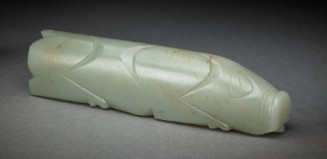
The crouching animal carved with deep slashes to the flat snout, haunches, eyes and tail, the stone of pale celadon tone with russet rivering
Chinese Artist
Han dynasty (206 BCE-220 CE)
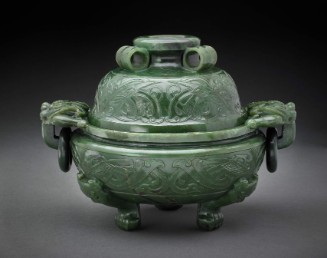
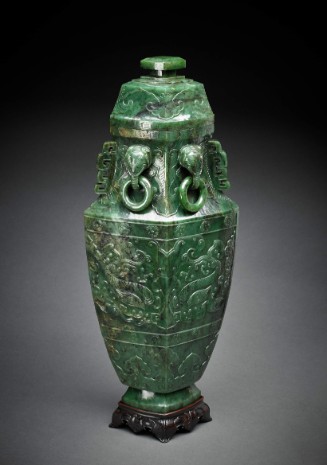
Raised on three monster mask and claw feet, well carved around the sides with three spaced foliate masks, interrupted by two horned monster mask handles suspending loose rings, the fitted, domed cover with matching decoration, encircling the hollowed ring knop with three tubular tabs, the dark green stone with typical black inclusions and white rivering.
Chinese Artist
18th-19th century
The wide base rising to the steeply rounded upright sides, supported on a low footring encircling the slightly concave base, the stone of rich dark grey color with paler grey rivering and a slight flaw around the foot.
Chinese Artist
18th-19th Century
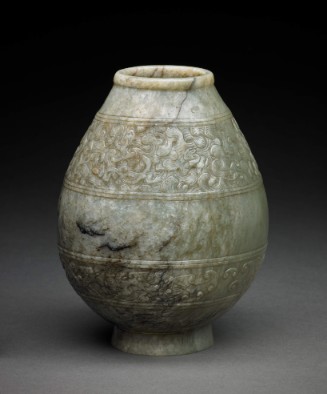
Of swelling ovoid form, decorated with dense frieze of numerous mythical animals interweaving amid interlocking scrollwork, above a further smaller band of hooked scrolls, volutes and masks, the greenish gray stone suffused with white and black rivering overall.
Chinese Artist
Qing dynasty (1644 -1911), 17th-18th century
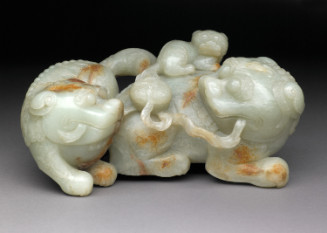
The massive stone well carved as a pair of recumbent fu lions turned to face each other, a beribboned brocade ball trailing from one of the lion's closed jaws, the 'snail' curled mane trailing over each lion's back to meet the bushy tails, one small cub poised on the back, the underside detailed with clawed feet, the stone of celadon tone with patches of russet highlights
Chinese Artist
17th-18th century
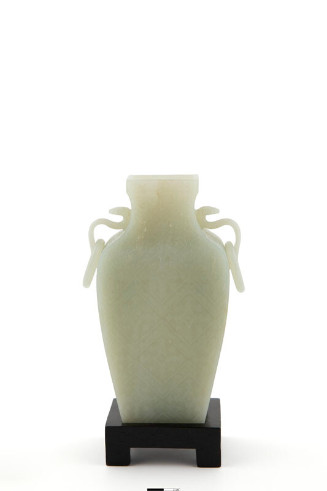
A jade vase of rectangular section, the sides gently tapering towards the slightly recessed base, the waisted neck with straight mouth rim, and worked in relief with two ruyi-sceptre handles from which loose rings are suspended. They body decorated overall in sunken relief with a geometric design of chevrons, clouds and squares. The stone a pale celadon stone. The base with an incised six-character reign mark Qianlong yu yong (for imperial use).
Chinese Artist
18th-19th century
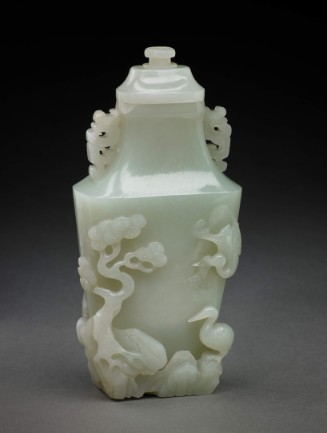
Well carved around the sides with a pine tree growing from the rocks that form the base and with five cranes, four grasping auspicious sprigs in their beaks, including prunus, lingzhi fungus, peach and bamboo, with archaistic bird scroll handles, the cover with rope-twist finial, the well-polished stone of pale greenish-white color
Chinese Artist
Qing Dynasty (1644 - 1911), 18th century
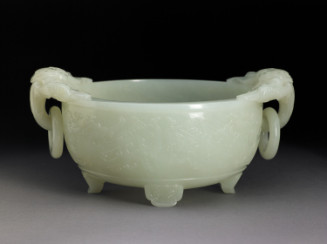
Of circular form, well-carved with two loop handles suspending rings formed from a pair of bats on either side of a ruyi-shaped terminal, the body carved in light relief with two pairs of diffused and stylized dragons and supported on four small scrolled feet, the stone of even white tone.
Chinese Artist
Qing Dynasty (1644-1911), Qianlong period (1736-1795)
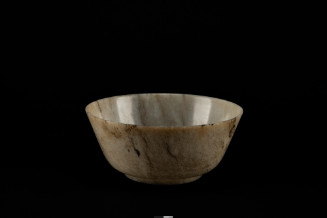
Well carved bowl with slightly flaring sides rising from a shallow foot ring, the stone of pale greyish-white tone with opaque white flecks and pale brown mottling and veining throughout, softly and evenly polished.
Chinese Artist
17th-18th century
Carved with archaistic motifs
Chinese Artist
19th century
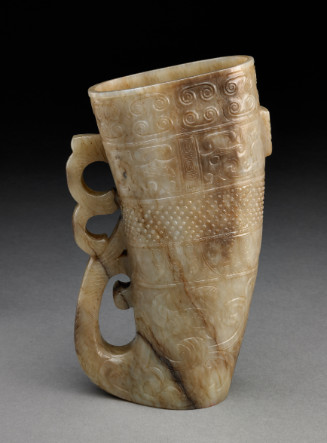
The well hollowed vessel carved in shallow relief with four bands of archaistic designs, including confronted C-scrolls, taotie masks separated by a taotie mask carved in high relief, bosses and mask-filled blades, all divided by rope twist borders and positioned above a phoenix and a dragon confronted on a vertical, keyfret band with a scrolling bird-like tail rising off center up one side from a pattern of intertwined swirls carved in a flat base, the stone of pale grayish brown color suffused…
Chinese Artist
Ming dynasty (1368-1644)
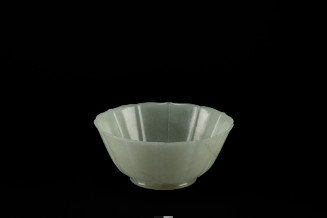
Bowl of deep rounded form, the lobed sides well carved as six elongated petals rising from the shallow, flaring foot to the barbed rim, the semi-translucent stone of pale celadon tone.
Chinese Artist
Qing Dynasty (1644 - 1911), 18th century
null