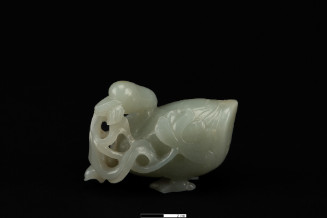
Duck
Duck
Courtesy of the Harn Museum of Art, Photography by Foad Seyed Mohammadi

Duck

Artist Chinese Artist
Date17th-18th century
Place of originChina, Asia
MediumJade
Dimensions1 1/2 x 2 5/16 x 1 1/8 in. (3.8 x 5.9 x 2.9 cm)
ClassificationsSculpture
Credit LineBequest of Dr. David A. Cofrin
Object number2009.48.104
Collections
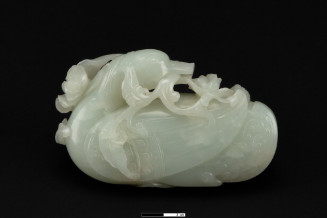
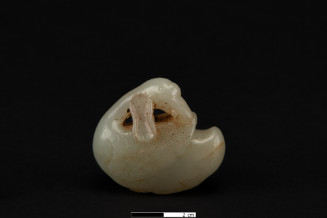
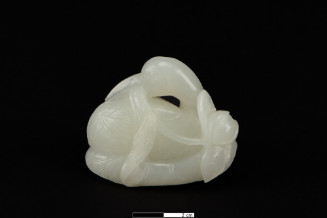
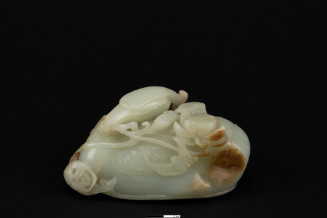
Finely carved with its head turned back over its wings folded back and incised with archaistic decoration, a long leafy lotus spray trailing from its beak, the underside detailed with webbed feet, the stone of even tone.
Chinese Artist
18th century
Grasping a stem of millet in its beak
Chinese Artist
Song and Ming dynasty (960-1644)
Grasping a lotus leaf in its beak.
Chinese Artist
17th-18th century
Recumbent Duck
Chinese Artist
18th-19th century
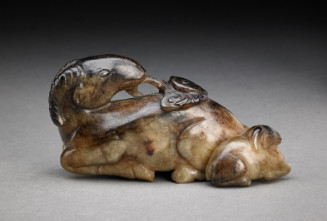
The recumbent animal holding in its beak a leafy branch of blossoming lotus bloom enclosing a stylized shou medallion, the elaborately patterned wings swept back close to the body, the underside detailed with billowy waves, the stone of even tone with russet skin highlights.
Chinese Artist
17th-18th century
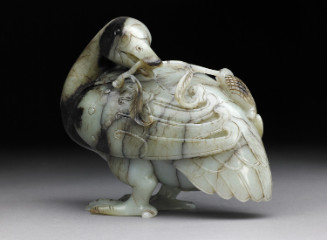
Duck with lotus sprig in beak.
Chinese Artist
18th-19th century
Shown standing with head turned backwards while grasping a millet stem in its beak, the wings carved with dots and curled tips, the tail feathers represented in two overlapping rows, the pale greyish-white stone with soft polish and blackish-brown staining
Chinese Artist
17th-18th century
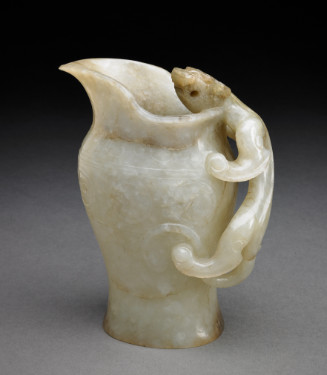
An oval vase-shaped ewer with curved spout elegantly carved from translucent jade. The mottled white material has greenish-gray tones and inclusions. The handle is carved aways from the cup in the sculptural from of a chih dragon with turned head clutching the rim. The dragon has a raised spine, spiraling articulations, and stylized wings on the thighs and shoulders.
Chinese Artist
possibly Ming Dynasty (1368-1644)
cleverly using the natural inclusions to depict a large recumbent horned ram, its head turned to one side and spewing forth a cloud vapor and yinyang medallion, accompanied by two young rams.
Chinese Artist
Ming dynasty (1368-1644)
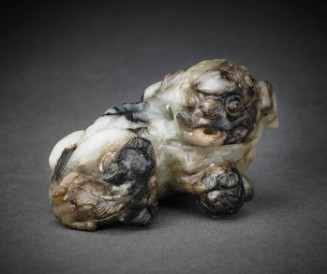
Carved as a recumbent lion, its paw resting on a brocade ball and head turned to one side, its long ears laid back flanking tufts of hair falling on either side of the ribbed backbone, opposite the tail flicked to one side, accompanied by a cub, the stone of mottled, black brown and white tones
Chinese Artist
18th-19th Century or later
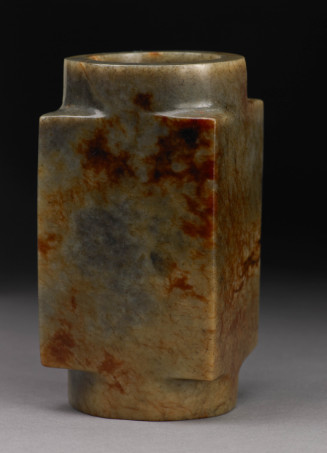
Carved from black-flecked, gray stone shading to buff with areas and veins of russet coloring in the form of a rectangular block surrounding a hollowed cylinder extending beyond the sharp triangular shoulders at either end to form a collar, the interior showing evidence of having been carved from both ends
Chinese Artist
Western Zhou dynasty (c. 1050-771 BCE)
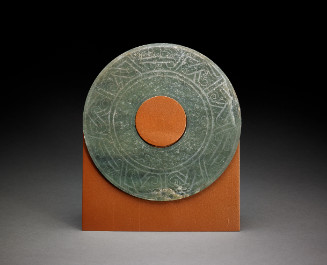
Carved from a light green jade with black inclusions, both sides of the disc are divided into two finely executed concentric decor zones. The inner band contains a grid of low relief curls within elevated hexagonal units, bordered by three "Bucraniums" that embellish the outer band. They stylized dragon forms are fluidly shaped from thick and thin incisions in a curvilinear pattern and separated by incised double brackets. Consistent with the practice of the time, cinnabar was applied to enhance…
Chinese Artist
Han Dynasty (206 BCE-220 CE)
null