Weight
Weight
Courtesy of the Harn Museum of Art, Photography by Foad Seyed Mohammadi

Weight

Maker Thai Artist
Date19th century
Place of originThailand
MediumBronze
Dimensions2 3/4 × 1 3/4 × 1 3/8 in. (7 × 4.4 × 3.5 cm)
ClassificationsSculpture
Credit LineGift of Roy Hunt
Object number2016.42.6
Collections
Visual DescriptionSingh animal-form bronze weight
Weight
Thai Artist
19th century
Weight
Thai Artist
1890s
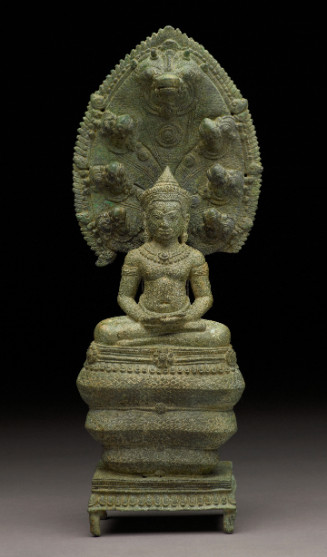
A sculpture cast in two parts, one being the seated bronze Buddha, deep in meditation, the other the seven-headed Naga snakes shielding surrounding Buddha’s head like a halo.
Thai Artist
Bayon period, 12th-13th century
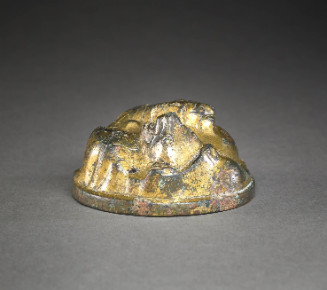
Solid bronze; cast in the shape of a bear and a tiger locked in combat; the bear is caught with open eyes and mouth; the tiger bites the bear's back with a ferocious demeanor; engraved details.
Chinese Artist
Han dynasty (206 BCE-220 CE)
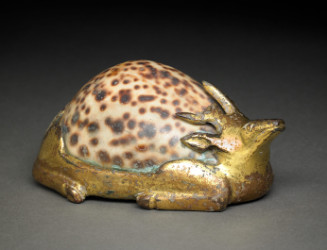
A sea shell forming the body of the gilt-bronze animal lying semi-recumbent with legs tucked neatly under the body and with head raised up, with antlers and ears flared back to hold the shell in place
Chinese Artist
Western Han Dynasty (206 B.C. - 9 A.D.)
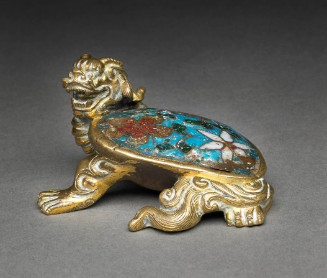
Heavily and finely cast as a three-legged bixi, a mythological dragon-tortoise with dragon-like head with forked antlers and bushy tail, the carapace inlaid with a cloisonné enamel fragment of 16th century date decorated with thee flower heads and green leafy tendrils reserved on a turquoise-blue ground
Chinese Artist
17th - 18th Century
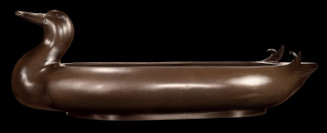
Suiban or tray style flower arranging vase, in the form of a swimming duck. Of cast and cold-chiseled bronze.
Tsuda Shinobu
1929
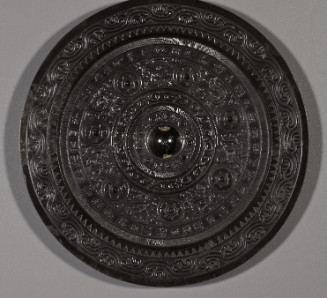
mirror of darkened bronze with geometric and animal decoration
Chinese Artist
Eastern Han Dynasty (25-220)
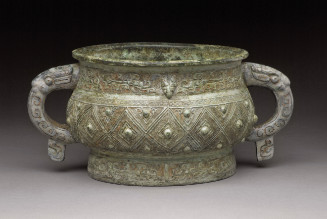
A bronze food vessel with wide opening, two handles emerging from animal masks, a round body resting on a foot ring. Decorated with lozenge patterns around central band.
Chinese Artist
Western Zhou dynasty (1100–771 BCE)
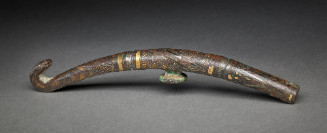
Silver and gold-inlaid bronze garment hook, Warring States, the arched shaft finely inlaid with dotted feather or scale pattern divided by cheveron and horizontal bands, with an animal-head hook at one end and an inlaid button on the underside, inlaid at one end with a bird
Chinese Artist
Warring States Period (c. 475-221 BCE)
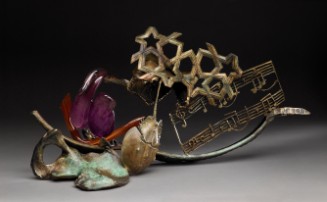
Glass inset rests on bronze (see image for orientation); off the pipe Venetian glass organic form, arched hand, cut feather serpent.
Nancy Graves
1994
null