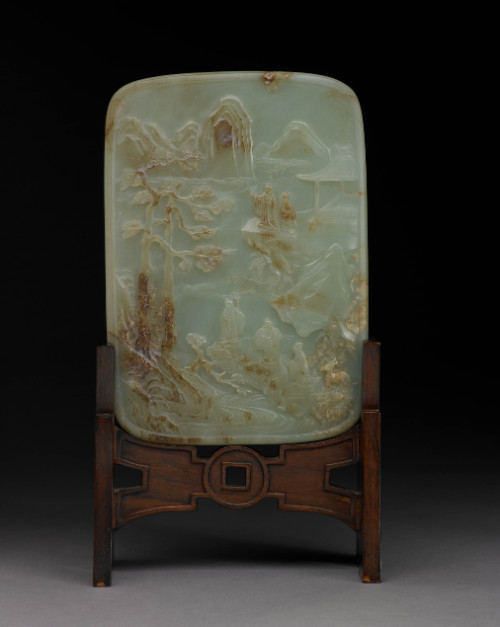
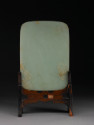
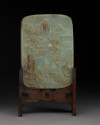
The thick rounded rectangular panel carved with five immortals in a cloud-swept mountainous landscape, the brown 'skin' cleverly used to highlight the relief
Table Screen
Courtesy of the Harn Museum of Art, Photography by Randy Batista

Table Screen

Artist Chinese Artist
Date18th-19th century
Place of originChina
MediumJade
Dimensions8 1/16 x 5 11/16 x 5/8 in. (20.5 x 14.4 x 1.6 cm)
ClassificationsSculpture
Credit LineBequest of Dr. David A. Cofrin
Object number2009.48.201
Collections
Visual DescriptionThe thick rounded rectangular panel carved with five immortals in a cloud-swept mountainous landscape, the brown 'skin' cleverly used to highlight the relief
Bibliography
In a Perfect World
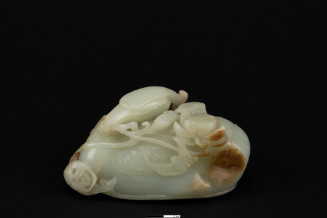
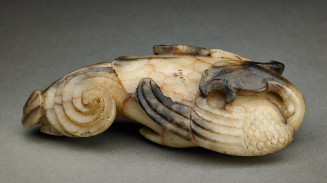
The recumbent animal holding in its beak a leafy branch of blossoming lotus bloom enclosing a stylized shou medallion, the elaborately patterned wings swept back close to the body, the underside detailed with billowy waves, the stone of even tone with russet skin highlights.
Chinese Artist
17th-18th century
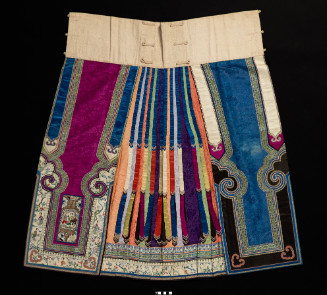
This embroidered hanging bears scenes of a gathering of immortals.  The individuals are separated into four sections, each on a different level, with the top ones descending from the clouds, the second in a building, the third on a boat, and the fourth on the ground level.
Chinese Artist
late 18th-early 19th century
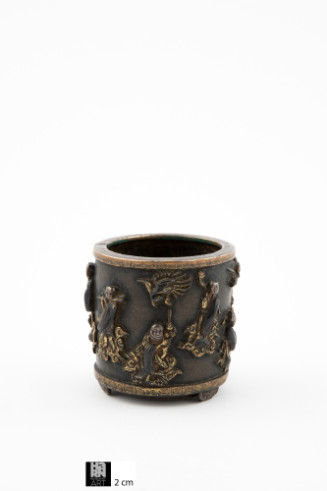
The sides of the bronze vessel decorated in high relief with the Eight Daoist Immortals, each with silver head and gilded body, with a pair of phoenixes and a pair of cranes in flight above, all reserved on a fine ring matted ground between gilt borders of key fret above and below, raised on three silver ruyi-head feet and with silver mouth rim
Chinese Artist
17th-18th century
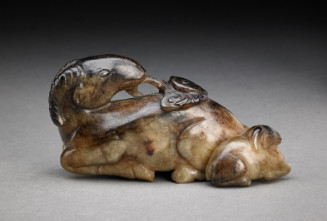
cleverly using the natural inclusions to depict a large recumbent horned ram, its head turned to one side and spewing forth a cloud vapor and yinyang medallion, accompanied by two young rams.
Chinese Artist
Ming dynasty (1368-1644)
Shown with head arched back and resting on its body, some small chips to wings and tail feathers
Chinese Artist
Song and Ming dynasty (960-1644)
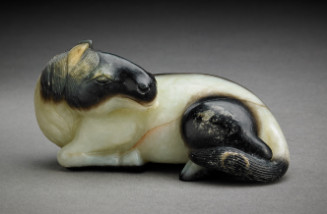
Well carved along the natural curves of the stone, the head turned towards the back, the face framed by long locks of gently incised mane, seated on its haunches with its tail swished to one side, the underside well detailed hooves, the stone of white tone with dark brown highlights
Chinese Artist
Ming dynasty (1368-1644)
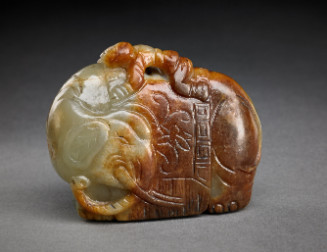
The yellow jade pebble carved as a recumbent elephant with a boy riding on top with a string of cash, the stone with deep reddish brown skin
Chinese Artist
18th-19th century or later
The yellow jade pebble carved as a recumbent elephant with a boy riding on top with a string of cash, the stone with a deep reddish brown skin.
Chinese Artist
late Ming dynasty (1368-1644)
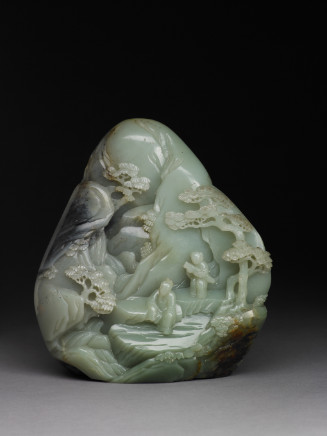
The massive boulder carved with a scholar at rest under a pine tree in front of a cascading waterfall, accompanied by a young acolyte holding an instrument in attendance, all surrounded by a tree-lined rocky moutainscape, the reverse boldly carved with further pine trees growing from jagged rockwork, the underside detailed, the stone of dark celadon tone with areas of black and cream highlights.
Chinese Artist
Qing dynasty (1644-1911)
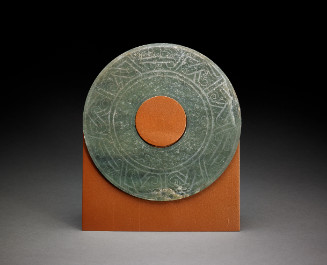
Carved from a light green jade with black inclusions, both sides of the disc are divided into two finely executed concentric decor zones. The inner band contains a grid of low relief curls within elevated hexagonal units, bordered by three "Bucraniums" that embellish the outer band. They stylized dragon forms are fluidly shaped from thick and thin incisions in a curvilinear pattern and separated by incised double brackets. Consistent with the practice of the time, cinnabar was applied to enhance…
Chinese Artist
Han Dynasty (206 BCE-220 CE)
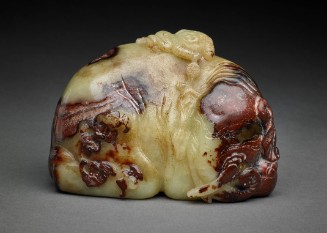
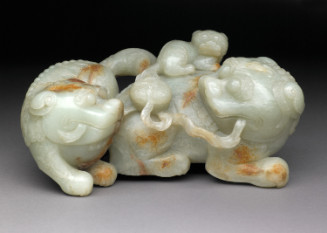
The massive stone well carved as a pair of recumbent fu lions turned to face each other, a beribboned brocade ball trailing from one of the lion's closed jaws, the 'snail' curled mane trailing over each lion's back to meet the bushy tails, one small cub poised on the back, the underside detailed with clawed feet, the stone of celadon tone with patches of russet highlights
Chinese Artist
17th-18th century
null