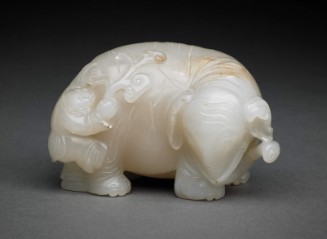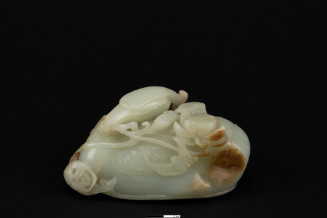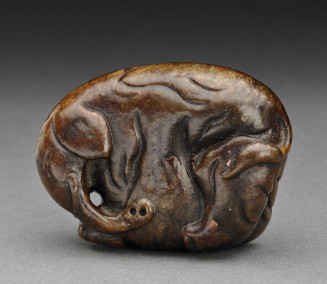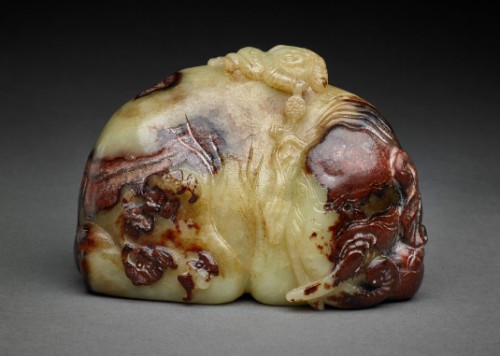
The yellow jade pebble carved as a recumbent elephant with a boy riding on top with a string of cash, the stone with deep reddish brown skin
Elephant
Courtesy of the Harn Museum of Art, Photography by Randy Batista

Elephant

Artist Chinese Artist
Date18th-19th century or later
Place of originChina, Asia
MediumJade
Dimensions3 3/16 x 4 11/16 x 2 3/4 in. (8.1 x 11.9 x 7 cm)
ClassificationsSculpture
Credit LineBequest of Dr. David A. Cofrin
Object number2009.48.287
Collections
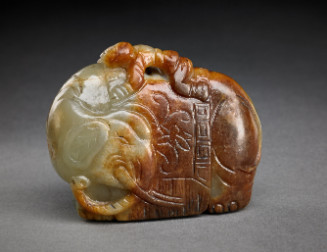
Visual DescriptionThe yellow jade pebble carved as a recumbent elephant with a boy riding on top with a string of cash, the stone with deep reddish brown skin
The yellow jade pebble carved as a recumbent elephant with a boy riding on top with a string of cash, the stone with a deep reddish brown skin.
Chinese Artist
late Ming dynasty (1368-1644)
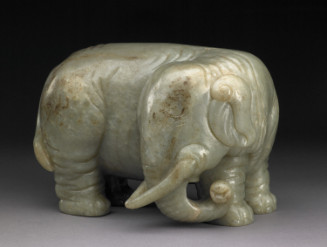
Of pale greyish-green stone, the standing elephant carved with head turned back, its trunk between its tusks meeting at the tips, its tail flicked forward on its right hind leg, its floppy ears and wrinkled skin well delineated
Chinese Artist
Ming dynasty (1368-1644)
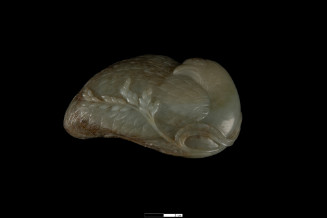
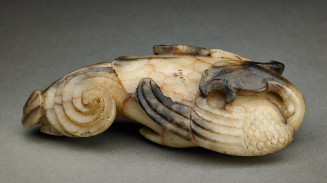
The rounded pebble in the form of a nesting quail with head turned towards its back surrounded by a long leafy millet spray, carved overall with detailed overlapping feathers, the stone of deep celadon tone with brown accents
Chinese Artist
18th-19th century
The beast well carved standing four square with the head turned to one side with a boy clambering over its back clasping a lotus sprig, the white jade with brown inclusions
Chinese Artist
Qing dynasty (1644-1911) or later
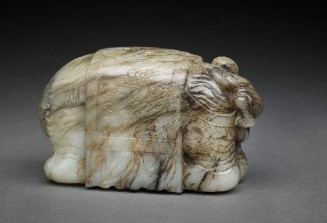
Well carved with an attendant holding a brush clinging to the rear haunches of the stocky elephant as it turns its head to the side, the blanket draped over its back decorated with fish leaping from waves below a yinyang symbol, the greyish-buff stone with dark brown veining (description taken from Christie's auction results, not donor appraisal
Chinese Artist
17th-18th century
The recumbent animal holding in its beak a leafy branch of blossoming lotus bloom enclosing a stylized shou medallion, the elaborately patterned wings swept back close to the body, the underside detailed with billowy waves, the stone of even tone with russet skin highlights.
Chinese Artist
17th-18th century
The small size carving depicting a vigorous elephant, the stone of a well-patinated brown tone
Chinese Artist
Ming dynasty (1368-1644) or later
Shown with head arched back and resting on its body, some small chips to wings and tail feathers
Chinese Artist
Song and Ming dynasty (960-1644)
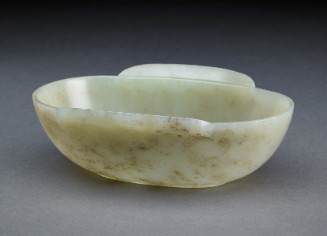
This ear cup reflects the Song period's profound interest in history in its characteristic design found in jades of the late Han period (206BC-AD220). The thinly worked oval cup has two flat handles projecting just below the rim at the longer sides, resting on an oval base with a raised foot ring. The highly translucent yellow jade possesses darker russet brown inclusions creating a desirable "skin" throughout the cup. The ear cup is of a fine, smooth polish. In our opinion, this ear cup is a fi…
Chinese Artist
Qing dynasty (1644-1911) or later
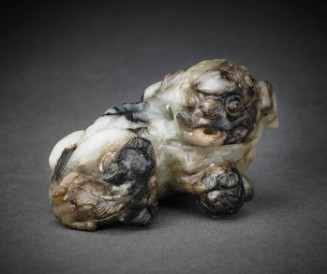
Carved as a recumbent lion, its paw resting on a brocade ball and head turned to one side, its long ears laid back flanking tufts of hair falling on either side of the ribbed backbone, opposite the tail flicked to one side, accompanied by a cub, the stone of mottled, black brown and white tones
Chinese Artist
18th-19th Century or later
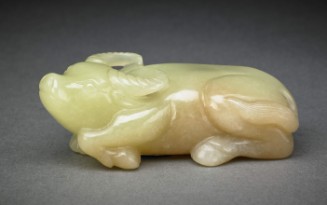
Water Buffalo
Chinese Artist
Qing dynasty (1644-1911), Qianlong period (1736-1795)
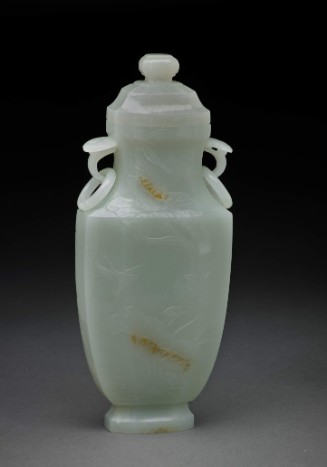
This striking octagonal vase is delicately worked from icy white jade with pale yellow surface skin markings. The artist has expertly incorporated the subtle yellow inclusions of the material with the edges of the broad graceful lotus leaves. The design extends the length of the vase to the concave neck. On either side, the covered vase is graced by handles in the shape of ruyi, or wish granting scepters. From each handle, circular rings are worked from the same jade boulder. In our opinion, the…
Chinese Artist
18th-19th century
null