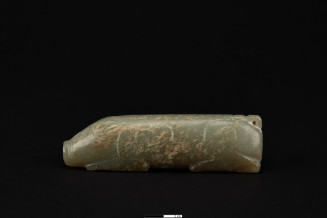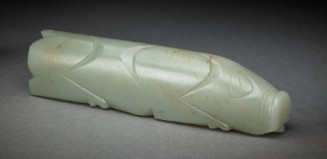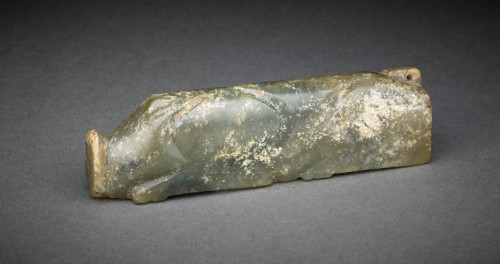
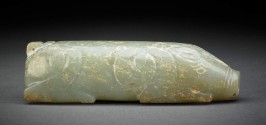
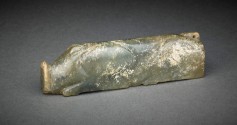
Of simple form, the legs and body delineated by simple cuts to the stone with soft polishing, the tail and the base of the snout pierced for suspension
Pig
Courtesy of the Harn Museum of Art, Photography by Randy Batista

Pig

Artist Chinese Artist
DateHan dynasty (206 BCE - 220 CE)
Place of originChina, Asia
MediumJade
Dimensions1 x 3 11/16 x 3/4 in. (2.5 x 9.4 x 1.9 cm)
ClassificationsSculpture
Credit LineBequest of Dr. David A. Cofrin
Object number2009.48.11
Collections
Visual DescriptionOf simple form, the legs and body delineated by simple cuts to the stone with soft polishing, the tail and the base of the snout pierced for suspension
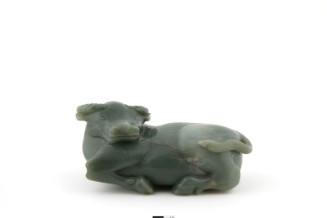
Water Buffalo
Chinese Artist
Qing dynasty (1644-1911), Qianlong period (1736-1795)
The slender crouching animal carved with deep slashes for the flat snout, haunches, ears and upturned tail, the tail and snout pierced with a hole for attachment, the stone of pale celadon color with areas of calcification
Chinese Artist
Han dynasty (206 BCE-220 CE)
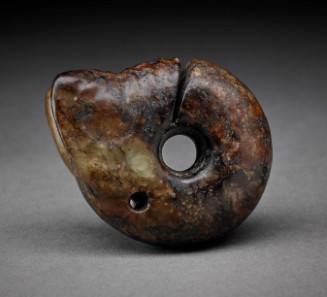
Pig Dragon
Chinese Artist
Neolithic period, c. 3500-3000 BCE or later
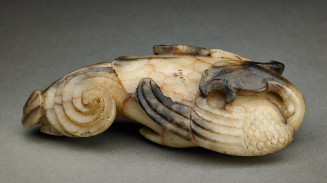
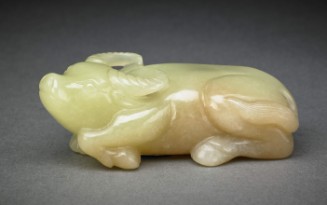
The thick stone carved as a recumbent buffalo following the form of the boulder, the legs tucked beneath the body, the head turned to one side, with broad snout and large curled horns, opposite the tail flicked to one side, the gray green stone with a broad suffusion of dark green and white on reverse.
Chinese Artist
19th century or later
The thick stone well carved as a recumbent buffalo following the form of the boulder, the legs ticked beneath the body, the head turned to tone side, with broad snout and large curled horns, opposite the tail flicked to one side, the grayish green stone infused with a patch of white, small chip
Chinese Artist
19th-20th century
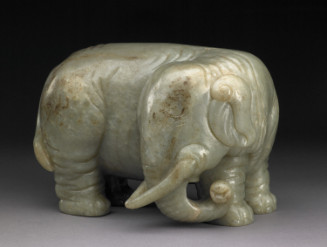
Of pale greyish-green stone, the standing elephant carved with head turned back, its trunk between its tusks meeting at the tips, its tail flicked forward on its right hind leg, its floppy ears and wrinkled skin well delineated
Chinese Artist
Ming dynasty (1368-1644)
The crouching animal carved with deep slashes to the flat snout, haunches, eyes and tail, the stone of pale celadon tone with russet rivering
Chinese Artist
Han dynasty (206 BCE-220 CE)
With the hind legs and front left leg folded under the body, and the right front leg flexed as the creature prepares to rise, the tail colored around to rest on the left haunch, the belly and neck faintly ribbed to indicate folds, the head facing forward with well-defined horns above ears delineated with fine incising, the greenish-gray stone with pale mottling.
Chinese Artist
Qing dynasty (1644 -1911)
Shown with head arched back and resting on its body, some small chips to wings and tail feathers
Chinese Artist
Song and Ming dynasty (960-1644)
A cicada, the surface with simple incised linear details, the stone a translucent light green tone. Possible chip to mouth, nicks to tips of wings.
Chinese Artist
Han dynasty (206 BCE-220 CE)
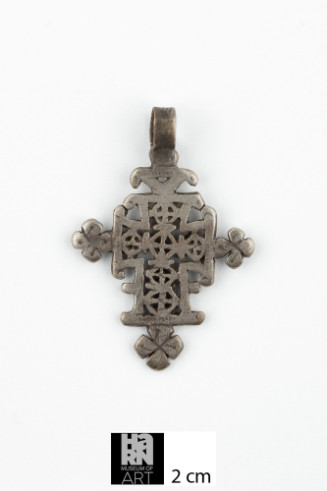
Simple silver pendant in the form of a Latin cross; the ends of the arms have trefoil shaped finials; there are 6 small crosses enclosed in circles collectively taking the shape of a cross with a pierced pattern; superior arm has a ring for suspension
Ethiopian Artist
undated
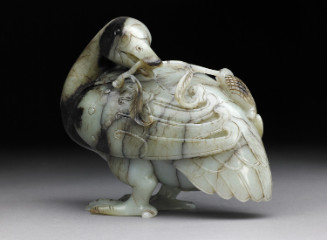
Shown standing with head turned backwards while grasping a millet stem in its beak, the wings carved with dots and curled tips, the tail feathers represented in two overlapping rows, the pale greyish-white stone with soft polish and blackish-brown staining
Chinese Artist
17th-18th century
null