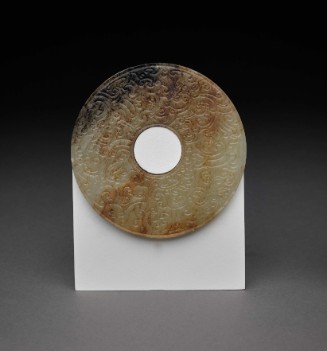
Carved with grain pattern
Disc
Courtesy of the Harn Museum of Art, Photography by Randy Batista

Disc

Artist Chinese Artist
DateSong and Ming dynasty (960-1644)
Place of originChina, Asia
MediumJade
DimensionsThickness x Diameter: 5/16 x 1 11/16 in. (0.8 x 4.3 cm)
ClassificationsSculpture
Credit LineBequest of Dr. David A. Cofrin
Object number2009.48.157
Collections
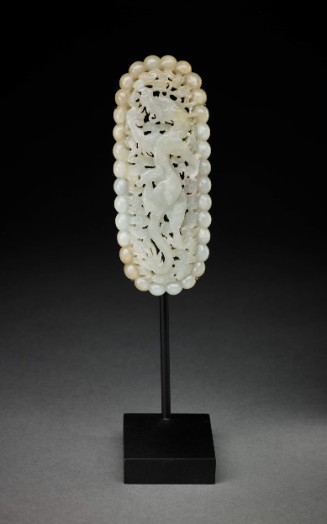
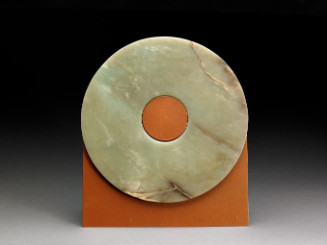
Visual DescriptionCarved with grain pattern, with a few nicks to the edges
Carved with a dragon amidst swirling clouds, all within a beaded overall border, small nicks to edge of border
Chinese Artist
18th century or later
A cicada, the surface with simple incised linear details, the stone a translucent light green tone. Possible chip to mouth, nicks to tips of wings.
Chinese Artist
Han dynasty (206 BCE-220 CE)
Disc with Cloud Pattern
Chinese Artist
Eastern Zhou dynasty (770-256 BCE)
Disc
Chinese Artist
Neolithic Period or later
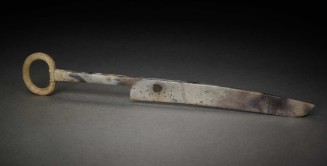
Carved as a long slender blade of slightly curved outline tapering in thickness towards the tip and the cutting edge from an upper, and thicker, flat edge which is a continuation of the narrow, beveled handle, fitted at its end with a short similar section set at the base of a slight saddle with raised edges from which issues a faceted oval ring, the blade now altered from burial to an opaque pale and dark mottled gray with a few translucent buff patches remaining, the ring section somewhat opaq…
Chinese Artist
Warring States Period (c. 475-221 BCE)
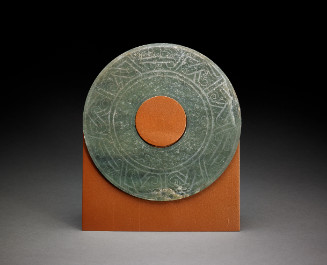
Carved from a light green jade with black inclusions, both sides of the disc are divided into two finely executed concentric decor zones. The inner band contains a grid of low relief curls within elevated hexagonal units, bordered by three "Bucraniums" that embellish the outer band. They stylized dragon forms are fluidly shaped from thick and thin incisions in a curvilinear pattern and separated by incised double brackets. Consistent with the practice of the time, cinnabar was applied to enhance…
Chinese Artist
Han Dynasty (206 BCE-220 CE)
This semi-translucent stone of soft olive-green color with opaque buff mottling and some dark brown coloring in areas that show signs of alteration from burial, the inner and outer edges well finished and the stone with a high, soft polish, some chips
Chinese Artist
Zhou Dynasty (c.1050-256 BCE) or earlier
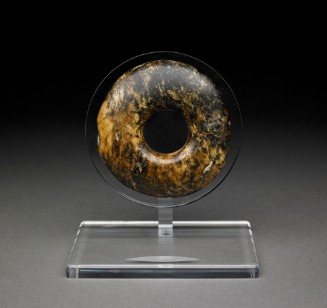
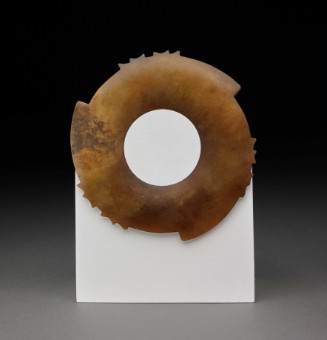
Of circular bi-shape and convex section, the edges with three equidistant notches and serrations, one surface etched with two lines at right angles, the jade of mottled brown color with a small area of calcification
Chinese, Longshan Culture
Neolithic period, c. 2300-1700 BCE or later
Standing and carrying a lotus branch across his shoulders, conveying the good wish of having sons consecutively, the stone of a celadon tone with edges stained to reddish brown
Chinese Artist
17th-18th century
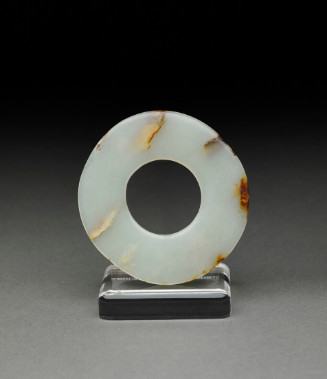
The smooth translucent stone, pierced with a circular aperture, with slightly rounded sides on both sides tapering to the inside and outside edges, the white stone with strong russet streaks
Chinese Artist
Neolithic Period or later
Jade Prism (Cong) 玉琮
Chinese Artist
Zhou dynasty (1050–256 BCE) or later
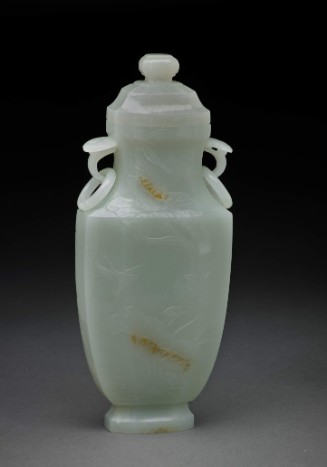
This striking octagonal vase is delicately worked from icy white jade with pale yellow surface skin markings. The artist has expertly incorporated the subtle yellow inclusions of the material with the edges of the broad graceful lotus leaves. The design extends the length of the vase to the concave neck. On either side, the covered vase is graced by handles in the shape of ruyi, or wish granting scepters. From each handle, circular rings are worked from the same jade boulder. In our opinion, the…
Chinese Artist
18th-19th century
null