Dog
Dog
Courtesy of the Harn Museum of Art, Photography by Randy Batista

Dog

Artist Chinese Artist
DateMing dynasty (1368-1644)
Place of originChina, Asia
MediumJade
Dimensions1 5/8 x 1 7/8 x 7/8 in. (4.1 x 4.8 x 2.2 cm)
ClassificationsSculpture
Credit LineBequest of Dr. David A. Cofrin
Object number2009.48.100
Collections
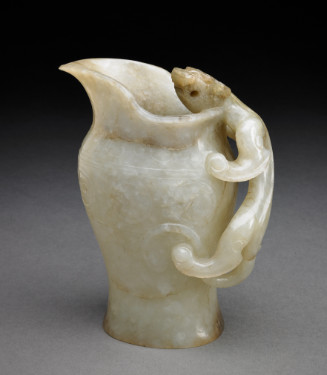
An oval vase-shaped ewer with curved spout elegantly carved from translucent jade. The mottled white material has greenish-gray tones and inclusions. The handle is carved aways from the cup in the sculptural from of a chih dragon with turned head clutching the rim. The dragon has a raised spine, spiraling articulations, and stylized wings on the thighs and shoulders.
Chinese Artist
possibly Ming Dynasty (1368-1644)
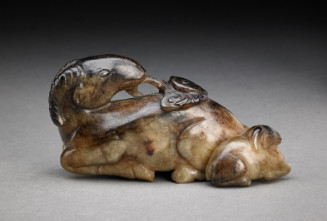
cleverly using the natural inclusions to depict a large recumbent horned ram, its head turned to one side and spewing forth a cloud vapor and yinyang medallion, accompanied by two young rams.
Chinese Artist
Ming dynasty (1368-1644)
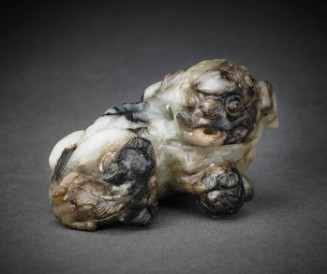
Carved as a recumbent lion, its paw resting on a brocade ball and head turned to one side, its long ears laid back flanking tufts of hair falling on either side of the ribbed backbone, opposite the tail flicked to one side, accompanied by a cub, the stone of mottled, black brown and white tones
Chinese Artist
18th-19th Century or later
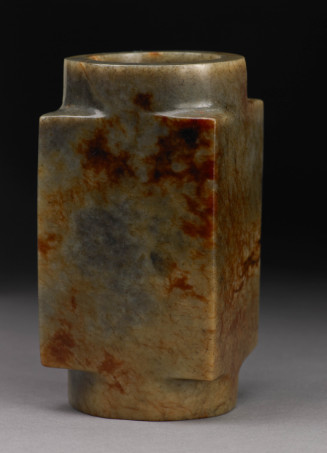
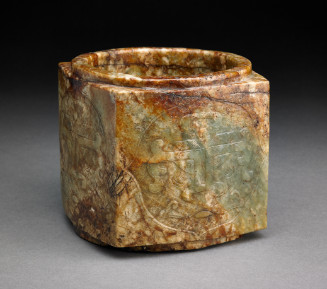
Carved from black-flecked, gray stone shading to buff with areas and veins of russet coloring in the form of a rectangular block surrounding a hollowed cylinder extending beyond the sharp triangular shoulders at either end to form a collar, the interior showing evidence of having been carved from both ends
Chinese Artist
Western Zhou dynasty (c. 1050-771 BCE)
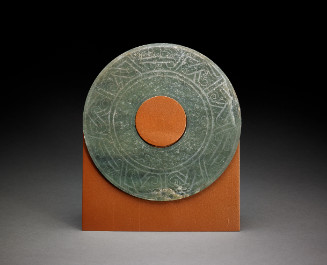
Carved from a light green jade with black inclusions, both sides of the disc are divided into two finely executed concentric decor zones. The inner band contains a grid of low relief curls within elevated hexagonal units, bordered by three "Bucraniums" that embellish the outer band. They stylized dragon forms are fluidly shaped from thick and thin incisions in a curvilinear pattern and separated by incised double brackets. Consistent with the practice of the time, cinnabar was applied to enhance…
Chinese Artist
Han Dynasty (206 BCE-220 CE)
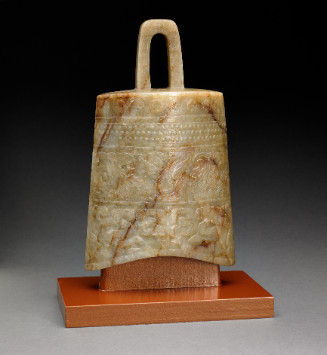
Bell is divided into sections which are reminiscent of the piece-mold technique of seaming the elements of the bronze bells together, seen on this jade bell as design elements. This archaistic bell is of greenish-gray jade with russet inclusions. In our opinion this archaistic bell expresses the refinement of design and technical workmanship of the late Song to early Ming period.
Chinese Artist
Song Dynasty (960-1279) or later
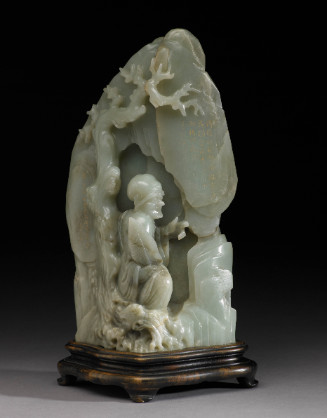
This large celadon jade boulder with darker inclusions is worked in full relief with the figure of the eleventh lohan, Chota-Pantanthaka, or Pantha the Younger, seated in a rocky grotto.
Chinese Artist
18th-19th century or later
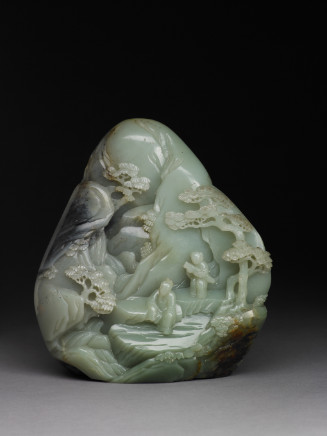
The massive boulder carved with a scholar at rest under a pine tree in front of a cascading waterfall, accompanied by a young acolyte holding an instrument in attendance, all surrounded by a tree-lined rocky moutainscape, the reverse boldly carved with further pine trees growing from jagged rockwork, the underside detailed, the stone of dark celadon tone with areas of black and cream highlights.
Chinese Artist
Qing dynasty (1644-1911)
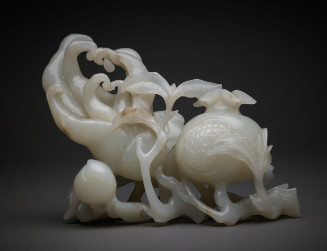
Sanduo Carving
Chinese Artist
Qing dynasty (1644-1911), 18th-19th century
Cong with Taotie Designs
Chinese Artist
Ming dynasty (1368-1644) or later
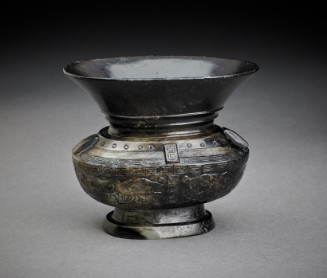
Of compressed zun form, the sides carved in shallow relief with two pairs of confronted dragons contained within keyfret borders, below four raised keyfret-incised flanges which divide the shoulder and interrupt a band of dots above, the widely flared neck encircled by two bowstring bands and carved on the interior with three grooved lines, intentionally altered to a blackish color with areas of the pale gray stone showing through, minor rim chips.
Chinese Artist
Song dynasty (960-1279)
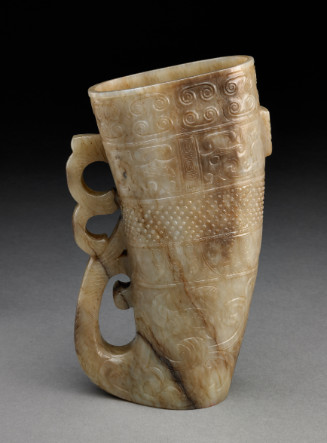
The well hollowed vessel carved in shallow relief with four bands of archaistic designs, including confronted C-scrolls, taotie masks separated by a taotie mask carved in high relief, bosses and mask-filled blades, all divided by rope twist borders and positioned above a phoenix and a dragon confronted on a vertical, keyfret band with a scrolling bird-like tail rising off center up one side from a pattern of intertwined swirls carved in a flat base, the stone of pale grayish brown color suffused…
Chinese Artist
Ming dynasty (1368-1644)
null