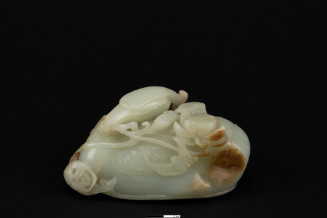
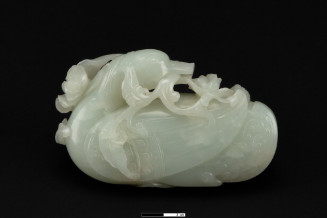
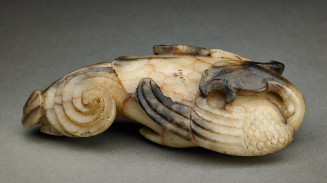
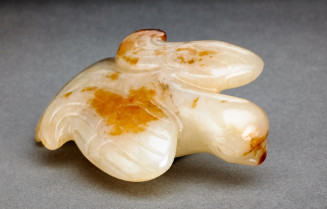
Figure of a quail, Ming Dynasty, incised with long upturned wings and bustling tail, the underside detailed, the stone of yellowish beige tone with brown highlights
Quail
Courtesy of the Harn Museum of Art, Photography by Randy Batista

Quail

Artist Chinese Artist
DateMing dynasty (1368-1644)
Place of originChina, Asia
MediumJade
Dimensions1 11/16 x 3 3/16 x 1 7/16 in. (4.3 x 8.1 x 3.7 cm)
ClassificationsSculpture
Credit LineBequest of Dr. David A. Cofrin
Object number2009.48.145
Collections
Visual DescriptionFigure of a quail, Ming Dynasty, incised with long upturned wings and bustling tail, the underside detailed, the stone of yellowish beige tone with brown highlights
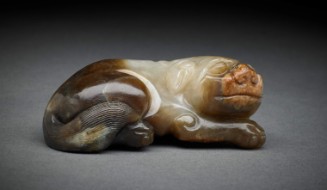
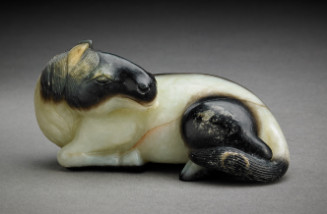
Well carved along the natural curves of the stone, the head turned towards the back, the face framed by long locks of gently incised mane, seated on its haunches with its tail swished to one side, the underside well detailed hooves, the stone of white tone with dark brown highlights
Chinese Artist
Ming dynasty (1368-1644)
The recumbent animal holding in its beak a leafy branch of blossoming lotus bloom enclosing a stylized shou medallion, the elaborately patterned wings swept back close to the body, the underside detailed with billowy waves, the stone of even tone with russet skin highlights.
Chinese Artist
17th-18th century
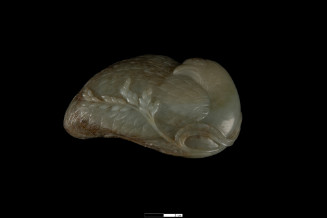
The rounded pebble in the form of a nesting quail with head turned towards its back surrounded by a long leafy millet spray, carved overall with detailed overlapping feathers, the stone of deep celadon tone with brown accents
Chinese Artist
18th-19th century
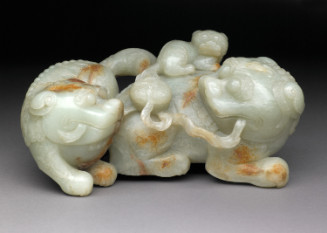
The massive stone well carved as a pair of recumbent fu lions turned to face each other, a beribboned brocade ball trailing from one of the lion's closed jaws, the 'snail' curled mane trailing over each lion's back to meet the bushy tails, one small cub poised on the back, the underside detailed with clawed feet, the stone of celadon tone with patches of russet highlights
Chinese Artist
17th-18th century
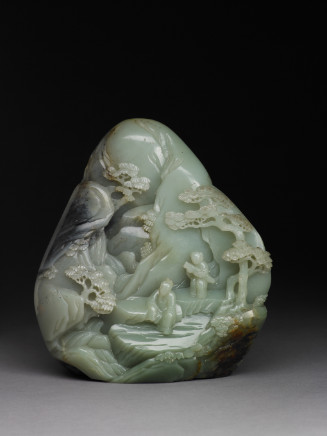
The massive boulder carved with a scholar at rest under a pine tree in front of a cascading waterfall, accompanied by a young acolyte holding an instrument in attendance, all surrounded by a tree-lined rocky moutainscape, the reverse boldly carved with further pine trees growing from jagged rockwork, the underside detailed, the stone of dark celadon tone with areas of black and cream highlights.
Chinese Artist
Qing dynasty (1644-1911)
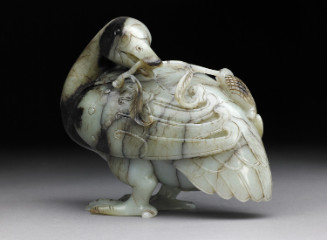
Finely carved with its head turned back over its wings folded back and incised with archaistic decoration, a long leafy lotus spray trailing from its beak, the underside detailed with webbed feet, the stone of even tone.
Chinese Artist
18th century
Shown with head arched back and resting on its body, some small chips to wings and tail feathers
Chinese Artist
Song and Ming dynasty (960-1644)
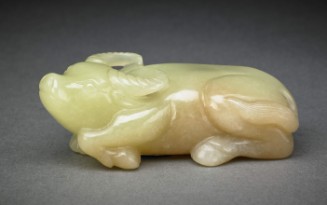
Water Buffalo
Chinese Artist
Qing dynasty (1644-1911), Qianlong period (1736-1795)
cleverly carved using the natural inclusions of the stone, its head turned to one side, its combed mane trailing over its ribbed back, opposite the tail flicked to one side, the underside detailed with padded paws, the stone of mottled brown, beige and white tones
Chinese Artist
Ming dynasty (1368-1644)
A cicada, the surface with simple incised linear details, the stone a translucent light green tone. Possible chip to mouth, nicks to tips of wings.
Chinese Artist
Han dynasty (206 BCE-220 CE)
This elegantly formed bird is depicted with wings outstretched and feet tightly tucked on the underside as if in flight. The detail of the eyes and feathers is rendered with incised lines. The artist has carefully and sensitively followed the natural shape and coloration of the pebble.
Chinese Artist
Ming dynasty (1368-1644) or later
Shown standing with head turned backwards while grasping a millet stem in its beak, the wings carved with dots and curled tips, the tail feathers represented in two overlapping rows, the pale greyish-white stone with soft polish and blackish-brown staining
Chinese Artist
17th-18th century
null