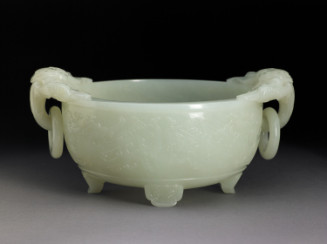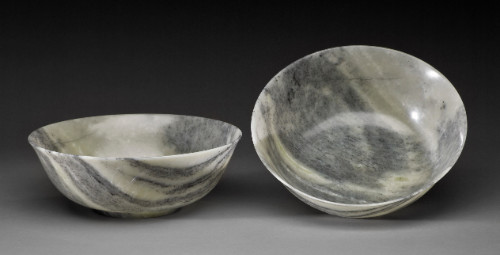
One of a pair, carved in studios of the Caobanzhu.
bowl
Courtesy of the Harn Museum of Art, Photography by Randy Batista

bowl

Artist Chinese Artist
DateQing Dynasty (1644 -1911), Qianlong reign (1736-1795)
Place of originChina, Asia
MediumJade, white nephrite
Dimensions3 1/4 x 9 1/4 x 9 1/4 in. (8.3 x 23.5 x 23.5 cm)
ClassificationsFurnishings and Equipment
Credit LineLeRoy C. and Aileen H. Paslay
Object number1987.3.18
Collections
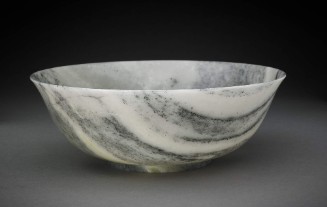
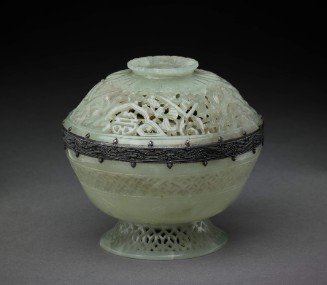
Visual DescriptionOne of a pair, carved in studios of the Caobanzhu.
A shallow, wide-rimmed bowl with a marbled pattern of swirling white and dark grey, resting on a small foot.
Chinese Artist
Qing Dynasty (1644 -1911), Qianlong reign (1736-1795)
Reticulated Bowl
Chinese Artist
19th century or later
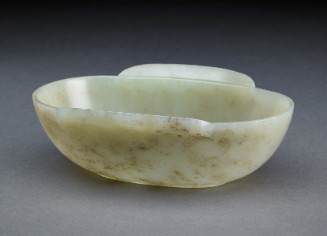
This ear cup reflects the Song period's profound interest in history in its characteristic design found in jades of the late Han period (206BC-AD220). The thinly worked oval cup has two flat handles projecting just below the rim at the longer sides, resting on an oval base with a raised foot ring. The highly translucent yellow jade possesses darker russet brown inclusions creating a desirable "skin" throughout the cup. The ear cup is of a fine, smooth polish. In our opinion, this ear cup is a fi…
Chinese Artist
Qing dynasty (1644-1911) or later
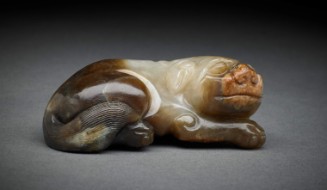
cleverly carved using the natural inclusions of the stone, its head turned to one side, its combed mane trailing over its ribbed back, opposite the tail flicked to one side, the underside detailed with padded paws, the stone of mottled brown, beige and white tones
Chinese Artist
Ming dynasty (1368-1644)
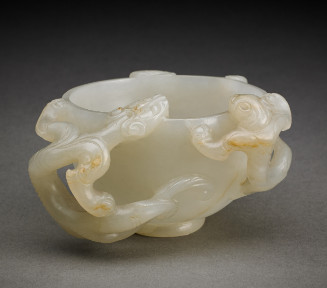
The rounded deep body vessel of even greenish-white color, the sides with three well carved reticulated chilong grasping the vessel lip, on a low finely cut foot
Chinese Artist
Ming dynasty (1368-1644)
Of circular form, well-carved with two loop handles suspending rings formed from a pair of bats on either side of a ruyi-shaped terminal, the body carved in light relief with two pairs of diffused and stylized dragons and supported on four small scrolled feet, the stone of even white tone.
Chinese Artist
Qing Dynasty (1644-1911), Qianlong period (1736-1795)
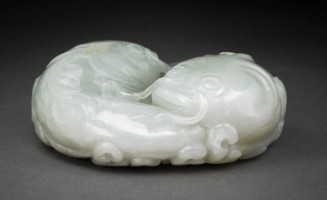
Naturalistically and finely carved as a pair of catfish coiled end to end, each with round eyes and long whiskers, above spiraling and swirling waves, the stone of even white tone suffused with small areas of russet
Chinese Artist
18th century
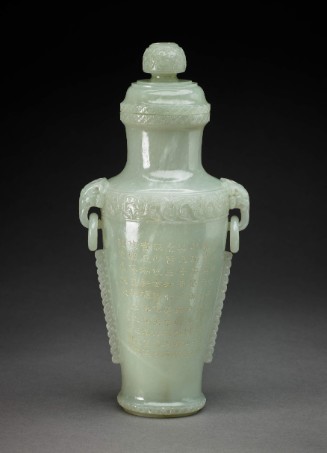
Covered Vase with Imperial Inscription
Chinese Artist
18th-19th century or later
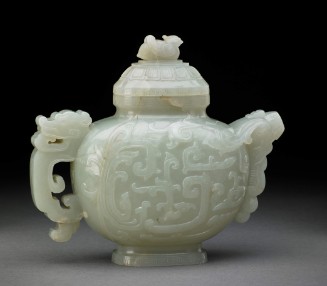
Of oval section, carved overall in low relief with bands of archaistic kuei dragons and keyfret, flanked by the thick handle and spout further carved as archaistic kuei, the domed cover decorated with pendant leaves surmounted by a quail-form knop, one body fissure
Chinese Artist
Qing dynasty (1644 -1911), 18th century
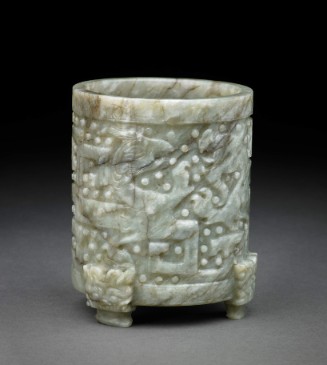
With upright cylindrical sides raised on three monster mask feet, carved on one side with a broad taotie mask flanked by an angular strapwork dragon and phoenix confronting on the reverse, between bands of archaistic motifs, the gray stone striated with deep brown and gray
Chinese Artist
18th-19th century or later
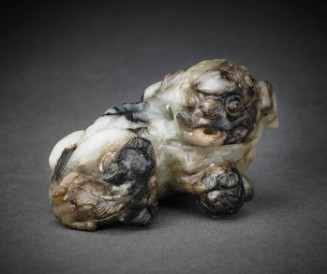
Carved as a recumbent lion, its paw resting on a brocade ball and head turned to one side, its long ears laid back flanking tufts of hair falling on either side of the ribbed backbone, opposite the tail flicked to one side, accompanied by a cub, the stone of mottled, black brown and white tones
Chinese Artist
18th-19th Century or later
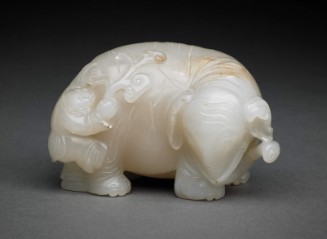
The beast well carved standing four square with the head turned to one side with a boy clambering over its back clasping a lotus sprig, the white jade with brown inclusions
Chinese Artist
Qing dynasty (1644-1911) or later
null